• 文献检索
  • 文档翻译
  • 深度研究
  • 学术资讯
  • Suppr Zotero 插件Zotero 插件
  • 邀请有礼
  • 套餐&价格
  • 历史记录
应用&插件
Suppr Zotero 插件Zotero 插件浏览器插件Mac 客户端Windows 客户端微信小程序
定价
高级版会员购买积分包购买API积分包
服务
文献检索文档翻译深度研究API 文档MCP 服务
关于我们
关于 Suppr公司介绍联系我们用户协议隐私条款
关注我们

Suppr 超能文献

核心技术专利:CN118964589B侵权必究
粤ICP备2023148730 号-1Suppr @ 2026

文献检索

告别复杂PubMed语法,用中文像聊天一样搜索,搜遍4000万医学文献。AI智能推荐,让科研检索更轻松。

立即免费搜索

文件翻译

保留排版,准确专业,支持PDF/Word/PPT等文件格式,支持 12+语言互译。

免费翻译文档

深度研究

AI帮你快速写综述,25分钟生成高质量综述,智能提取关键信息,辅助科研写作。

立即免费体验

基于热泡微泵技术的单细胞分离微流控芯片。

Single-Cell Isolation Microfluidic Chip Based on Thermal Bubble Micropump Technology.

机构信息

School of Microelectronics, Shanghai University, Shanghai 201800, China.

Shanghai Aure Technology Limited Company, Shanghai 201800, China.

出版信息

Sensors (Basel). 2023 Mar 30;23(7):3623. doi: 10.3390/s23073623.

DOI:10.3390/s23073623
PMID:37050683
原文链接:https://pmc.ncbi.nlm.nih.gov/articles/PMC10099219/
Abstract

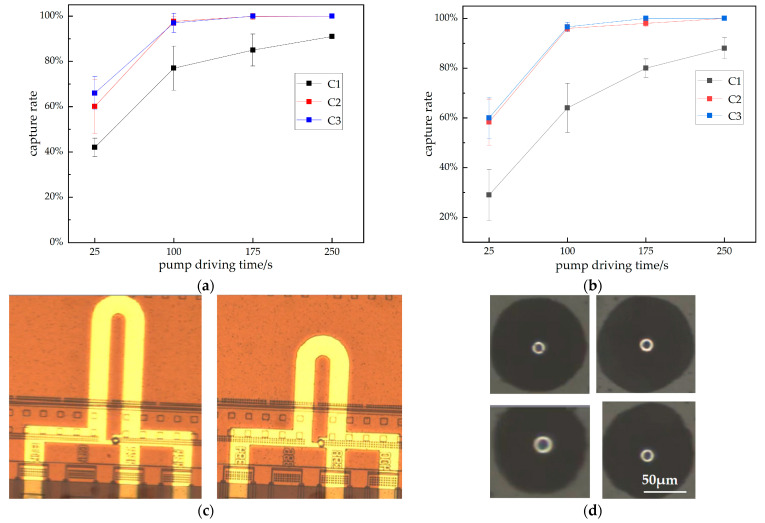
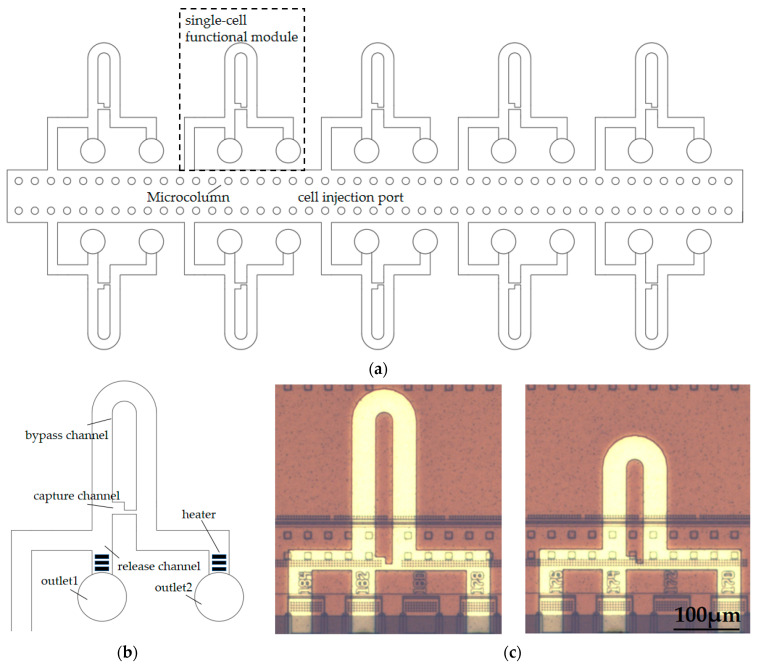
The isolation of single cells is essential for the development of single cell analysis methods, such as single-cell sequencing, monoclonal antibodies, and drug development. Traditional single-cell isolation techniques include flow cytometry (FACS), laser capture microdissection (LCM), micromanipulation, etc., but their operations are complex and have low throughput. Here, we present a microfluidic chip that can isolate individual cells from cell suspension and release them onto a well plate. It uses thermal bubble micropump technology to drive the fluid flow, and single-cell isolation is achieved by matching the flow resistance of the flow channel. Therefore, injection pumps and peristaltic pumps are not required for cell loading. Because of its small size, we can integrate hundreds of single-cell functional modules, which makes high-throughput single-cell isolation possible. For polystyrene beads, the capture rate of the single bead is close to 100%. Finally, the method has been applied to cells, and the capture rate of the single cell is also about 75%. This is a promising method for single-cell isolation.

摘要

单细胞的分离对于单细胞分析方法的发展至关重要,例如单细胞测序、单克隆抗体和药物开发。传统的单细胞分离技术包括流式细胞术(FACS)、激光捕获显微切割(LCM)、显微操作等,但它们的操作复杂,通量低。在这里,我们提出了一种微流控芯片,可以从细胞悬浮液中分离单个细胞,并将其释放到微孔板上。它使用热气泡微泵技术来驱动流体流动,通过匹配流道的流动阻力来实现单细胞分离。因此,不需要注射泵和蠕动泵进行细胞加载。由于其体积小,我们可以集成数百个单细胞功能模块,从而实现高通量单细胞分离。对于聚苯乙烯珠,单个珠的捕获率接近 100%。最后,该方法已应用于细胞,单细胞的捕获率也约为 75%。这是一种很有前途的单细胞分离方法。
https://cdn.ncbi.nlm.nih.gov/pmc/blobs/d6c5/10099219/390012f175eb/sensors-23-03623-g009.jpg
https://cdn.ncbi.nlm.nih.gov/pmc/blobs/d6c5/10099219/7ea10fb25f68/sensors-23-03623-g001.jpg
https://cdn.ncbi.nlm.nih.gov/pmc/blobs/d6c5/10099219/093f9077a528/sensors-23-03623-g002.jpg
https://cdn.ncbi.nlm.nih.gov/pmc/blobs/d6c5/10099219/a2c1230123ad/sensors-23-03623-g003.jpg
https://cdn.ncbi.nlm.nih.gov/pmc/blobs/d6c5/10099219/b99ca22bdc3a/sensors-23-03623-g004.jpg
https://cdn.ncbi.nlm.nih.gov/pmc/blobs/d6c5/10099219/36546d488867/sensors-23-03623-g005.jpg
https://cdn.ncbi.nlm.nih.gov/pmc/blobs/d6c5/10099219/0416b50641c0/sensors-23-03623-g006.jpg
https://cdn.ncbi.nlm.nih.gov/pmc/blobs/d6c5/10099219/84bcd0d4fc60/sensors-23-03623-g007.jpg
https://cdn.ncbi.nlm.nih.gov/pmc/blobs/d6c5/10099219/f4e697dbbeb8/sensors-23-03623-g008.jpg
https://cdn.ncbi.nlm.nih.gov/pmc/blobs/d6c5/10099219/390012f175eb/sensors-23-03623-g009.jpg
https://cdn.ncbi.nlm.nih.gov/pmc/blobs/d6c5/10099219/7ea10fb25f68/sensors-23-03623-g001.jpg
https://cdn.ncbi.nlm.nih.gov/pmc/blobs/d6c5/10099219/093f9077a528/sensors-23-03623-g002.jpg
https://cdn.ncbi.nlm.nih.gov/pmc/blobs/d6c5/10099219/a2c1230123ad/sensors-23-03623-g003.jpg
https://cdn.ncbi.nlm.nih.gov/pmc/blobs/d6c5/10099219/b99ca22bdc3a/sensors-23-03623-g004.jpg
https://cdn.ncbi.nlm.nih.gov/pmc/blobs/d6c5/10099219/36546d488867/sensors-23-03623-g005.jpg
https://cdn.ncbi.nlm.nih.gov/pmc/blobs/d6c5/10099219/0416b50641c0/sensors-23-03623-g006.jpg
https://cdn.ncbi.nlm.nih.gov/pmc/blobs/d6c5/10099219/84bcd0d4fc60/sensors-23-03623-g007.jpg
https://cdn.ncbi.nlm.nih.gov/pmc/blobs/d6c5/10099219/f4e697dbbeb8/sensors-23-03623-g008.jpg
https://cdn.ncbi.nlm.nih.gov/pmc/blobs/d6c5/10099219/390012f175eb/sensors-23-03623-g009.jpg

相似文献

1
Single-Cell Isolation Microfluidic Chip Based on Thermal Bubble Micropump Technology.基于热泡微泵技术的单细胞分离微流控芯片。
Sensors (Basel). 2023 Mar 30;23(7):3623. doi: 10.3390/s23073623.
2
High throughput single-cell and multiple-cell micro-encapsulation.高通量单细胞和多细胞微囊化
J Vis Exp. 2012 Jun 15(64):e4096. doi: 10.3791/4096.
3
Label-free single-cell isolation enabled by microfluidic impact printing and real-time cellular recognition.基于微流控冲击印刷术和实时细胞识别的无标记单细胞分离。
Lab Chip. 2021 Sep 28;21(19):3695-3706. doi: 10.1039/d1lc00326g.
4
Microfluidic Biochips for Single-Cell Isolation and Single-Cell Analysis of Multiomics and Exosomes.用于单细胞分离和多组学及外泌体单细胞分析的微流控生物芯片。
Adv Sci (Weinh). 2024 Jul;11(28):e2401263. doi: 10.1002/advs.202401263. Epub 2024 May 20.
5
Exceeding 80% Efficiency of Single-Bead Encapsulation in Microdroplets through Hydrogel Coating-Assisted Close-Packed Ordering.通过水凝胶涂层辅助紧密排列实现微滴中单颗粒封装效率超过 80%。
Anal Chem. 2023 Jun 13;95(23):8889-8897. doi: 10.1021/acs.analchem.3c00425. Epub 2023 May 26.
6
The up-to-date strategies for the isolation and manipulation of single cells.单细胞分离与操作的最新策略。
Talanta. 2020 Oct 1;218:121147. doi: 10.1016/j.talanta.2020.121147. Epub 2020 May 11.
7
A Dual-Channel Microfluidic Chip for Single Tobacco Protoplast Isolation and Dynamic Capture.一种用于单个烟草原生质体分离和动态捕获的双通道微流控芯片。
Micromachines (Basel). 2022 Nov 29;13(12):2109. doi: 10.3390/mi13122109.
8
Magnetic nanoparticle-mediated enrichment technology combined with microfluidic single cell separation technology: A technology for efficient separation and degradation of functional bacteria in single cell liquid phase.磁性纳米颗粒介导的富集技术与微流控单细胞分离技术相结合:单细胞液相中功能菌高效分离与降解技术。
Bioresour Technol. 2024 Jun;401:130686. doi: 10.1016/j.biortech.2024.130686. Epub 2024 Apr 8.
9
Microfluidics in structured multimaterial fibers.结构化多材料纤维中的微流控技术。
Proc Natl Acad Sci U S A. 2018 Nov 13;115(46):E10830-E10838. doi: 10.1073/pnas.1809459115. Epub 2018 Oct 29.
10
Single-cell analysis and sorting using droplet-based microfluidics.基于液滴的微流控技术进行单细胞分析和分选。
Nat Protoc. 2013 May;8(5):870-91. doi: 10.1038/nprot.2013.046. Epub 2013 Apr 4.

引用本文的文献

1
Deciphering cellular complexity: advances and future directions in single-cell protein analysis.解析细胞复杂性:单细胞蛋白质分析的进展与未来方向
Front Bioeng Biotechnol. 2025 Jan 14;12:1507460. doi: 10.3389/fbioe.2024.1507460. eCollection 2024.
2
Digital PCR for Single-Cell Analysis.数字 PCR 用于单细胞分析。
Biosensors (Basel). 2024 Jan 24;14(2):64. doi: 10.3390/bios14020064.
3
Recent Methods for Modifying Mechanical Properties of Tissue-Engineered Scaffolds for Clinical Applications.用于临床应用的组织工程支架机械性能改性的最新方法

本文引用的文献

1
Application of single-cell RNA sequencing methodologies in understanding haematopoiesis and immunology.单细胞 RNA 测序方法在理解造血和免疫学中的应用。
Essays Biochem. 2019 Jul 3;63(2):217-225. doi: 10.1042/EBC20180072.
2
Platforms for Single-Cell Collection and Analysis.单细胞采集和分析平台。
Int J Mol Sci. 2018 Mar 11;19(3):807. doi: 10.3390/ijms19030807.
3
Single Cell Isolation and Analysis.单细胞分离与分析
Biomimetics (Basel). 2023 May 16;8(2):205. doi: 10.3390/biomimetics8020205.
Front Cell Dev Biol. 2016 Oct 25;4:116. doi: 10.3389/fcell.2016.00116. eCollection 2016.
4
Single-cell RNA-sequencing: The future of genome biology is now.单细胞RNA测序:基因组生物学的未来已来。
RNA Biol. 2017 May 4;14(5):637-650. doi: 10.1080/15476286.2016.1201618. Epub 2016 Jul 21.
5
Technologies for Single-Cell Isolation.单细胞分离技术。
Int J Mol Sci. 2015 Jul 24;16(8):16897-919. doi: 10.3390/ijms160816897.
6
Single-cell printing based on impedance detection.基于阻抗检测的单细胞打印。
Biomicrofluidics. 2015 Feb 11;9(1):014117. doi: 10.1063/1.4907896. eCollection 2015 Jan.
7
Dissecting genomic diversity, one cell at a time.逐个细胞解析基因组多样性。
Nat Methods. 2014 Jan;11(1):19-21. doi: 10.1038/nmeth.2783.
8
Recent advances in the development of single cell analysis--a review.单细胞分析的最新进展——综述。
Anal Chim Acta. 2013 Oct 24;800:12-21. doi: 10.1016/j.aca.2013.09.004. Epub 2013 Sep 10.
9
Cancer stem cells in lung cancer: Evidence and controversies.肺癌中的癌症干细胞:证据与争议。
Respirology. 2013 Jul;18(5):757-64. doi: 10.1111/resp.12094.
10
V(D)J recombination: mechanisms of initiation.V(D)J 重组:起始机制。
Annu Rev Genet. 2011;45:167-202. doi: 10.1146/annurev-genet-110410-132552. Epub 2011 Aug 19.