Abi Doumeth Sarah, Gong Jenny, Silversteyn Laura, O'Mara Megan, Singh Shivali, Anthony Donald D, Mattar Maya
Case Western Reserve University School of Medicine, Cleveland, OH, United States.
Louis Stokes Cleveland VA Medical Center, Cleveland, OH, United States.
Vaccine X. 2023 Aug;14:100295. doi: 10.1016/j.jvacx.2023.100295. Epub 2023 Apr 4.
Following the introduction of the COVID-19 vaccines, there has been uncertainty as to whether receiving the COVID-19 vaccine will result in overactivation of the immune system and subsequently lead to an autoimmune disease flare.The purpose of this study was to assess whether rheumatoid arthritis (RA) patients who received the mRNA COVID-19 vaccine are at increased risk for disease flare.
We conducted a single-center retrospective and prospective study at the Louis Stokes Cleveland VA Medical Center between 12/2021 and 2/2022. We included 100 patients with rheumatoid arthritis (RA) who were actively on immunosuppressive therapy and received three doses of the Pfizer-BioNTech vaccine. A survey questionnaire was used to collect data about their RA and if they developed symptoms post vaccination. Our primary end point was to determine incidence of flare of RA after COVID-19 vaccine. Secondary end points were to estimate the side effect profile from the vaccine, and to check if patients developed a COVID-19 infection after they received the vaccine.
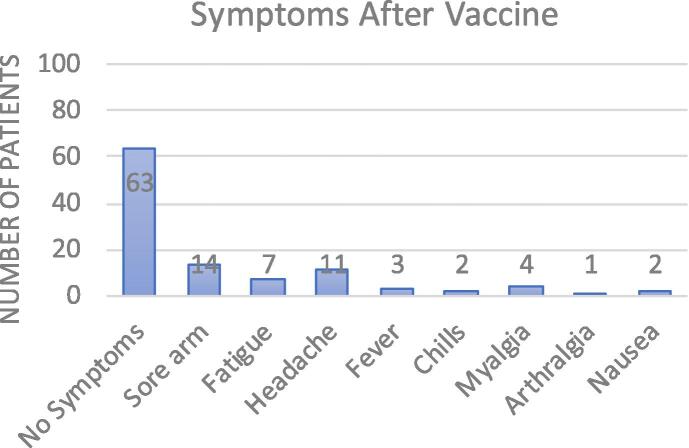
None of the patients reported symptoms of RA flare within two months of receiving the 3 doses of the vaccine. Most common vaccine side effects were soreness over the injection site (n = 14), headache (n = 11), fatigue(n = 7) and myalgias(n = 4). 5 patients developed a COVID-19 infection prior to receiving the vaccine, 8 after being vaccinated, 3 of the 8 within 5 months from the second dose and 5 out of the 8 within 3 months from the third vaccine dose.
RA patients receiving the COVID-19 Pfizer mRNA vaccine do not appear to commonly develop major symptoms, flares or side effects following the vaccine. Further research with larger numbers of patients with rheumatoid arthritis as well as those with other autoimmune disease is needed to better understand the safety and effectiveness of COVID-19 vaccine.
自新冠病毒疫苗引入以来,接种该疫苗是否会导致免疫系统过度激活并进而引发自身免疫性疾病发作一直存在不确定性。本研究旨在评估接种信使核糖核酸新冠病毒疫苗的类风湿关节炎(RA)患者疾病发作风险是否增加。
2021年12月至2022年2月期间,我们在路易斯·斯托克斯克利夫兰退伍军人事务医疗中心开展了一项单中心回顾性和前瞻性研究。我们纳入了100名正在接受免疫抑制治疗且接种了三剂辉瑞 - 生物科技疫苗的类风湿关节炎患者。通过调查问卷收集有关他们类风湿关节炎的情况以及接种疫苗后是否出现症状的数据。我们的主要终点是确定新冠病毒疫苗接种后类风湿关节炎发作的发生率。次要终点是评估疫苗的副作用情况,以及检查患者接种疫苗后是否感染新冠病毒。
在接种三剂疫苗后的两个月内,没有患者报告类风湿关节炎发作的症状。最常见的疫苗副作用是注射部位疼痛(n = 14)、头痛(n = 11)、疲劳(n = 7)和肌痛(n = 4)。5名患者在接种疫苗前感染了新冠病毒,8名在接种疫苗后感染,其中8名中的3名在第二剂接种后5个月内感染,8名中的5名在第三剂接种后3个月内感染。
接种新冠病毒辉瑞信使核糖核酸疫苗的类风湿关节炎患者在接种疫苗后似乎通常不会出现主要症状、疾病发作或副作用。需要对更多类风湿关节炎患者以及其他自身免疫性疾病患者进行进一步研究,以更好地了解新冠病毒疫苗的安全性和有效性。