Department of Neurosurgery, The First Affiliated Hospital of China Medical University, Shenyang, Liaoning 110000, P.R. China.
Department of Neurosurgery, The Fourth Hospital of China Medical University, Shenyang, Liaoning 110084, P.R. China.
Int J Mol Med. 2023 Jun;51(6). doi: 10.3892/ijmm.2023.5249. Epub 2023 Apr 13.
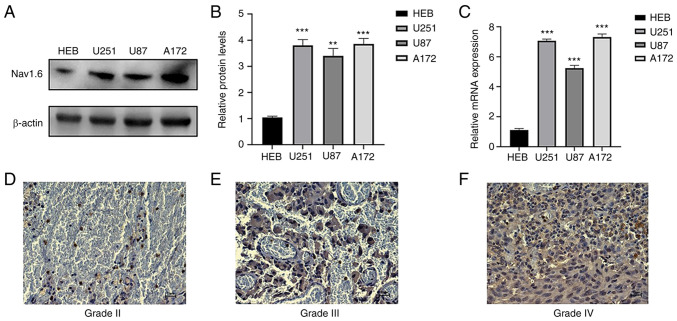
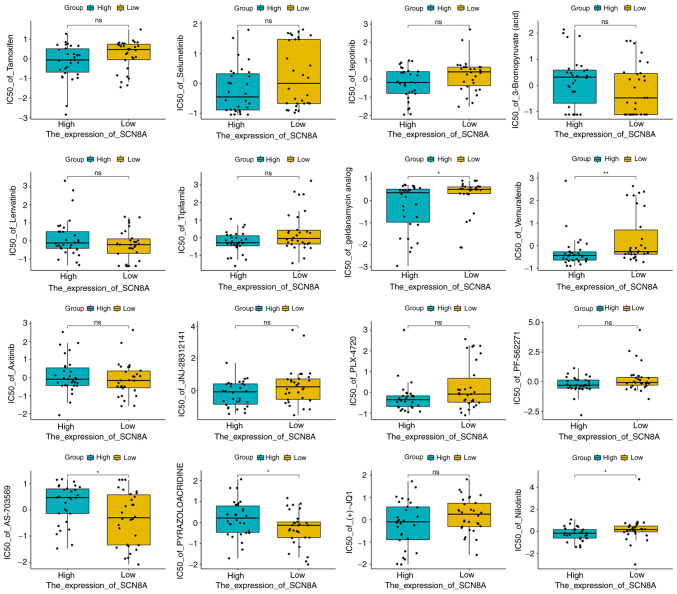
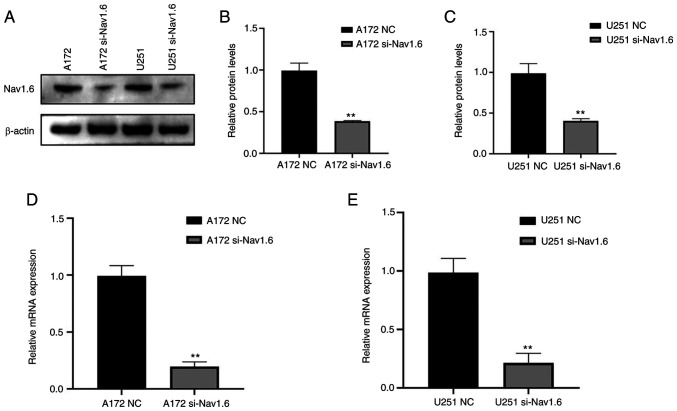
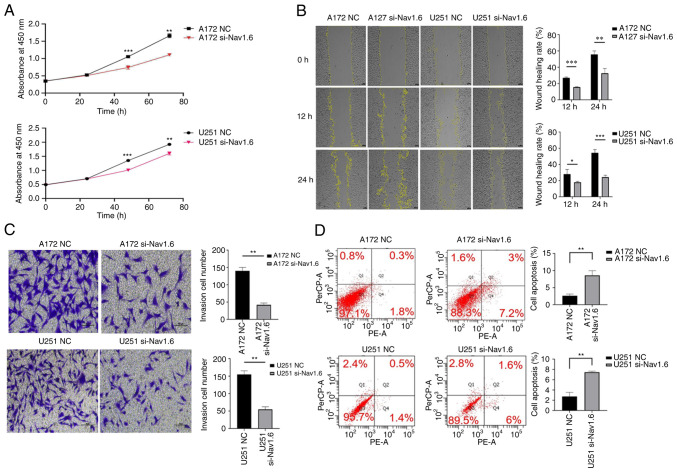
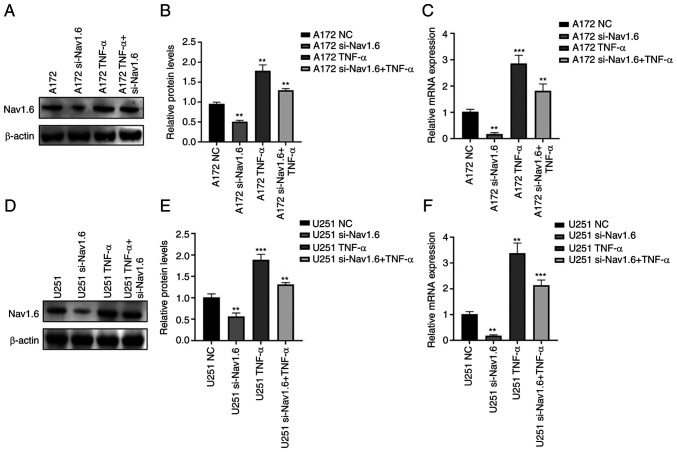
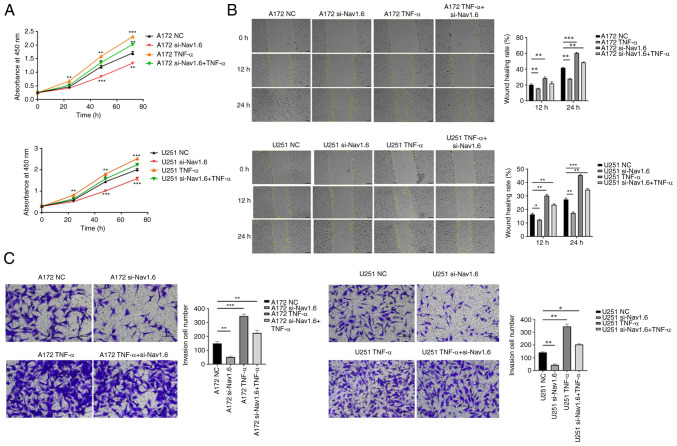
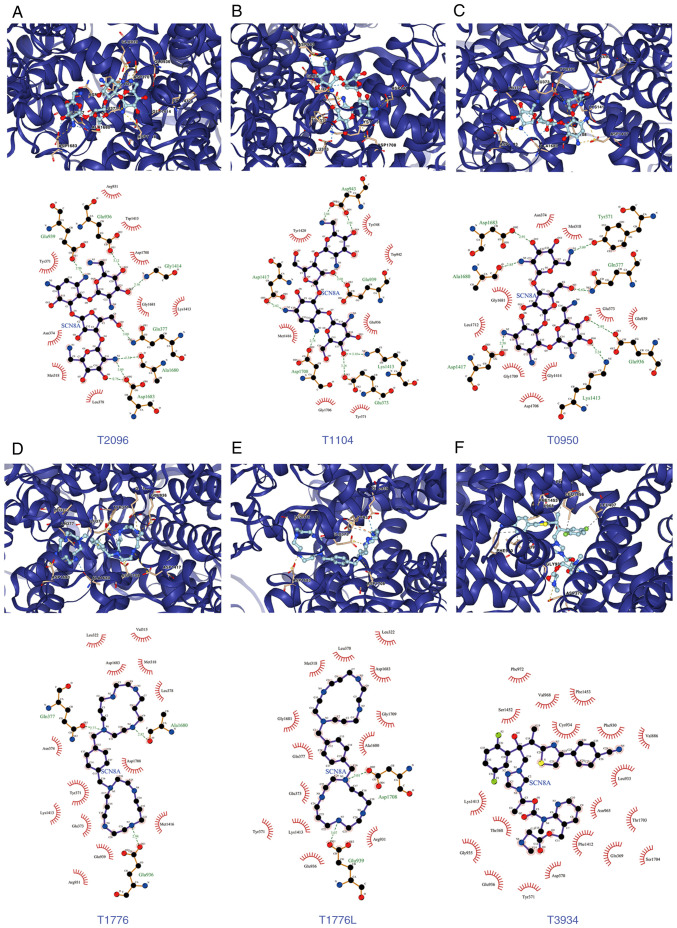
Gliomas remain a clinical challenge, common and fatal. Treatment of glioblastoma remains elusive, and researchers have focused on discovering new mechanisms and drugs. It has been well established that the expression of voltage‑gated sodium channels (VGSCs) is abnormally increased in numerous malignancies and, in general, is rarely expressed in the corresponding normal tissues. This suggests that ion channel activity appears to be associated with malignant progression of tumors. VGSCs remain largely unknown as to how their activity leads to an increase in cancer cell activity or invasiveness. Certain sodium ion channel subtypes (for instance, Nav1.5 and Nav1.7) are associated with metastasis and invasion in cancers including breast and colorectal cancers. A previous study by the authors explored the expression of certain ion channels in glioma, but there are few studies related to Nav1.6. The current study aimed to elucidate the expression and role of Nav1.6 in glioma and to screen potential drugs for the treatment of glioma by virtual screening and drug sensitivity analysis. Nav1.6 relative expression of mRNA and protein was determined by reverse transcription‑quantitative PCR and western blot analysis. Cell proliferation was determined by Cell Counting Kit‑8 assay. Cell migration was assessed by cellular wound healing assay. Cell invasion and apoptosis were detected by Transwell cell invasion assay and flow cytometry. Last but not least, FDA‑approved drugs were screened using virtual screening, molecular docking and NCI‑60 drug sensitivity analyses based on the expression and structure of Nav1.6. In glioma cells, Nav1.6 was significantly upregulated and expressed mostly in the cytoplasm and cell membrane; its expression was positively correlated with pathological grade. A172 and U251 cells exhibited reduced proliferation, migration and invasion when Nav1.6 expression was knocked down, and apoptosis was increased. TNF‑α (100 pg/ml) acting on glioma cells was found to upregulate the expression level of Nav1.6, and TNF‑α was involved in the process of Nav1.6 promoting malignant progression of glioma. Finally, certain FDA‑approved drugs were identified by virtual screening and drug sensitivity analysis. In conclusion, the present study demonstrated the expression and role of Nav1.6 in glioma and identified several FDA‑approved drugs that are highly correlated with Nav1.6 and could be candidate drugs for patients with glioma.
神经胶质瘤仍然是一个临床挑战,常见且致命。胶质母细胞瘤的治疗仍然难以捉摸,研究人员专注于发现新的机制和药物。已经证实,电压门控钠离子通道(VGSCs)的表达在许多恶性肿瘤中异常增加,而在相应的正常组织中很少表达。这表明离子通道活性似乎与肿瘤的恶性进展有关。VGSCs 的活性如何导致癌细胞活性或侵袭性增加,目前仍知之甚少。某些钠离子通道亚型(例如 Nav1.5 和 Nav1.7)与包括乳腺癌和结直肠癌在内的癌症的转移和侵袭有关。作者之前的一项研究探讨了神经胶质瘤中某些离子通道的表达,但与 Nav1.6 相关的研究很少。本研究旨在阐明 Nav1.6 在神经胶质瘤中的表达和作用,并通过虚拟筛选和药物敏感性分析筛选治疗神经胶质瘤的潜在药物。通过逆转录定量 PCR 和 Western blot 分析确定 Nav1.6 的 mRNA 和蛋白相对表达。通过细胞计数试剂盒-8 测定细胞增殖。通过细胞划痕愈合测定评估细胞迁移。通过 Transwell 细胞侵袭测定和流式细胞术检测细胞侵袭和细胞凋亡。最后但并非最不重要的一点是,根据 Nav1.6 的表达和结构,使用虚拟筛选、分子对接和 NCI-60 药物敏感性分析筛选 FDA 批准的药物。在神经胶质瘤细胞中,Nav1.6 显著上调,主要表达于细胞质和细胞膜;其表达与病理分级呈正相关。当 Nav1.6 表达被敲低时,A172 和 U251 细胞的增殖、迁移和侵袭减少,凋亡增加。TNF-α(100 pg/ml)作用于神经胶质瘤细胞可上调 Nav1.6 的表达水平,TNF-α参与 Nav1.6 促进神经胶质瘤恶性进展的过程。最后,通过虚拟筛选和药物敏感性分析鉴定了某些 FDA 批准的药物。总之,本研究表明 Nav1.6 在神经胶质瘤中的表达和作用,并鉴定了几种与 Nav1.6 高度相关的 FDA 批准药物,它们可能是神经胶质瘤患者的候选药物。