Centre for Clinical Haematology, Queen Elizabeth Hospital, Birmingham, United Kingdom.
Cancer Research UK Clinical Trials Unit, University of Birmingham, Birmingham, United Kingdom.
Blood Adv. 2023 Jul 25;7(14):3666-3676. doi: 10.1182/bloodadvances.2022009493.
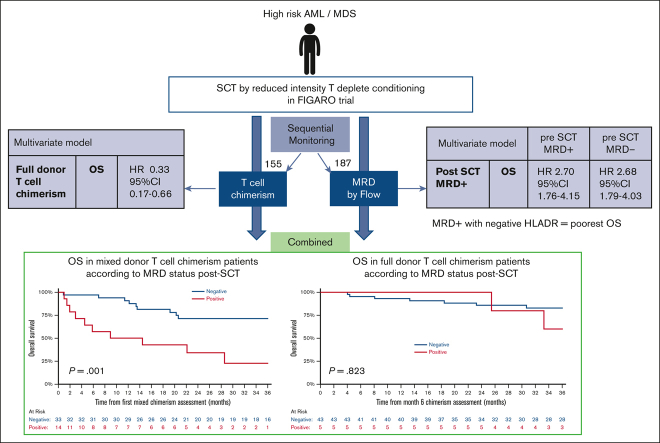
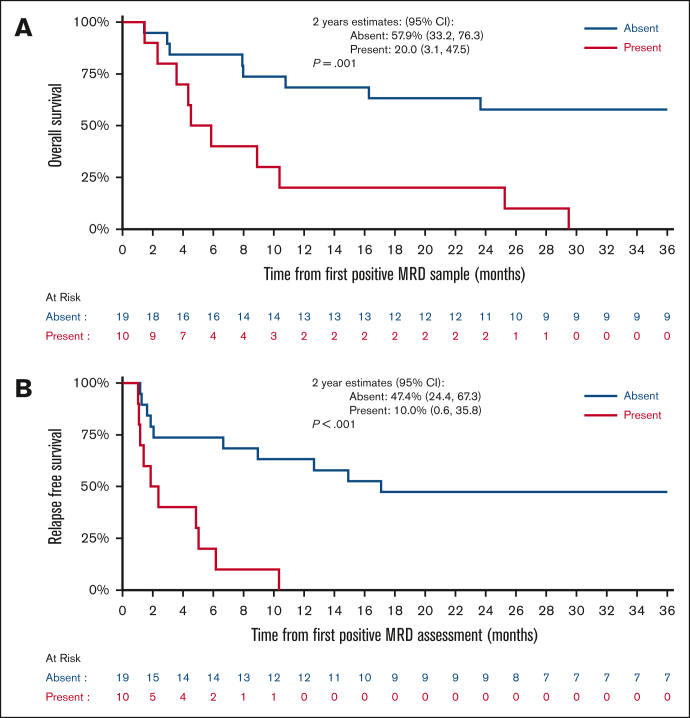
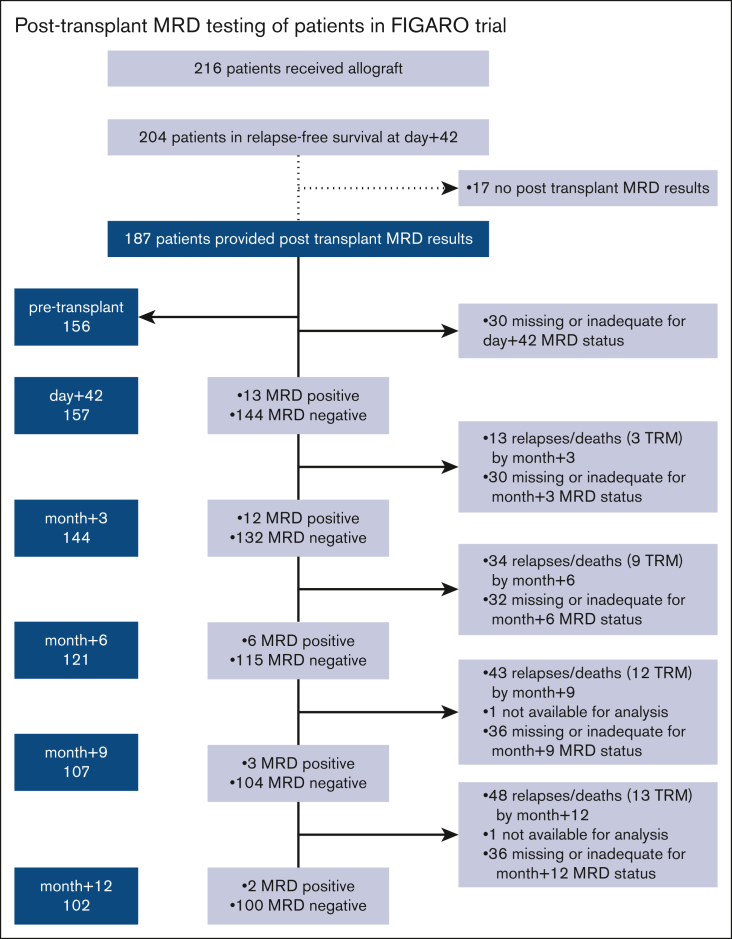
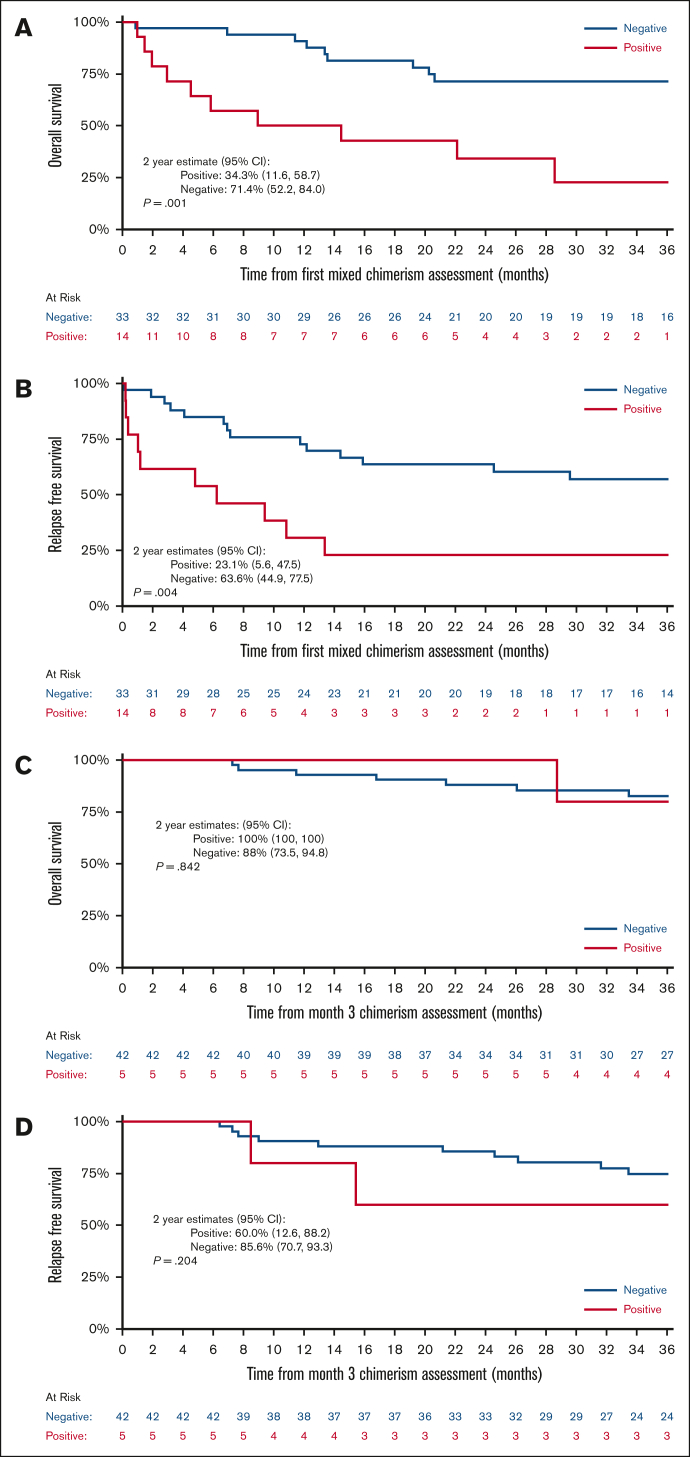
Allogeneic stem-cell transplant allows for the delivery of curative graft-versus-leukemia (GVL) in patients with acute myeloid leukemia/myelodysplasia (AML/MDS). Surveillance of T-cell chimerism, measurable residual disease (MRD) and blast HLA-DR expression may inform whether GVL effectiveness is reduced. We report here the prognostic impact of these biomarkers in patients allografted for AML/MDS. One hundred eighty-seven patients from FIGARO, a randomized trial of reduced-intensity conditioning regimens in AML/MDS, were alive and relapse-free at the first MRD time-point and provided monitoring samples for flow cytometric MRD and T-cell chimerism, requested to month+12. Twenty-nine (15.5%) patients had at least 1 MRD-positive result posttransplant. MRD-positivity was associated with reduced overall survival (OS) (hazard ratio [HR], 2.18; P = .0028) as a time-varying Cox variable and remained significant irrespective of pretransplant MRD status in multivariate analyses (P < .001). Ninety-four patients had sequential MRD with T-cell chimerism results at months+3/+6. Patients with full donor T-cell chimerism (FDTC) had an improved OS as compared with patients with mixed donor T-cell chimerism (MDTC) (adjusted HR=0.4; P = .0019). In patients with MDTC (month+3 or +6), MRD-positivity was associated with a decreased 2-year OS (34.3%) vs MRD-negativity (71.4%) (P = .001). In contrast, in the group with FDTC, MRD was infrequent and did not affect the outcome. Among patients with posttransplant MRD-positivity, decreased HLA-DR expression on blasts significantly reduced OS, supporting this as a mechanism for GVL escape. In conclusion, posttransplant MRD is an important predictor of the outcome in patients allografted for AML/MDS and is most informative when combined with T-cell chimerism results, underlining the importance of a GVL effect in AML/MDS.
异基因造血干细胞移植可在急性髓系白血病/骨髓增生异常综合征(AML/MDS)患者中实现治愈性的移植物抗白血病(GVL)作用。T 细胞嵌合状态、可测量残留疾病(MRD)和白血病 HLA-DR 表达的监测可以提示 GVL 效果是否降低。我们在此报告这些生物标志物在 AML/MDS 异基因移植患者中的预后影响。FIGARO 是一项关于 AML/MDS 中强化与非强化预处理方案的随机临床试验,其中 187 例患者在首次 MRD 时间点时存活且无疾病复发,并提供了流式细胞术 MRD 和 T 细胞嵌合状态监测样本,要求在移植后 12 个月时进行。29 例(15.5%)患者至少有 1 次移植后 MRD 阳性结果。MRD 阳性与总生存(OS)降低相关(风险比[HR],2.18;P=0.0028),作为时变 Cox 变量,并且在多变量分析中仍然具有显著性,无论移植前 MRD 状态如何(P<0.001)。94 例患者具有连续的 MRD 和 T 细胞嵌合状态结果,在移植后 3 个月和 6 个月时进行检测。完全供者 T 细胞嵌合(FDTC)患者的 OS 优于混合供者 T 细胞嵌合(MDTC)患者(调整后的 HR=0.4;P=0.0019)。在 MDTC 患者(移植后 3 个月或 6 个月)中,MRD 阳性与 2 年 OS 降低相关(34.3% vs MRD 阴性,71.4%)(P=0.001)。相比之下,在 FDTC 组中,MRD 较为罕见,且不会影响结果。在移植后 MRD 阳性的患者中,白血病 HLA-DR 表达的降低显著降低了 OS,支持这是 GVL 逃逸的一种机制。总之,移植后 MRD 是 AML/MDS 异基因移植患者预后的重要预测因素,当与 T 细胞嵌合状态结果结合时最具信息性,突出了 GVL 作用在 AML/MDS 中的重要性。