Institute of Immunology and Immunotherapy, University of Birmingham, Birmingham, UK.
Laboratory of Myeloid Malignancies, Hematology Branch, National Heart, Lung, and Blood Institute, National Institutes of Health, Bethesda, MD, USA.
Leukemia. 2024 Aug;38(8):1667-1673. doi: 10.1038/s41375-024-02300-z. Epub 2024 Jun 18.
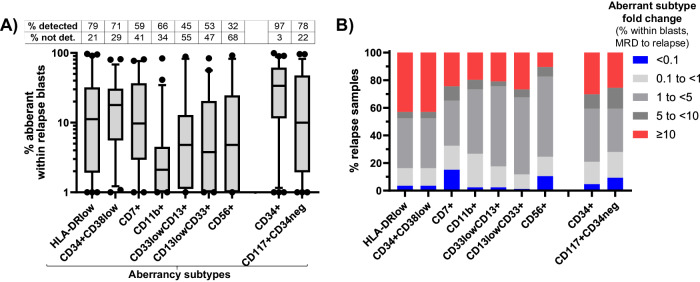
Measurable residual disease (MRD) surveillance in acute myeloid leukemia (AML) may identify patients destined for relapse and thus provide the option of pre-emptive therapy to improve their outcome. Whilst flow cytometric MRD (Flow-MRD) can be applied to high-risk AML/ myelodysplasia patients, its diagnostic performance for detecting impending relapse is unknown. We evaluated this in a cohort comprising 136 true positives (bone marrows preceding relapse by a median of 2.45 months) and 155 true negatives (bone marrows during sustained remission). At an optimal Flow-MRD threshold of 0.040%, clinical sensitivity and specificity for relapse was 74% and 87% respectively (51% and 98% for Flow-MRD ≥ 0.1%) by 'different-from-normal' analysis. Median relapse kinetics were 0.78 log/month but significantly higher at 0.92 log/month for FLT3-mutated AML. Computational (unsupervised) Flow-MRD (C-Flow-MRD) generated optimal MRD thresholds of 0.036% and 0.082% with equivalent clinical sensitivity to standard analysis. C-Flow-MRD-identified aberrancies in HLADRlow or CD34+CD38low (LSC-type) subpopulations contributed the greatest clinical accuracy (56% sensitivity, 90% specificity) and notably, by longitudinal profiling expanded rapidly within blasts in > 40% of 86 paired MRD and relapse samples. In conclusion, flow MRD surveillance can detect MRD relapse in high risk AML and its evaluation may be enhanced by computational analysis.
在急性髓系白血病(AML)中进行可测量残留疾病(MRD)监测,可能可以识别出注定会复发的患者,并为他们提供抢先治疗的选择,以改善预后。虽然流式细胞术 MRD(Flow-MRD)可应用于高危 AML/骨髓增生异常综合征患者,但目前尚不清楚其检测即将复发的诊断性能。我们在一个包含 136 例真性阳性(骨髓在复发前中位数为 2.45 个月)和 155 例真性阴性(骨髓处于持续缓解期)的队列中评估了这一点。在最佳 Flow-MRD 阈值为 0.040%时,基于“不同于正常”分析,Flow-MRD 检测复发的临床敏感性和特异性分别为 74%和 87%(Flow-MRD≥0.1%时为 51%和 98%)。中位复发动力学为 0.78 log/月,但 FLT3 突变 AML 明显更高,为 0.92 log/月。计算(非监督)Flow-MRD(C-Flow-MRD)生成的最佳 MRD 阈值分别为 0.036%和 0.082%,与标准分析具有等效的临床敏感性。C-Flow-MRD 识别 HLA-DRlow 或 CD34+CD38low(LSC 型)亚群的异常,对临床准确性的贡献最大(敏感性为 56%,特异性为 90%),值得注意的是,在 86 对 MRD 和复发样本的纵向分析中,超过 40%的样本中,这些异常在 blast 中迅速扩展。总之,流式细胞术 MRD 监测可检测高危 AML 中的 MRD 复发,计算分析可能会提高其评估效果。