Cell Cycle Lab, Institut de Recerca Biomèdica de Lleida (IRB Lleida), Lleida, Spain; Dermatology Department, Hospital Santa Caterina, Salt, Girona, Spain.
Proteomics Unit, Josep Carreras Leukaemia Research Institute, Badalona, Spain.
Mol Cell Proteomics. 2023 Jun;22(6):100547. doi: 10.1016/j.mcpro.2023.100547. Epub 2023 Apr 13.
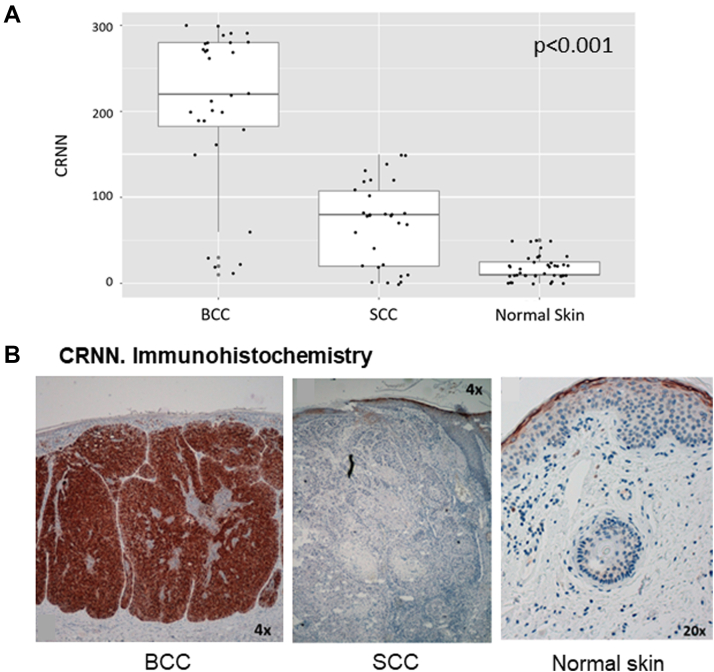
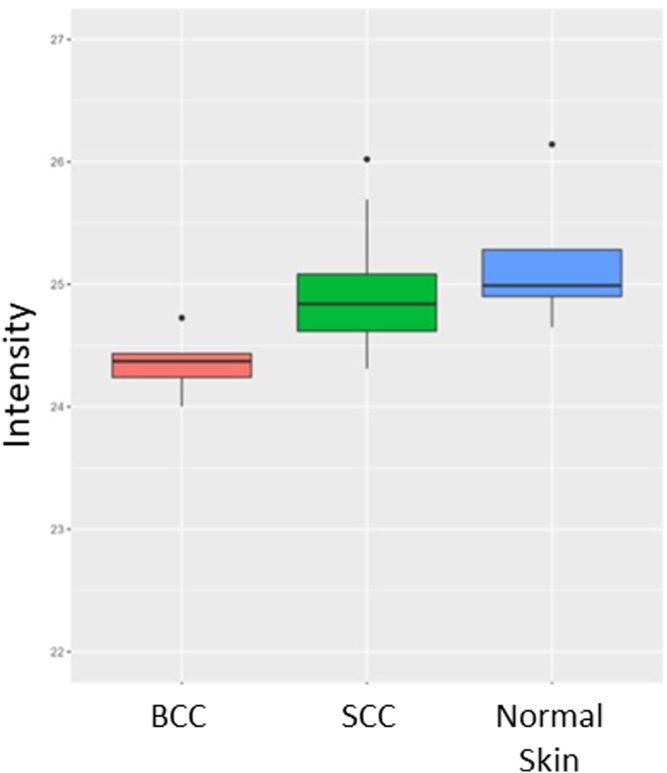
Basal cell carcinomas (BCCs) and cutaneous squamous cell carcinomas (SCCs) are the most frequent types of cancer, and both originate from the keratinocyte transformation, giving rise to the group of tumors called keratinocyte carcinomas (KCs). The invasive behavior is different in each group of KC and may be influenced by their tumor microenvironment. The principal aim of the study is to characterize the protein profile of the tumor interstitial fluid (TIF) of KC to evaluate changes in the microenvironment that could be associated with their different invasive and metastatic capabilities. We obtained TIF from 27 skin biopsies and conducted a label-free quantitative proteomic analysis comparing seven BCCs, 16 SCCs, and four normal skins. A total of 2945 proteins were identified, 511 of them quantified in more than half of the samples of each tumoral type. The proteomic analysis revealed differentially expressed TIF proteins that could explain the different metastatic behavior in both KCs. In detail, the SCC samples disclosed an enrichment of proteins related to cytoskeleton, such as Stratafin and Ladinin-1. Previous studies found their upregulation positively correlated with tumor progression. Furthermore, the TIF of SCC samples was enriched with the cytokines S100A8/S100A9. These cytokines influence the metastatic output in other tumors through the activation of NF-kB signaling. According to this, we observed a significant increase in nuclear NF-kB subunit p65 in SCCs but not in BCCs. In addition, the TIF of both tumors was enriched with proteins involved in the immune response, highlighting the relevance of this process in the composition of the tumor environment. Thus, the comparison of the TIF composition of both KCs provides the discovery of a new set of differential biomarkers. Among them, secreted cytokines such as S100A9 may help explain the higher aggressiveness of SCCs, while Cornulin is a specific biomarker for BCCs. Finally, the proteomic landscape of TIF provides key information on tumor growth and metastasis, which can contribute to the identification of clinically applicable biomarkers that may be used in the diagnosis of KC, as well as therapeutic targets.
基底细胞癌(BCC)和皮肤鳞状细胞癌(SCC)是最常见的癌症类型,它们均起源于角质形成细胞的转化,导致一组称为角质形成细胞癌(KC)的肿瘤。每个 KC 组的侵袭行为不同,可能受其肿瘤微环境的影响。本研究的主要目的是描述 KC 肿瘤间质液(TIF)的蛋白质谱,以评估与不同侵袭和转移能力相关的微环境变化。我们从 27 个皮肤活检中获得 TIF,并进行了无标签定量蛋白质组学分析,比较了 7 个 BCC、16 个 SCC 和 4 个正常皮肤。共鉴定出 2945 种蛋白质,其中 511 种在每种肿瘤类型的一半以上样本中进行了定量。蛋白质组学分析揭示了差异表达的 TIF 蛋白,这些蛋白可以解释两种 KC 不同的转移行为。具体而言,SCC 样本中富含与细胞骨架相关的蛋白,如 Stratafin 和 Ladinin-1。先前的研究发现,它们的上调与肿瘤进展呈正相关。此外,SCC 样本的 TIF 富含细胞因子 S100A8/S100A9。这些细胞因子通过激活 NF-kB 信号影响其他肿瘤的转移输出。根据这一点,我们观察到 SCC 中核 NF-kB 亚基 p65显著增加,但在 BCC 中没有。此外,两种肿瘤的 TIF 均富含参与免疫反应的蛋白,突出了该过程在肿瘤环境组成中的重要性。因此,比较两种 KC 的 TIF 组成提供了一组新的差异生物标志物的发现。其中,分泌细胞因子如 S100A9 可能有助于解释 SCC 的更高侵袭性,而 Cornulin 是 BCC 的特异性生物标志物。最后,TIF 的蛋白质组景观提供了关于肿瘤生长和转移的关键信息,这有助于识别临床适用的生物标志物,可用于 KC 的诊断,以及治疗靶点。