Lu Jianming, Chen Jiahong, Lin Zhuoyuan, Liu Qinwei, Zhong Chuanfan, Cai Zhouda, Jia Zhenyu, Zhong Weide, Liang Yingke, Cai Chao
Department of Urology, Minimally Invasive Surgery Center, The First Affiliated Hospital of Guangzhou Medical University; Guangdong Key Laboratory of Urology; Guangzhou, Guangdong 510230, China; Department of Andrology, Guangzhou First People's Hospital, Guangzhou Medical University, Guangzhou 510180, China.
Department of Urology, Huizhou Municipal Central Hospital, Huizhou, Guangdong 516001, China.
Transl Oncol. 2023 Jul;33:101670. doi: 10.1016/j.tranon.2023.101670. Epub 2023 Apr 13.
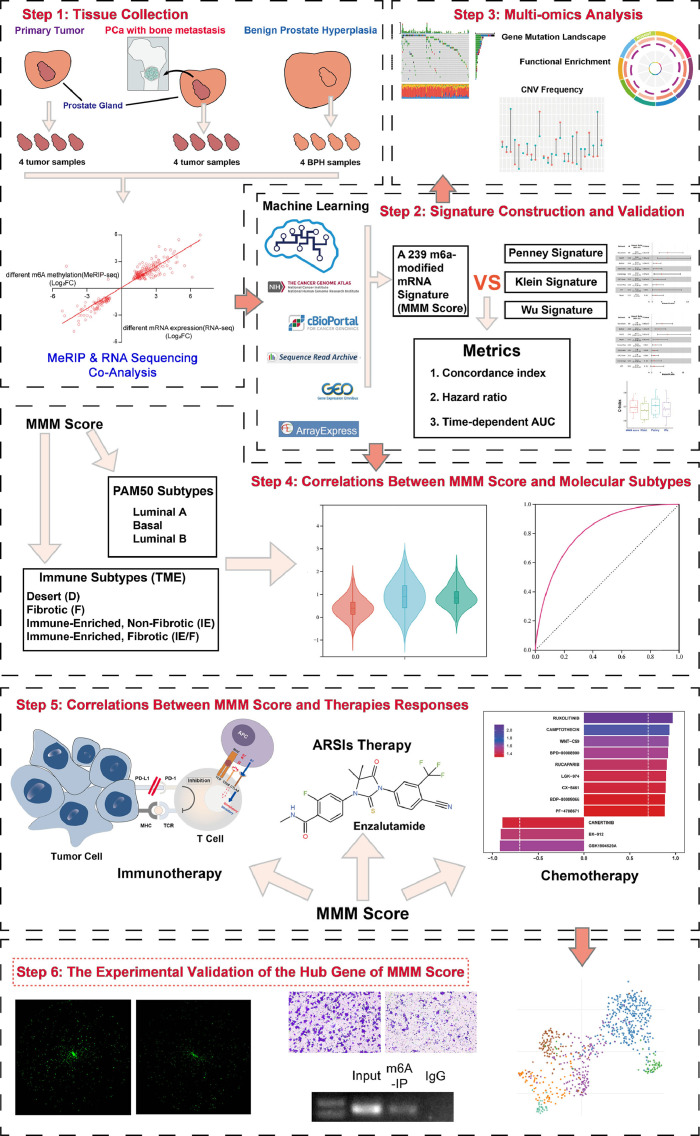
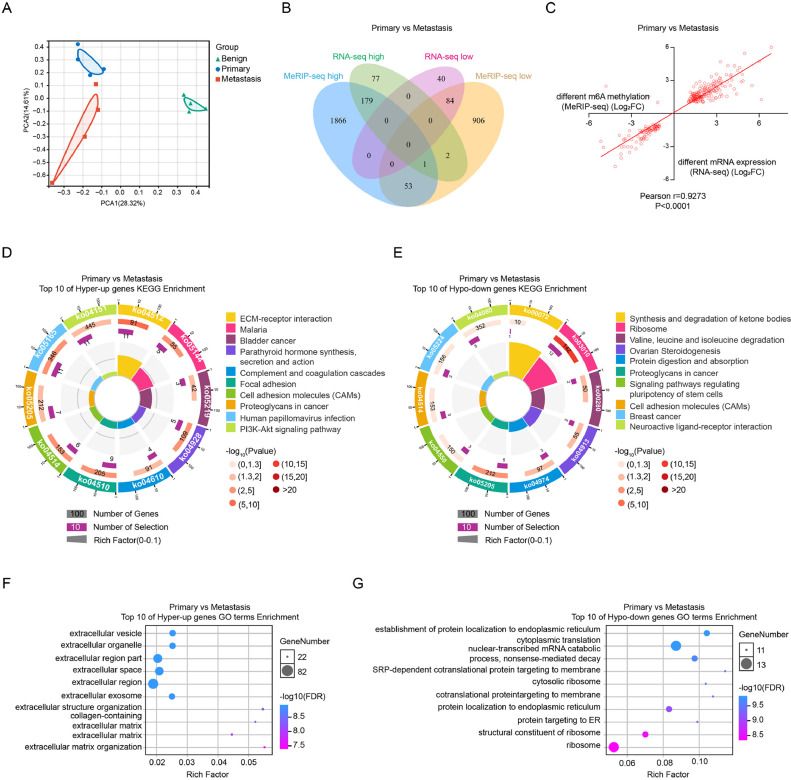
Novel biomarkers are urgently needed to improve the prediction of clinical outcomes and guide personalized treatment for prostate cancer (PCa) patients. However, the role of N6-methyladenosine (m6A) modifications in PCa initiation and progression remains largely elusive. In our study, we collected benign Prostate Hyperplasia (BPH), localized PCa, and metastatic PCa samples from patients and performed methylated RNA immunoprecipitation sequencing (MeRIP-Seq) to map m6A-methylated mRNAs. Furthermore, we developed a prognostic signature based on 239 differentially methylated RNAs and the TCGA-PRAD dataset, which can be used to calculate an m6A-modified mRNA (MMM) score for a PCa patient, validated by independent multi-center cohorts. Our findings revealed that differential m6A modifications were positively correlated with altered expressions of mapped m6A-modified mRNAs. Higher MMM scores were associated with shorter times to biochemical recurrence (BCR) in PCa patients, and the MMM scoring system outperformed three well-established signatures in nine independent validation cohorts, as demonstrated by Kaplan-Meier survival analysis, C-index and ROC. Patients who did not respond to androgen receptor signaling inhibitor (ARSI) therapy and immunotherapy were found to have high MMM scores. Two hub genes, TLE1 and PFKL, were confirmed to have m6A sites through MeRIP-qPCR, and their knockdown promoted PCa cell invasion. Bioinformatics analysis of single-cell databases identified cell types with high transcript abundance levels of these two genes. In summary, our study is the first to perform transcriptome-wide m6A mapping in prostate tissues. The translational potential of a prognostic signature, comprising m6A-methylated mRNAs, in predicting clinical outcomes and therapy responses for PCa patients, is demonstrated.
迫切需要新型生物标志物来改善前列腺癌(PCa)患者临床结局的预测并指导个性化治疗。然而,N6-甲基腺苷(m6A)修饰在PCa发生和进展中的作用仍 largely 难以捉摸。在我们的研究中,我们收集了患者的良性前列腺增生(BPH)、局限性PCa和转移性PCa样本,并进行了甲基化RNA免疫沉淀测序(MeRIP-Seq)以绘制m6A甲基化的mRNA图谱。此外,我们基于239个差异甲基化RNA和TCGA-PRAD数据集开发了一种预后特征,可用于计算PCa患者的m6A修饰mRNA(MMM)评分,并通过独立的多中心队列进行了验证。我们的研究结果表明,差异m6A修饰与映射的m6A修饰mRNA的表达改变呈正相关。较高的MMM评分与PCa患者生化复发(BCR)时间较短相关,并且MMM评分系统在九个独立验证队列中优于三个成熟的特征,如Kaplan-Meier生存分析、C指数和ROC所示。发现对雄激素受体信号抑制剂(ARSI)治疗和免疫治疗无反应的患者具有高MMM评分。通过MeRIP-qPCR证实两个枢纽基因TLE1和PFKL具有m6A位点,并且它们的敲低促进了PCa细胞侵袭。单细胞数据库的生物信息学分析确定了这两个基因转录本丰度水平高的细胞类型。总之,我们的研究是首次在前列腺组织中进行全转录组范围的m6A图谱绘制。证明了包含m6A甲基化mRNA的预后特征在预测PCa患者临床结局和治疗反应方面的转化潜力。