Department of Bacteriology, Capital Institute of Pediatrics, Beijing, China; Children's Hospital Capital Institute of Pediatrics, Chinese Academy of Medical Sciences & Peking Union Medical College, Beijing, China.
Department of Bacteriology, Capital Institute of Pediatrics, Beijing, China.
EBioMedicine. 2023 May;91:104560. doi: 10.1016/j.ebiom.2023.104560. Epub 2023 Apr 13.
Patients with auto-brewery syndrome (ABS) become inebriated after the ingestion of an alcohol-free, high-carbohydrate diet. Our previous work has shown that high-alcohol-producing (HiAlc) Klebsiella pneumoniae can generate excessive endogenous ethanol and cause non-alcoholic fatty liver disease (NAFLD). Therefore, it is reasonable to speculate that such bacteria might play an important role in the pathogenesis of ABS.
The characteristics and metabolites of the intestinal flora from a clinical cohort of patients with ABS were analysed during different stages of disease and compared to a group of healthy controls. An in vitro culture system of relevant samples was used for screening drug sensitivity and ABS-inducing factors. Rabbit intestinal and murine models were established to verify if the isolated strains could induce ABS in vivo.
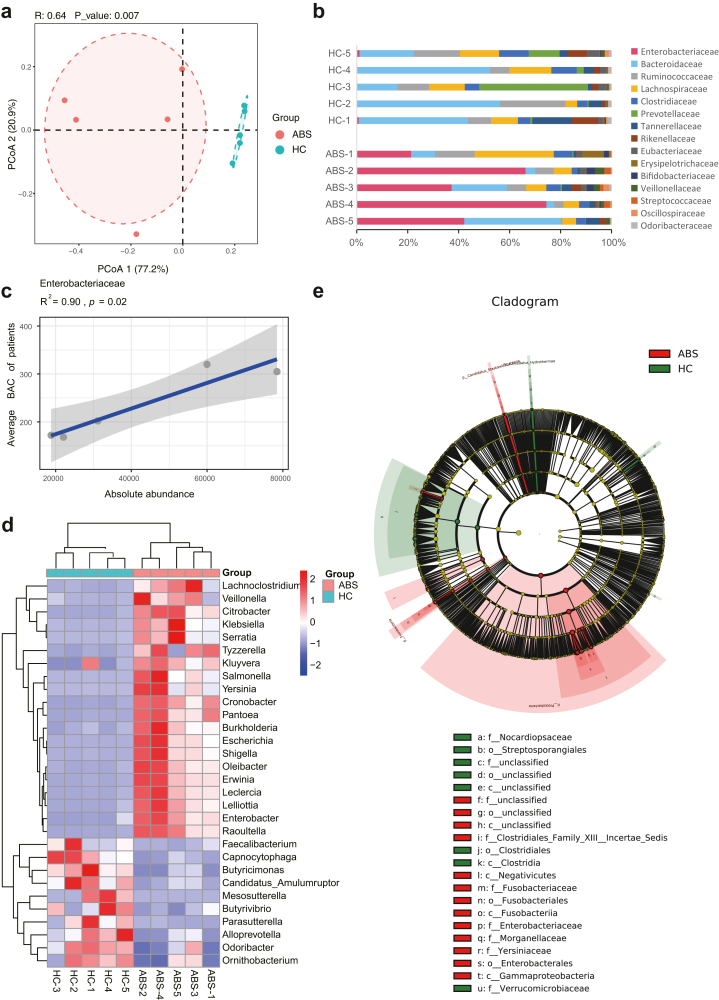
We observed intestinal dysbiosis with decreased abundance of Firmicutes and increased of Proteobacteria in patients with ABS compared with healthy controls. The abundance of the genus Klebsiella in Enterobacteriaceae was strongly associated with fluctuations of patient's blood alcohol concentration. We isolated three species of HiAlc Klebsiella from ABS patients, which were able to induce ABS in mice. Monosaccharide content was identified as a potential food-related inducing factor for alcohol production. Treatments with antibiotics, a complex probiotic preparation and a low-carbohydrate diet not only alleviated ABS, but also erased ABS relapse during the follow-up observation of one of the patients.
Excessive endogenous alcohol produced by HiAlc Klebsiella species was an underlying cause of bacterial ABS. Combined prescription of appropriate antibiotics, complex probiotic preparation and a controlled diet could be sufficient for treatment of bacteria-caused ABS.
The funders are listed in the acknowledgement.
患有自酿综合征(ABS)的患者在摄入无酒精、高碳水化合物饮食后会醉酒。我们之前的工作表明,能够产生高浓度酒精的(HiAlc)肺炎克雷伯菌可以产生过量的内源性乙醇并导致非酒精性脂肪性肝病(NAFLD)。因此,合理推测此类细菌可能在 ABS 的发病机制中起重要作用。
分析了临床 ABS 患者在不同疾病阶段的肠道菌群特征和代谢产物,并与健康对照组进行了比较。使用相关样本的体外培养系统筛选药物敏感性和 ABS 诱导因素。建立兔肠和鼠模型以验证分离株是否能在体内诱导 ABS。
与健康对照组相比,ABS 患者的肠道菌群失调,厚壁菌门减少,变形菌门增加。肠杆菌科中克雷伯菌属的丰度与患者血液酒精浓度的波动密切相关。我们从 ABS 患者中分离出三种 HiAlc 克雷伯菌,它们能够在小鼠中诱导 ABS。单糖含量被确定为酒精生产的一种潜在食物相关诱导因素。抗生素、复合益生菌制剂和低碳水化合物饮食治疗不仅缓解了 ABS,而且在其中一位患者的随访观察中消除了 ABS 复发。
HiAlc 克雷伯菌产生的过量内源性酒精是细菌 ABS 的根本原因。适当的抗生素、复合益生菌制剂和饮食控制联合处方可能足以治疗细菌引起的 ABS。
资助者列在致谢中。