Institute of Intensive Care Medicine, University Hospital Zurich, Rämistrasse 100, 8091, Zurich, Switzerland.
Department of Nephrology and Hypertension, Hannover Medical School, Hannover, Germany.
Trials. 2023 Apr 15;24(1):277. doi: 10.1186/s13063-023-07300-5.
Sepsis is as a life-threatening organ dysfunction caused by a dysregulated host response to an infection. The mortality of sepsis and particular of septic shock is very high. Treatment mostly focuses on infection control but a specific intervention that targets the underlying pathological host response is lacking to the present time. The investigators hypothesize that early therapeutic plasma exchange (TPE) will dampen the maladaptive host response by removing injurious mediators thereby limiting organ dysfunction and improving survival in patients with septic shock. Although small prospective studies demonstrated rapid hemodynamic stabilization under TPE, no adequately powered randomized clinical trial has investigated hard outcomes.
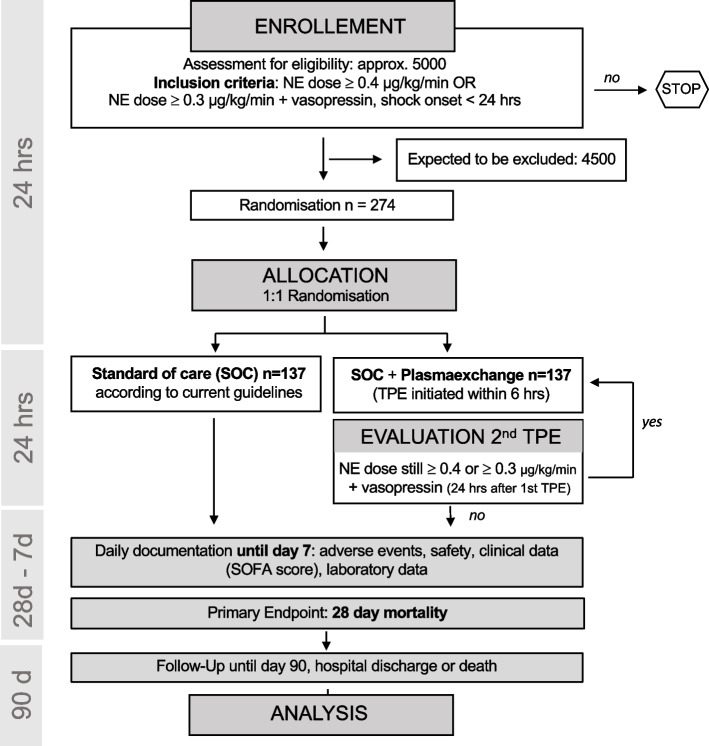
This is a randomized, prospective, multicenter, open-label, controlled, parallel-group interventional trial to test the adjunctive effect of TPE in patients with early septic shock. Patients with a refractory (defined as norepinephrine (NE) ≥ 0.4 μg/kg/min ≥ 30 min OR NE 0.3 μg/kg/min + vasopressin) and early (shock onset < 24 h) septic shock will be included. The intervention is a standard TPE with donor fresh frozen plasma (1.2 × individual plasma volume) performed within 6 h after randomization and will be compared to a standard of care (SOC) control arm. The primary endpoint is 28 days mortality for which the power analysis revealed a group size of 137 / arm (n = 274) to demonstrate a benefit of 15%. The key secondary objective will be to compare the extent of organ failure indicated by mean SOFA over the first 7 days as well as organ support-free days until day 28 following randomization. Besides numerous biological secondary, safety endpoints such as incidence of bleeding, allergic reactions, transfusion associated lung injury, severe thrombocytopenia, and other severe adverse events will be assessed during the first 7 days. For exploratory scientific analyses, biomaterial will be acquired longitudinally and multiple predefined scientific subprojects are planned. This study is an investigator-initiated trial supported by the German Research Foundation (DFG, DA 1209/7-1), in which 26 different centers in Germany, Switzerland, and Austria will participate over a duration of 33 months.
This trial has substantial clinical relevance as it evaluates a promising adjunctive treatment option in refractory septic shock patients suffering from an extraordinary high mortality. A positive trial result could change the current standard of care for this septic subgroup. The results of this study will be disseminated through presentations at international congresses, workshops, and peer-reviewed publications.
ClinicalTrials.gov NCT05726825 , Registered on 14 February 2023.
败血症是一种危及生命的器官功能障碍,由宿主对感染的失调反应引起。败血症,尤其是败血症性休克的死亡率非常高。目前的治疗主要集中在感染控制上,但缺乏针对潜在病理宿主反应的特定干预措施。研究人员假设早期治疗性血浆置换(TPE)通过清除有害介质来抑制适应性宿主反应,从而限制器官功能障碍并提高败血症性休克患者的生存率。尽管小型前瞻性研究表明 TPE 可迅速稳定血流动力学,但尚无足够大的随机临床试验调查硬终点。
这是一项随机、前瞻性、多中心、开放标签、对照、平行组干预试验,旨在测试 TPE 在早期败血症性休克患者中的辅助作用。将纳入难治性(定义为去甲肾上腺素(NE)≥0.4μg/kg/min≥30 分钟或 NE 0.3μg/kg/min+血管加压素)和早期(休克发作<24 小时)败血症性休克的患者。干预措施是在随机分组后 6 小时内进行标准 TPE 和供体新鲜冷冻血浆(1.2×个体血浆容量),并与标准治疗(SOC)对照组进行比较。主要终点是 28 天死亡率,通过功率分析显示每组需要 137 例/臂(n=274 例)才能证明 15%的获益。关键次要目标是比较前 7 天内 SOFA 平均器官衰竭程度以及随机分组后第 28 天前的器官支持无天数。除了许多生物学次要终点和安全性终点(如出血、过敏反应、输血相关肺损伤、严重血小板减少症和其他严重不良事件的发生率)外,还将在第 7 天内进行评估。为了进行探索性科学分析,将进行纵向采集生物材料,并计划进行多个预先定义的科学子项目。这项研究是由德国研究基金会(DFG,DA 1209/7-1)资助的一项由研究者发起的试验,德国、瑞士和奥地利的 26 个不同中心将参与该试验,持续 33 个月。
这项试验具有重要的临床意义,因为它评估了一种有前途的辅助治疗选择,适用于患有极高死亡率的难治性败血症性休克患者。阳性试验结果可能会改变这种败血症亚组的当前标准治疗方法。该研究的结果将通过在国际会议、研讨会和同行评议出版物上的演讲进行传播。
ClinicalTrials.gov NCT05726825,于 2023 年 2 月 14 日注册。
