Wang Bingyan, Sun Hui, Pan Xiaona, Ma Wenshuai, Dong Linghui, Wang Qiang, Meng Pingping
Department of Rehabilitation Medicine, Affiliated Hospital of Qingdao University, Qingdao, China.
Department of Radiology, Affiliated Hospital of Qingdao University, Qingdao, China.
Front Hum Neurosci. 2023 Mar 30;17:1100320. doi: 10.3389/fnhum.2023.1100320. eCollection 2023.
We aimed to investigate the effects and mechanisms of swallowing-related brain regions using resting-state functional magnetic resonance imaging (rs-fMRI) in healthy subjects who underwent intermittent theta burst stimulation (iTBS) on dominant or non-dominant cerebellar hemispheres.
Thirty-nine healthy subjects were randomized into three groups that completed different iTBS protocols (dominant cerebellum group, non-dominant cerebellum group and sham group). Before iTBS, the resting motor threshold (rMT) was measured by single-pulse transcranial magnetic stimulation (sTMS) on the cerebellar representation of the suprahyoid muscles, and the dominant cerebellar hemisphere for swallowing was determined. Forty-eight hours after elution, iTBS protocols were completed: in the dominant cerebellum group, iTBS was administered to the dominant cerebellar hemisphere, and the non-dominant cerebellar hemisphere was given sham stimulation; in the non-dominant cerebellum group, iTBS was administered to the non-dominant cerebellar hemisphere, and sham stimulation was delivered to the dominant cerebellar hemisphere; in the sham group, sham stimulation was applied to the cerebellum bilaterally. Rs-fMRI was performed before and after iTBS stimulation to observe changes in the fractional amplitude of low-frequency fluctuation (fALFF) in the whole brain.
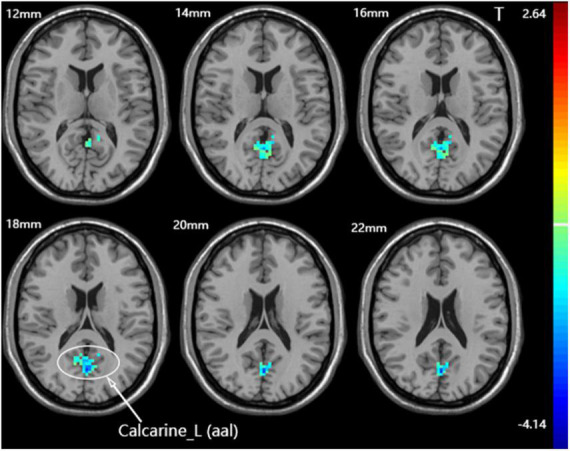
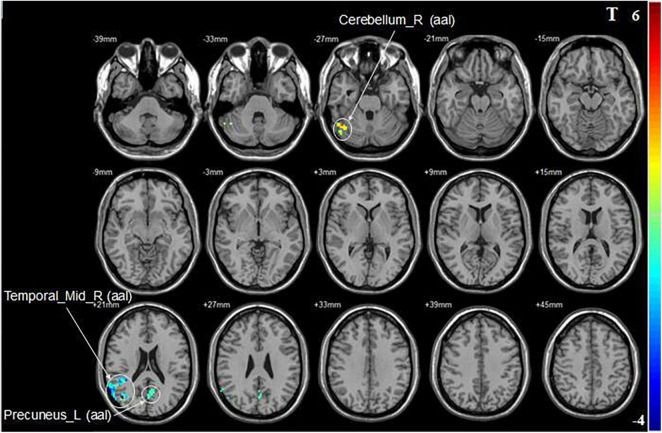
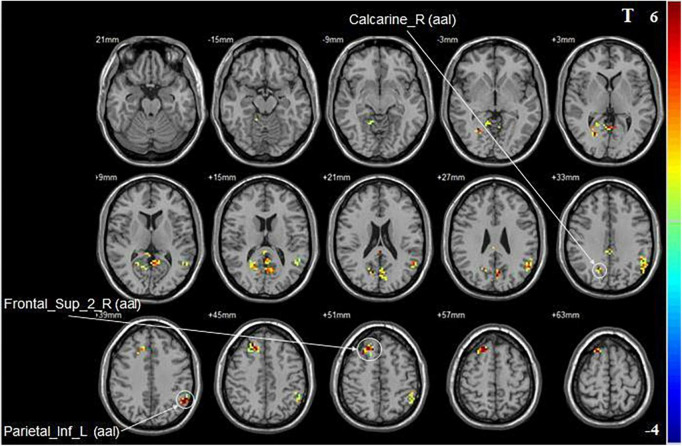
Compared with baseline, the dominant cerebellum group showed increased fALFF in the ipsilateral cerebellum, and decreased fALFF in the ipsilateral middle temporal gyrus and contralateral precuneus after iTBS; the iTBS of the non-dominant cerebellum group induced increased fALFF in the ipsilateral superior frontal gyrus, the calcarine fissure and the surrounding cortex, and the contralateral inferior parietal lobule; and in the sham group, there was no significant difference in fALFF. Exploring the effects induced by iTBS among groups, the dominant cerebellum group showed decreased fALFF in the contralateral calcarine fissure, and surrounding cortex compared with the sham group.
Intermittent theta burst stimulation of the dominant cerebellar hemisphere for swallowing excited the ipsilateral cerebellum, and stimulation of the non-dominant cerebellar hemisphere increased the spontaneous neural activity of multiple cerebrocortical areas related to swallowing. In conclusion, regardless of which side of the cerebellum is stimulated, iTBS can facilitate part of the brain neural network related to swallowing. Our findings provide supporting evidence that cerebellar iTBS can be used as a potential method to modulate human swallowing movement.
我们旨在使用静息态功能磁共振成像(rs-fMRI),对接受优势或非优势小脑半球间歇性θ波爆发刺激(iTBS)的健康受试者,研究与吞咽相关脑区的作用及机制。
39名健康受试者被随机分为三组,分别完成不同的iTBS方案(优势小脑组、非优势小脑组和假刺激组)。在进行iTBS之前,通过对舌骨上肌群小脑代表区进行单脉冲经颅磁刺激(sTMS)测量静息运动阈值(rMT),并确定吞咽的优势小脑半球。洗脱48小时后,完成iTBS方案:在优势小脑组中,对优势小脑半球进行iTBS,对非优势小脑半球给予假刺激;在非优势小脑组中,对非优势小脑半球进行iTBS,对优势小脑半球给予假刺激;在假刺激组中,对双侧小脑进行假刺激。在iTBS刺激前后进行rs-fMRI,以观察全脑低频振幅分数(fALFF)的变化。
与基线相比,优势小脑组在iTBS后同侧小脑的fALFF增加,同侧颞中回和对侧楔前叶的fALFF降低;非优势小脑组的iTBS诱导同侧额上回、距状裂及其周围皮质以及对侧下顶叶的fALFF增加;而在假刺激组中,fALFF无显著差异。探索iTBS在组间诱导的效应,与假刺激组相比,优势小脑组对侧距状裂及其周围皮质的fALFF降低。
对吞咽的优势小脑半球进行间歇性θ波爆发刺激可兴奋同侧小脑,对非优势小脑半球的刺激可增加与吞咽相关的多个大脑皮质区域的自发神经活动。总之,无论刺激小脑的哪一侧,iTBS均可促进与吞咽相关的部分脑神经网络。我们的研究结果提供了支持性证据,表明小脑iTBS可作为调节人类吞咽运动的一种潜在方法。