Roy Siddhartha, Petrie Keith J, Gamble Greg, Edwards Marc A
Department of Civil and Environmental Engineering, Virginia Tech, Blacksburg, VA, USA.
UNC Water Institute, Gillings School of Global Public Health, University of North Carolina, Chapel Hill, NC, USA.
Clin Psychol Eur. 2023 Mar 31;5(1):e9577. doi: 10.32872/cpe.9577. eCollection 2023 Mar.
Exposure to waterborne lead during the Flint Water Crisis during April 2014-October 2015 is believed to have caused increased special education enrollment in Flint children.
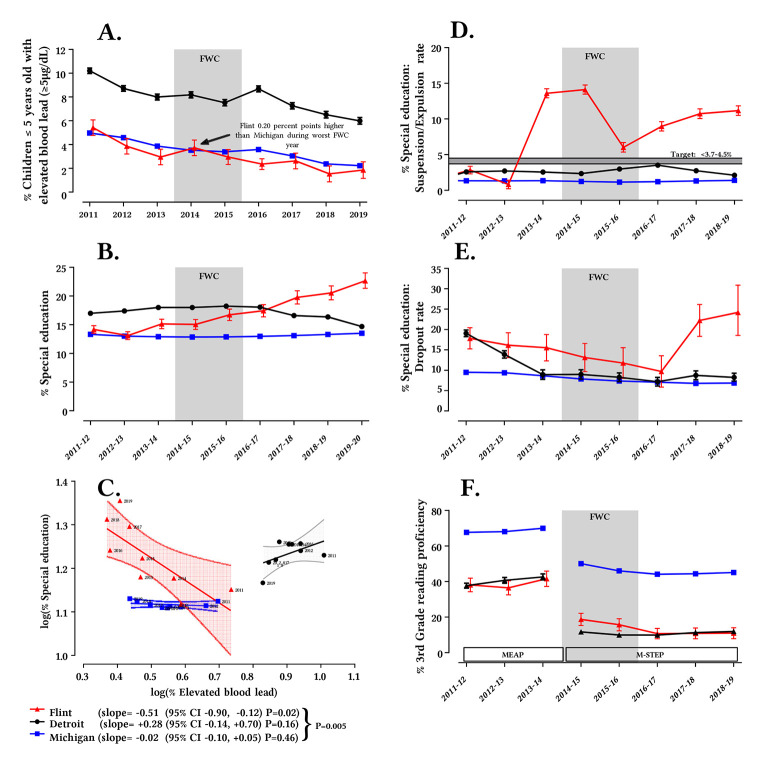
This retrospective population-based cohort study utilized de-identified data for children under six years of age who had their blood lead tested during 2011 to 2019, and special education outcomes data for children enrolled in public schools for corresponding academic years (2011-12 to 2019-20) in Flint, Detroit (control city) and the State of Michigan. Trends in the following crisis-related covariates were also evaluated: waterborne contaminants, poverty, nutrition, city governance, school district policies, negative community expectations, media coverage and social media interactions.
Between 2011 and 2019, including the 2014-15 crisis period, the incidence of elevated blood lead in Flint children (≥ 5µg/dL) was always at least 47% lower than in the control city of Detroit (p < .0001) and was also never significantly higher than that for all children tested in Michigan (p = 0.33). Nonetheless, special education enrollment in Flint spiked relative to Detroit and Michigan (p < .0001). There is actually an inverse relationship between childhood blood lead and special education enrollment in Flint.
This study failed to confirm any positive association between actual childhood blood lead levels and special education enrollment in Flint. Negative psychological effects associated with media predictions of brain damage could have created a self-fulfilling prophecy via a nocebo effect. The findings demonstrate a need for improved media coverage of complex events like the Flint Water Crisis.
2014年4月至2015年10月弗林特水危机期间接触水中铅被认为导致弗林特儿童特殊教育入学人数增加。
这项基于人群的回顾性队列研究利用了2011年至2019年期间接受血铅检测的6岁以下儿童的去识别数据,以及弗林特、底特律(对照城市)和密歇根州公立学校相应学年(2011 - 12至2019 - 20)入学儿童的特殊教育结果数据。还评估了以下与危机相关的协变量的趋势:水中污染物、贫困、营养、城市治理、学区政策、负面社区期望、媒体报道和社交媒体互动。
在2011年至2019年期间,包括2014 - 15年危机期间,弗林特儿童血铅升高(≥5µg/dL)的发生率始终比对照城市底特律低至少47%(p <.0001),并且也从未显著高于密歇根州所有接受检测儿童的发生率(p = 0.33)。尽管如此,弗林特的特殊教育入学人数相对于底特律和密歇根州仍大幅上升(p <.0001)。实际上,弗林特儿童血铅与特殊教育入学人数之间存在负相关关系。
本研究未能证实弗林特儿童实际血铅水平与特殊教育入学人数之间存在任何正相关关系。与媒体对脑损伤的预测相关的负面心理影响可能通过反安慰剂效应产生了自我实现的预言。研究结果表明,需要改进对弗林特水危机等复杂事件媒体报道。