Jan Syed Mansoor, Fahira Aamir, Shi Yongyong, Khan Mohammad Imran, Jamal Alam, Mahmood Arif, Shams Sulaiman, Parveen Zahida, Hu Junjian, Umair Muhammad, Wadood Abdul
Department of Biochemistry, Abdul Wali Khan University, Mardan 23200, Pakistan.
Bio-X Institutes, Key Laboratory for the Genetics of Developmental and Neuropsychiatric Disorders (Ministry of Education), Collaborative Innovation Center for Brain Science, Shanghai Jiao Tong University, Shanghai 200240, China.
ACS Omega. 2023 Mar 29;8(14):13332-13341. doi: 10.1021/acsomega.3c00696. eCollection 2023 Apr 11.
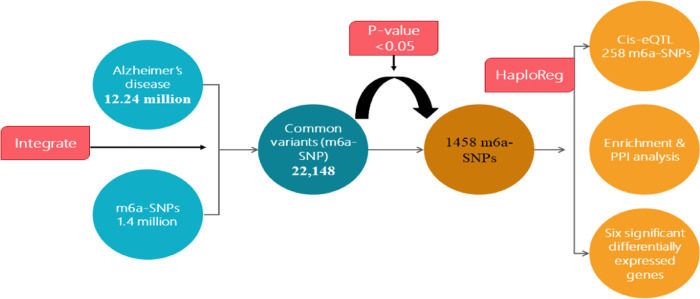
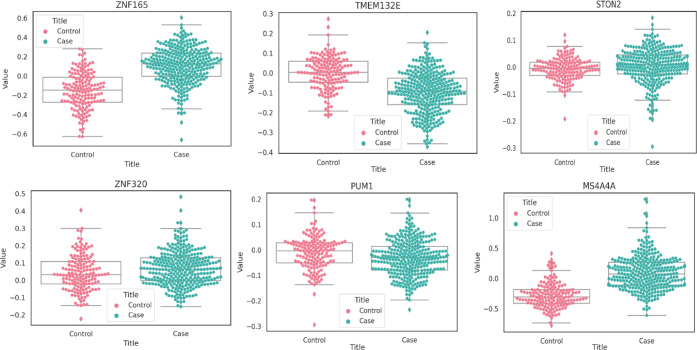
Alzheimer's disease (AD) is a neurodegenerative disorder that affects 35 million people worldwide. However, no potential therapeutics currently are available for AD because of the multiple factors involved in it, such as regulatory factors with their candidate genes, factors associated with the expression levels of its corresponding genes, and many others. To date, 29 novel loci from GWAS have been reported for AD by the Psychiatric Genomics Consortium (PGC2). Nevertheless, the main challenge of the post-GWAS era, namely to detect significant variants of the target disease, has not been conducted for AD. N6-methyladenosine (m6a) is reported as the most prevalent mRNA modification that exists in eukaryotes and that influences mRNA nuclear export, translation, splicing, and the stability of mRNA. Furthermore, studies have also reported m6a's association with neurogenesis and brain development. We carried out an integrative genomic analysis of AD variants from GWAS and m6a-SNPs from m6AVAR to identify the effects of m6a-SNPs on AD and identified the significant variants using the statistically significance value (-value <0.05). The cis-regularity variants with their corresponding genes and their influence on gene expression in the gene expression profiles of AD patients were determined, and showed 1458 potential m6a-SNPs (based on -value <0.05) associated with AD. eQTL analysis showed that 258 m6a-SNPs had cis-eQTL signals that overlapped with six significant differentially expressed genes based on -value <0.05 in two datasets of AD gene expression profiles. A follow-up study to elucidate the impact of our identified m6a-SNPs in the experimental study would validate our findings for AD, which would contribute to the etiology of AD.
阿尔茨海默病(AD)是一种影响全球3500万人的神经退行性疾病。然而,由于AD涉及多种因素,如调控因子及其候选基因、与其相应基因表达水平相关的因子等诸多因素,目前尚无针对AD的潜在治疗方法。迄今为止,精神基因组学联盟(PGC2)已报告了29个来自全基因组关联研究(GWAS)的AD新位点。然而,GWAS后时代的主要挑战,即检测目标疾病的显著变异,尚未在AD研究中开展。N6-甲基腺苷(m6A)被报道为真核生物中最普遍存在的mRNA修饰,它影响mRNA的核输出、翻译、剪接以及mRNA的稳定性。此外,研究还报道了m6A与神经发生和大脑发育的关联。我们对来自GWAS的AD变异和来自m6AVAR的m6A单核苷酸多态性(SNP)进行了综合基因组分析,以确定m6A-SNP对AD的影响,并使用统计学显著性值(P值<0.05)确定显著变异。确定了顺式调控变异及其相应基因,以及它们对AD患者基因表达谱中基因表达的影响,结果显示有1458个潜在的与AD相关的m6A-SNP(基于P值<0.05)。表达数量性状基因座(eQTL)分析表明,在两个AD基因表达谱数据集中,基于P值<0.05,有258个m6A-SNP具有与六个显著差异表达基因重叠的顺式eQTL信号。在实验研究中对我们鉴定出的m6A-SNP的影响进行后续研究,将验证我们对AD的研究结果,这将有助于AD病因学的研究。