Facciuolo Antonio, Van Kessel Jill, Kroeker Andrea, Liao Mingmin, Lew Jocelyne M, Falzarano Darryl, Kelvin Alyson A, Gerdts Volker, Napper Scott
Vaccine and Infectious Disease Organization (VIDO), University of Saskatchewan, Saskatoon, SK, Canada.
Department of Veterinary Microbiology, University of Saskatchewan, Saskatoon, SK, Canada.
Front Microbiol. 2023 Mar 29;14:1148255. doi: 10.3389/fmicb.2023.1148255. eCollection 2023.
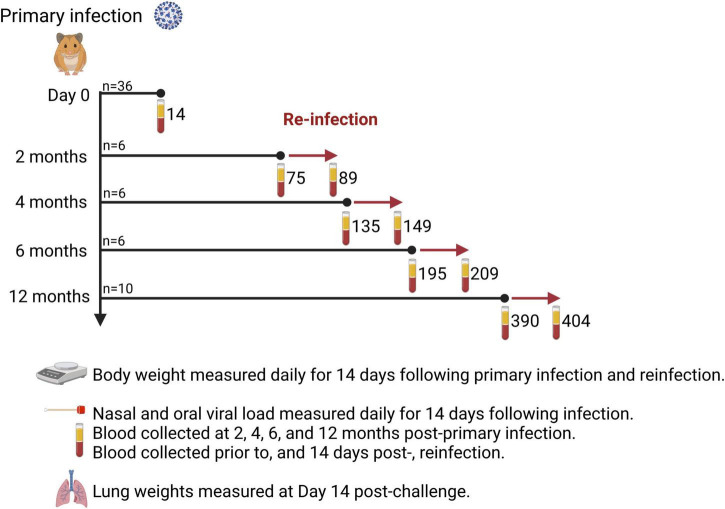
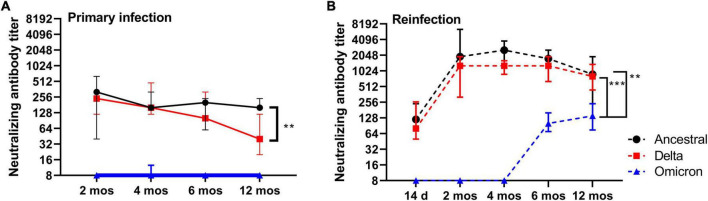
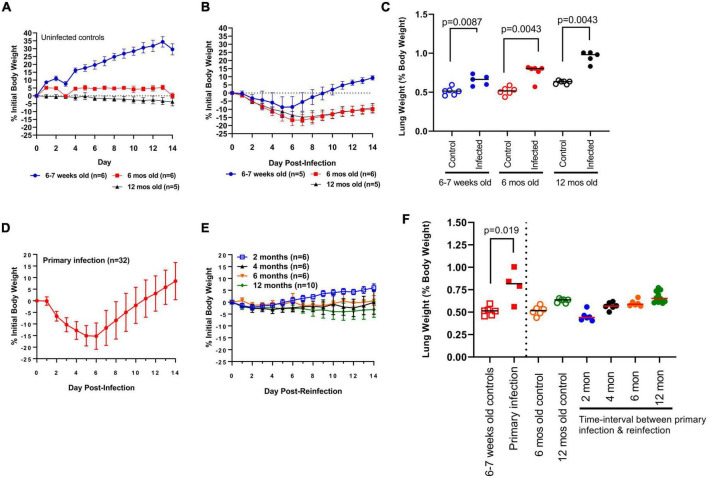
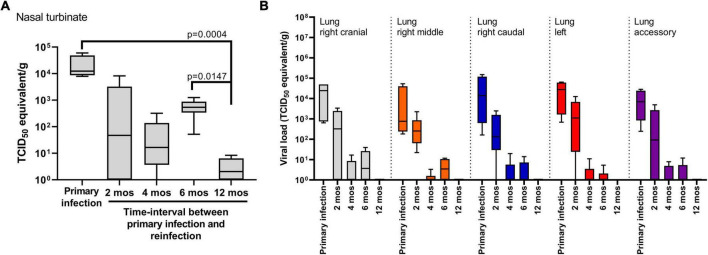
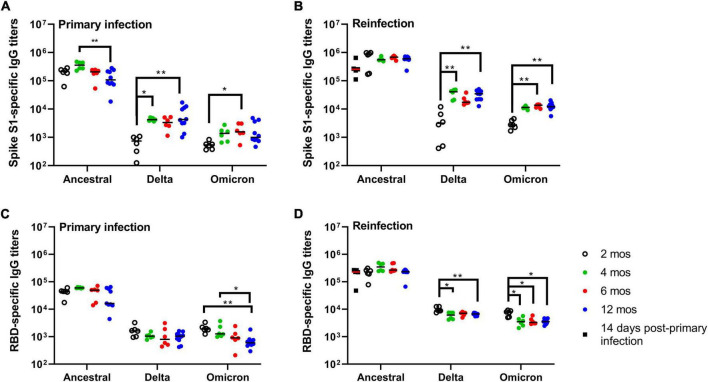
The ongoing evolution of SARS-CoV-2 continues to raise new questions regarding the duration of immunity to reinfection with emerging variants. To address these knowledge gaps, controlled investigations in established animal models are needed to assess duration of immunity induced by each SARS-CoV-2 lineage and precisely evaluate the extent of cross-reactivity and cross-protection afforded. Using the Syrian hamster model, we specifically investigated duration of infection acquired immunity to SARS-CoV-2 ancestral Wuhan strain over 12 months. Plasma spike- and RBD-specific IgG titers against ancestral SARS-CoV-2 peaked at 4 months post-infection and showed a modest decline by 12 months. Similar kinetics were observed with plasma virus neutralizing antibody titers which peaked at 2 months post-infection and showed a modest decline by 12 months. Reinfection with ancestral SARS-CoV-2 at regular intervals demonstrated that prior infection provides long-lasting immunity as hamsters were protected against severe disease when rechallenged at 2, 4, 6, and 12 months after primary infection, and this coincided with the induction of high virus neutralizing antibody titers. Cross-neutralizing antibody titers against the B.1.617.2 variant (Delta) progressively waned in blood over 12 months, however, re-infection boosted these titers to levels equivalent to ancestral SARS-CoV-2. Conversely, cross-neutralizing antibodies to the BA.1 variant (Omicron) were virtually undetectable at all time-points after primary infection and were only detected following reinfection at 6 and 12 months. Collectively, these data demonstrate that infection with ancestral SARS-CoV-2 strains generates antibody responses that continue to evolve long after resolution of infection with distinct kinetics and emergence of cross-reactive and cross-neutralizing antibodies to Delta and Omicron variants and their specific spike antigens.
严重急性呼吸综合征冠状病毒2(SARS-CoV-2)的持续演变不断引发新问题,即针对新出现变体再次感染的免疫持续时间。为填补这些知识空白,需要在成熟的动物模型中进行对照研究,以评估每个SARS-CoV-2谱系诱导的免疫持续时间,并精确评估交叉反应性和交叉保护的程度。我们使用叙利亚仓鼠模型,专门研究了对SARS-CoV-2原始武汉毒株的感染获得性免疫在12个月内的持续时间。针对原始SARS-CoV-2的血浆刺突蛋白和受体结合域(RBD)特异性IgG滴度在感染后4个月达到峰值,并在12个月时略有下降。血浆病毒中和抗体滴度也观察到类似的动力学,在感染后2个月达到峰值,并在12个月时略有下降。定期用原始SARS-CoV-2再次感染表明,先前的感染可提供持久免疫,因为仓鼠在初次感染后2、4、6和12个月再次受到攻击时可免受严重疾病侵害,这与高病毒中和抗体滴度的诱导相一致。针对B.1.617.2变体(德尔塔)的交叉中和抗体滴度在12个月内逐渐在血液中减弱,然而,再次感染将这些滴度提高到与原始SARS-CoV-2相当的水平。相反,针对BA.1变体(奥密克戎)的交叉中和抗体在初次感染后的所有时间点几乎都检测不到,仅在6个月和12个月再次感染后才检测到。总体而言,这些数据表明,感染原始SARS-CoV-2毒株会产生抗体反应,在感染消退后很长时间内,这些反应会以不同的动力学持续演变,并出现针对德尔塔和奥密克戎变体及其特定刺突抗原的交叉反应性和交叉中和抗体。