Faculty of Veterinary Medicine, University of Calgary, Calgary, AB, Canada.
Front Cell Infect Microbiol. 2023 Mar 30;13:1149419. doi: 10.3389/fcimb.2023.1149419. eCollection 2023.
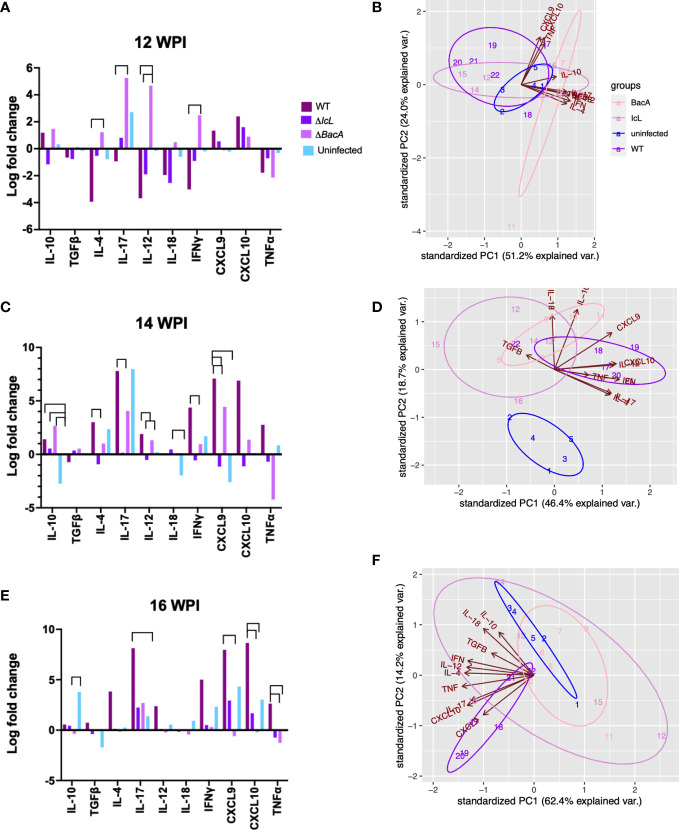
There has been little success in controlling Johne's disease, caused by subsp. , due to suboptimal diagnostics and the ineffectiveness of available vaccines. By knocking out and , genes required for MAP survival in dairy calves, two live-attenuated vaccine candidates were created. This study evaluated the host-specific attenuation of MAP and mutants in mouse and calf models, as well as the elicited immune responses. Deletion mutants were generated in MAP strain A1-157 through specialized transduction and found viable . First, the mutants' attenuation and elicited cytokine secretion were assessed in a mouse model, 3 weeks after intraperitoneal inoculation with MAP strains. Later, vaccine strains were assessed in a natural host infection model where calves received 10CFU oral dose of MAP wild-type or mutant strains at 2 weeks old. Transcription levels of cytokines in PBMCs were evaluated at 12-, 14-, and 16-weeks post-inoculation (WPI) and MAP colonization in tissue was assessed at 4.5 months after inoculation. Whereas both vaccine candidates colonized mouse tissues similarly to wild-type strain, both failed to persist in calf tissues. In either mouse or calf models, gene deletion did not reduce immunogenicity. Instead, inoculation with Δ induced a greater upregulation of proinflammatory cytokines than Δ and wild-type in both models and a greater expansion of cytotoxic and memory T-cells than uninfected control in calves. Δ and wild-type strains significantly increased secretion of IP-10, MIG, TNFα, and RANTES in mice serum compared to uninfected control. This agreed with upregulation of IL-12, IL-17, and TNFα in calves inoculated with Δ at all time points. The Δ also gave rise to greater populations of CD4+CD45RO+, and CD8+ cells than uninfected control calves at 16 WPI. Low survival rate of MAP in macrophages co-incubated with PBMCs isolated from the Δ group indicated that these cell populations are capable of killing MAP. Overall, the immune response elicited by Δ is stronger compared to Δ and it is maintained over two different models and over time in calves. Further investigation is warranted to evaluate the mutant's protection against MAP infection as a live attenuated vaccine candidate.
由于诊断效果不佳和现有疫苗无效,导致 subsp. 引起的约翰氏病的控制收效甚微。通过敲除 MAP 生存所需的 和 基因,创建了两种减毒活疫苗候选物。本研究评估了 MAP 和 突变体在小鼠和小牛模型中的宿主特异性衰减以及引发的免疫反应。通过专门的转导在 MAP 菌株 A1-157 中生成缺失突变体,并发现其具有活力。首先,在腹腔接种 MAP 菌株 3 周后,在小鼠模型中评估突变体的衰减和引发的细胞因子分泌。后来,在小牛在 2 周龄时接受 MAP 野生型或突变株 10CFU 口服剂量的自然宿主感染模型中评估疫苗株。在接种后 12、14 和 16 周(WPI)评估 PBMC 中细胞因子的转录水平,并在接种后 4.5 个月评估组织中的 MAP 定植。虽然两种疫苗候选物在小鼠组织中的定植与野生型菌株相似,但它们都未能在小牛组织中持续存在。在小鼠或小牛模型中,基因缺失并未降低免疫原性。相反,与野生型和 Δ相比,接种 Δ 会引起两种模型中促炎细胞因子的更大上调,并且在小牛中引起更多的细胞毒性和记忆 T 细胞扩增,而与未感染对照相比。与未感染对照相比,Δ 和野生型菌株显著增加了小鼠血清中 IP-10、MIG、TNFα 和 RANTES 的分泌。这与接种 Δ 的小牛中 IL-12、IL-17 和 TNFα 的上调一致。在 16 WPI 时,Δ 还引起了比未感染对照小牛更多的 CD4+CD45RO+和 CD8+细胞。与从 Δ 组分离的 PBMC 共孵育的巨噬细胞中 MAP 的低存活率表明这些细胞群体能够杀死 MAP。总体而言,与 Δ 和 相比,Δ 引发的免疫反应更强,并且在小牛中两种不同的模型和随时间推移得以维持。需要进一步研究来评估 突变体作为减毒活疫苗候选物对 MAP 感染的保护作用。