Metelmann Isabella B, Kraemer Sebastian, Steinert Matthias, Kersting Stephan, Busemann Alexandra
Department of Visceral, Transplant, Thoracic and Vascular Surgery, University Hospital of Leipzig, Leipzig, Germany.
Department of General, Visceral, Thoracic and Vascular Surgery, Universitätsmedizin, University of Greifswald, Greifswald, Germany.
J Thorac Dis. 2023 Mar 31;15(3):1106-1114. doi: 10.21037/jtd-22-1091. Epub 2023 Mar 13.
General clinical perception suggests a decline in the diagnosis and treatment of lung cancer during the SARS-CoV-2 pandemic. Early diagnosis of non-small cell lung cancer (NSCLC) is crucial in therapeutic regimes as early stages are potentially curable by operation alone or with combined therapy. Pandemic-triggered overload of the healthcare system may have prolonged the diagnosis of NSCLC, possibly leading to higher tumor stages at first diagnosis. This study aims to identify how COVID-19 affected the distribution of the Union for International Cancer Control (UICC) stage in NSCLC at first diagnosis.
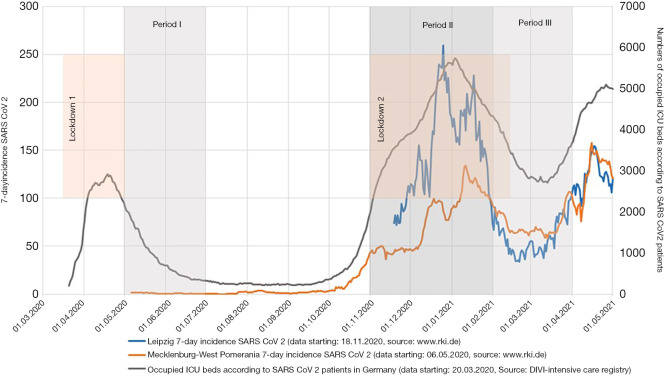
A retrospective case-control study was conducted, including all patients receiving their first diagnosis of NSCLC in the regions of Leipzig and Mecklenburg-Vorpommern (MV) between January 2019 and March 2021. Patient data were retrieved from the clinical cancer registries of the city of Leipzig and the federal state of MV. Ethical approval for this retrospective evaluation of archived, anonymized patient data was waived by the Scientific Ethical Committee at the Medical Faculty, Leipzig University. Three investigation periods were defined to study the effects of high incidences of SARS-COV-2: the curfew period as an enacted security measure, the period of high incidence rates and the period of the aftermath of high incidences. Differences in the UICC stages between these pandemic periods were studied by Mann-Whitney-U-Test. Pearson's correlation was calculated to examine changes in operability.
The number of patients diagnosed with NSCLC dropped substantially during investigation periods. There was a significant difference in the UICC status in the aftermath of high incidences and imposed security measures in Leipzig (P=0.016). N-status differed significantly in the aftermath of high incidences and imposed security measures (P=0.022) with a decrease of N0- and an increase of N3-status, respectively, while N1- and N2-status remained relatively unaffected. No pandemic phase showed a significant difference in operability.
The pandemic led to a delay in the diagnosis of NSCLC in the two examined regions. This resulted in higher UICC stages upon diagnosis. However, no increase in inoperable stages was shown. It remains to be seen, how this will affect the overall prognosis of the involved patients.
一般临床认知表明,在严重急性呼吸综合征冠状病毒2(SARS-CoV-2)大流行期间,肺癌的诊断和治疗有所下降。非小细胞肺癌(NSCLC)的早期诊断在治疗方案中至关重要,因为早期阶段仅通过手术或联合治疗可能治愈。大流行引发的医疗系统超负荷可能延长了NSCLC的诊断时间,可能导致初诊时肿瘤分期更高。本研究旨在确定2019冠状病毒病(COVID-19)如何影响NSCLC初诊时国际癌症控制联盟(UICC)分期的分布。
进行了一项回顾性病例对照研究,纳入2019年1月至2021年3月期间在莱比锡和梅克伦堡-前波美拉尼亚(MV)地区首次诊断为NSCLC的所有患者。患者数据从莱比锡市和MV联邦州的临床癌症登记处获取。莱比锡大学医学院科学伦理委员会免除了对存档的匿名患者数据进行这项回顾性评估的伦理批准。定义了三个调查期来研究SARS-CoV-2高发病率的影响:宵禁期作为一项已颁布的安全措施、高发病率期和高发病率后期。通过曼-惠特尼-U检验研究这些大流行时期之间UICC分期的差异。计算皮尔逊相关性以检查可手术性的变化。
在调查期间,诊断为NSCLC的患者数量大幅下降。莱比锡高发病率和实施安全措施后,UICC状态存在显著差异(P=0.016)。高发病率和实施安全措施后,N状态存在显著差异(P=0.022),N0状态分别下降,N3状态增加,而N1和N2状态相对未受影响。没有大流行阶段在可手术性方面显示出显著差异。
大流行导致两个研究地区NSCLC诊断延迟。这导致诊断时UICC分期更高。然而,不可手术分期没有增加。这将如何影响相关患者的总体预后还有待观察。