Nigg Carina, Petersen Evi, MacIntyre Tadhg
Institute of Sport Science, University of Bern, Bremgartenstrasse 145, 3012, Bern, Switzerland.
Institute of Sports and Sports Science, Karlsruhe Institute of Technology, Engler-Bunte-Ring 15, 76131, Karlsruhe, Germany.
J Environ Psychol. 2023 Jun;88:102009. doi: 10.1016/j.jenvp.2023.102009. Epub 2023 Apr 9.
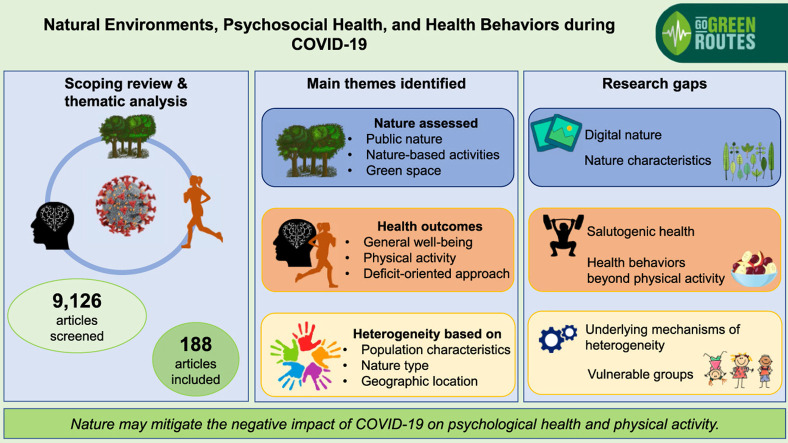
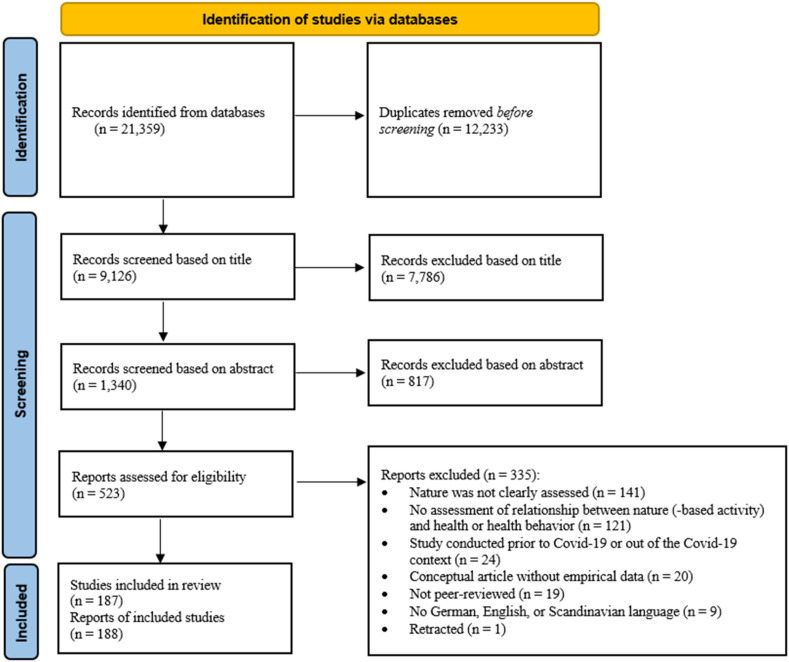
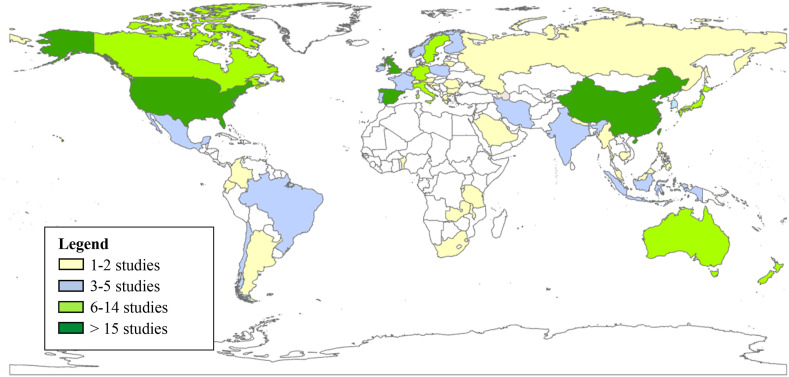
The COVID-19 outbreak led to major restrictions globally, affecting people's psychosocial health and their health behaviors. Thus, the purpose of this scoping review was to summarize the available research regarding nature and health in the COVID-19 context. Keywords relating to natural environments and COVID-19 were combined to conduct a systematic online search in six major databases. Eligibility criteria were a) published since 2020 with data collected in the COVID-19 context b) peer-reviewed, c) original empirical data collected on human participants, d) investigated the association between natural environments and psychosocial health or health behaviors, and e) English, German, or Scandinavian languages. Out of 9126 articles being screened, we identified 188 relevant articles, representing 187 distinct studies. Most research focused on adults in the general population and was predominantly conducted in the USA, Europe, and China. Overall, the findings indicate that nature may mitigate the impact of COVID-19 on psychological health and physical activity. Through a systematic thematic analysis of the extracted data, three primary themes were identified: 1) type of nature assessed, 2) psychosocial health and health behaviors investigated, and 3) heterogeneity in the nature-health relationship. Research gaps in the COVID-19 context were identified regarding I) nature characteristics that promote psychosocial health and health behaviors, II) investigations of digital and virtual nature, III) psychological constructs relating to mental health promotion, IV) health-promoting behaviors other than physical activity, V) underlying mechanisms regarding heterogeneity in the nature-health relationship based on human, nature, and geographic characteristics, and VI) research focusing on vulnerable groups. Overall, natural environments demonstrate considerable potential in buffering the impact of stressful events on a population level on mental health. However, future research is warranted to fill the mentioned research gaps and to examine the long-term effects of nature exposure during COVID-19.
新冠疫情在全球引发了重大限制措施,影响了人们的心理社会健康及其健康行为。因此,本综述的目的是总结新冠疫情背景下有关自然与健康的现有研究。将与自然环境和新冠疫情相关的关键词相结合,在六个主要数据库中进行系统的在线搜索。纳入标准为:a) 2020年以来发表,且数据收集于新冠疫情背景下;b) 经过同行评审;c) 收集了关于人类参与者的原始实证数据;d) 研究了自然环境与心理社会健康或健康行为之间的关联;e) 语言为英语、德语或斯堪的纳维亚语。在筛选的9126篇文章中,我们确定了188篇相关文章,代表187项不同的研究。大多数研究聚焦于普通人群中的成年人,主要在美国、欧洲和中国开展。总体而言,研究结果表明自然环境可能减轻新冠疫情对心理健康和身体活动的影响。通过对提取数据进行系统的主题分析,确定了三个主要主题:1) 所评估的自然环境类型;2) 所研究的心理社会健康和健康行为;3) 自然与健康关系中的异质性。确定了新冠疫情背景下的研究空白,包括:I) 促进心理社会健康和健康行为的自然环境特征;II) 数字和虚拟自然环境的研究;III) 与心理健康促进相关的心理结构;IV) 除身体活动之外的健康促进行为;V) 基于人类、自然和地理特征的自然与健康关系异质性的潜在机制;VI) 针对弱势群体的研究。总体而言,自然环境在缓冲压力事件对人群心理健康的影响方面具有巨大潜力。然而,有必要开展进一步研究以填补上述研究空白,并考察新冠疫情期间接触自然环境的长期影响。