Suzuki Joji, Prostko Sara, Szpak Veronica, Chai Peter R, Spagnolo Primavera A, Tenenbaum Ruth E, Ahmed Saeed, Weiss Roger D
Department of Psychiatry, Brigham and Women's Hospital, Boston, MA, United States.
Harvard Medical School, Boston, MA, United States.
Front Psychiatry. 2023 Mar 30;14:1155984. doi: 10.3389/fpsyt.2023.1155984. eCollection 2023.
Opioid use disorder (OUD) continues to be a significant public health concern. Medications for OUD (MOUD) such as buprenorphine reduce overdose mortality, but relapses occur often, leading to adverse outcomes. Preliminary data suggest that cannabidiol (CBD) may be a potential adjunctive treatment to MOUD by attenuating cue-reactivity. This pilot study sought to evaluate the impact of a single dose of CBD on reward- and stress-related neurocognitive processes implicated in relapse among those with OUD.
The study was a pilot, double-blind, placebo-controlled, randomized cross-over trial aimed at assessing the effects of a single dose of CBD (Epidiolex®) 600 mg or matching placebo administered to participants with OUD receiving either buprenorphine or methadone. Vital signs, mood states, pain, opioid withdrawal, cue-induced craving, attentional bias, decision-making, delayed discount, distress tolerance, and stress-reactivity were examined at each testing session on two separate testing days at least 1 week apart.
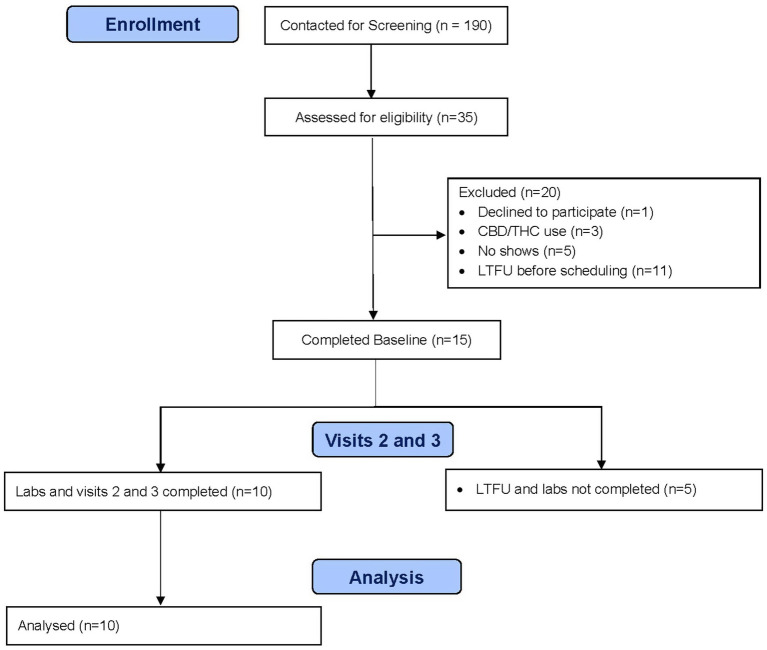
Ten participants completed all study procedures. Receipt of CBD was associated with a significant decrease in cue-induced craving (0.2 vs. 1.3, = 0.040), as well as reduced attentional bias toward drug-related cues as measured by the visual probe task (-80.4 vs. 100.3, = 0.041). No differences were found among all the other outcomes examined.
CBD may have promise as an adjunct to MOUD treatment by attenuating the brain response to drug-related cues, which, in turn, may reduce the risk of relapse and overdoses. Further research is warranted to evaluate the potential for CBD as an adjunctive therapy for individuals in treatment for OUD.
阿片类物质使用障碍(OUD)仍是一个重大的公共卫生问题。丁丙诺啡等用于治疗OUD的药物(MOUD)可降低过量用药死亡率,但复发情况经常发生,会导致不良后果。初步数据表明,大麻二酚(CBD)可能通过减弱线索反应性成为MOUD的一种潜在辅助治疗方法。这项试点研究旨在评估单剂量CBD对OUD患者复发相关的奖赏和应激相关神经认知过程的影响。
该研究是一项试点、双盲、安慰剂对照、随机交叉试验,旨在评估单剂量600毫克CBD( Epidiolex®)或匹配安慰剂对接受丁丙诺啡或美沙酮治疗的OUD参与者的影响。在至少相隔1周的两个不同测试日的每次测试环节中,对生命体征、情绪状态、疼痛、阿片类物质戒断反应、线索诱发的渴望、注意偏向、决策、延迟折扣、痛苦耐受性和应激反应性进行检查。
10名参与者完成了所有研究程序。服用CBD与线索诱发的渴望显著降低相关(0.2对1.3,P = 0.040),并且通过视觉探测任务测量,对药物相关线索的注意偏向也有所减少(-80.4对100.3,P = 0.041)。在检查的所有其他结果中未发现差异。
CBD可能有望作为MOUD治疗的辅助手段,通过减弱大脑对药物相关线索的反应,这反过来可能降低复发和过量用药的风险。有必要进行进一步研究,以评估CBD作为OUD治疗个体辅助疗法的潜力。