Division of Endocrinology, Diabetes and Bone Diseases, Department of Medicine III and University Center for Healthy Aging and.
Center for Regenerative Therapies Dresden, Technische Universität Dresden, Dresden, Germany.
J Clin Invest. 2023 Apr 17;133(8):e169069. doi: 10.1172/JCI169069.
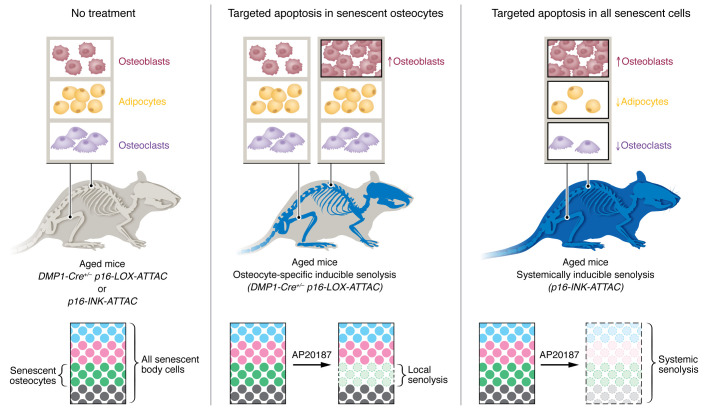
Osteocytes are specialized bone cells that orchestrate skeletal remodeling. Senescent osteocytes are characterized by an activation of cyclin-dependent kinase inhibitor p16Ink4a and have been implicated in the pathogenesis of several bone loss disorders. In this issue of the JCI, Farr et al. have now shown that systemic removal of senescent cells (termed senolysis) prevented age-related bone loss at the spine and femur and mitigated bone marrow adiposity through a robust effect on osteoblasts and osteoclasts, whereas cell-specific senolysis in osteocytes alone was only partially effective. Surprisingly, transplantation of senescent fibroblasts into the peritoneum of young mice caused host osteocyte senescence associated with bone loss. This refined concept of osteocyte senescence and the effects of remote senolysis may help to develop improved senolytic strategies against multisystem aging in bone and beyond.
成骨细胞是一种专门的骨骼细胞,可协调骨骼重塑。衰老的成骨细胞的特征是细胞周期蛋白依赖性激酶抑制剂 p16Ink4a 的激活,并且与几种骨丢失疾病的发病机制有关。在本期 JCI 中,Farr 等人现在表明,全身性清除衰老细胞(称为衰老细胞溶解)可预防脊柱和股骨的与年龄相关的骨质流失,并通过对成骨细胞和破骨细胞的强大作用减轻骨髓脂肪变性,而仅针对成骨细胞的特定衰老细胞溶解仅部分有效。令人惊讶的是,将衰老的成纤维细胞移植到年轻小鼠的腹膜中会导致宿主成骨细胞衰老与骨质流失相关。这种对成骨细胞衰老的精确概念以及远程衰老细胞溶解的影响可能有助于开发针对骨骼和其他多系统衰老的改进的衰老细胞溶解策略。