Department of Microbiology and Immunology, Weill Cornell Medicine, Cornell University, Ithaca, NY 14853.
Laboratory of Chemical Biology and Microbial Pathogenesis, Rockefeller University, New York, NY 10065.
Proc Natl Acad Sci U S A. 2023 Apr 25;120(17):e2302152120. doi: 10.1073/pnas.2302152120. Epub 2023 Apr 17.
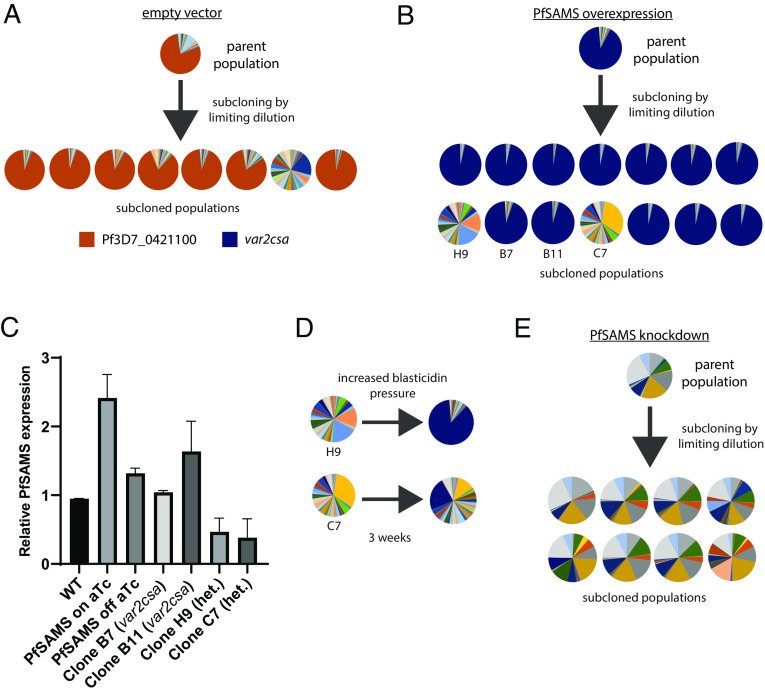
The primary antigenic and virulence determinant of the human malaria parasite is a variant surface protein called PfEMP1. Different forms of PfEMP1 are encoded by a multicopy gene family called , and switching between active genes enables the parasites to evade the antibody response of their human hosts. gene switching is key for the maintenance of chronic infections; however, what controls switching is unknown, although it has been suggested to occur at a constant frequency with little or no environmental influence. gene transcription is controlled epigenetically through the activity of histone methyltransferases (HMTs). Studies in model systems have shown that metabolism and epigenetic control of gene expression are linked through the availability of intracellular S-adenosylmethionine (SAM), the principal methyl donor in biological methylation modifications, which can fluctuate based on nutrient availability. To determine whether environmental conditions and changes in metabolism can influence gene expression, . was cultured in media with altered concentrations of nutrients involved in SAM metabolism. We found that conditions that influence lipid metabolism induce gene switching, indicating that parasites can respond to changes in their environment by altering gene expression patterns. Genetic modifications that directly modified expression of the enzymes that control SAM levels similarly led to profound changes in gene expression, confirming that changes in SAM availability modulate gene switching. These observations directly challenge the paradigm that antigenic variation in follows an intrinsic, programed switching rate, which operates independently of any external stimuli.
人类疟疾寄生虫的主要抗原和毒力决定因素是一种称为 PfEMP1 的变异表面蛋白。PfEMP1 的不同形式由一个称为 的多拷贝基因家族编码,而活跃基因之间的转换使寄生虫能够逃避其人类宿主的抗体反应。基因转换是维持慢性感染的关键;然而,控制转换的因素尚不清楚,尽管有人提出它以恒定的频率发生,几乎不受环境影响。基因转录通过组蛋白甲基转移酶(HMTs)的活性在表观遗传上受到控制。模型系统的研究表明,代谢和基因表达的表观遗传控制通过细胞内 S-腺苷甲硫氨酸(SAM)的可用性联系在一起,SAM 是生物甲基化修饰的主要甲基供体,其可用性可根据营养物质的可用性而波动。为了确定环境条件和代谢变化是否可以影响 基因表达,研究人员在改变了参与 SAM 代谢的营养物质浓度的培养基中培养 。他们发现,影响脂质代谢的条件会诱导 基因转换,这表明寄生虫可以通过改变 基因表达模式来对环境变化做出反应。同样,直接修饰控制 SAM 水平的酶的遗传修饰导致 基因表达的深刻变化,证实 SAM 可用性的变化调节 基因转换。这些观察结果直接挑战了这样一种范式,即 中的抗原变异遵循内在的、程序化的转换率,该转换率独立于任何外部刺激。