Faculty of Psychology, University of Warsaw, Stawki 5/7, 00-183, Warsaw, Poland.
Institute of Psychology, Cardinal Stefan Wyszynski University, Warsaw, Poland.
Sci Rep. 2023 Apr 17;13(1):6226. doi: 10.1038/s41598-023-33032-2.
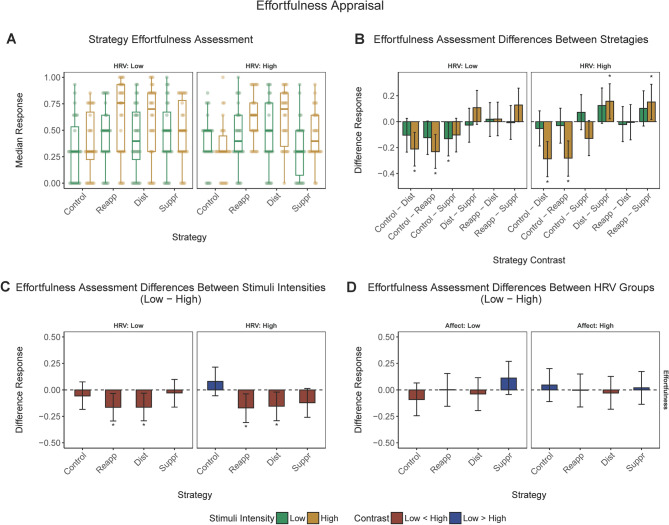
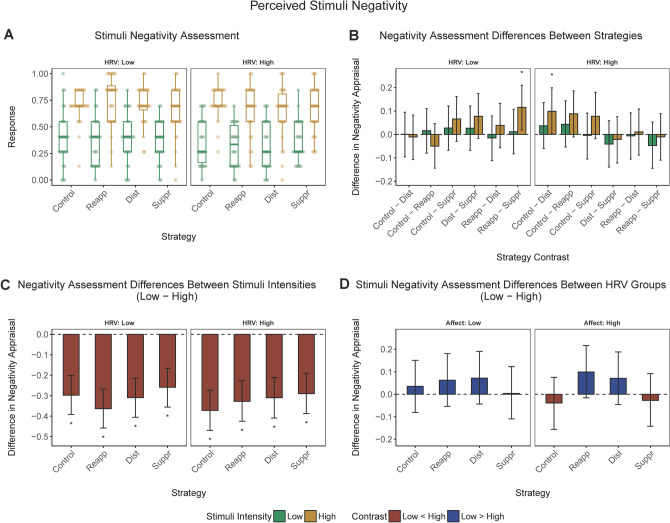
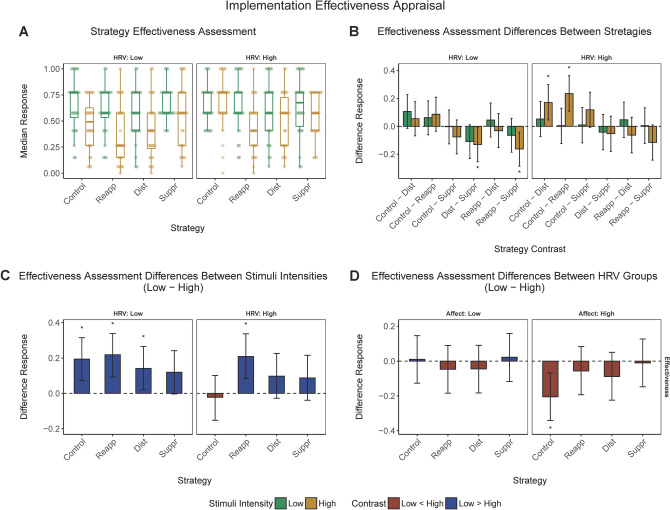
We investigated how emotion regulation (ER) effectiveness-on both a self-reported rating as well as emotional expression (corrugator supercilii muscle activity) level-is affected by the characteristics of the situation (low vs. high negativity), the strategy used (reinterpretation, distraction, suppression, no regulation control condition) and individual dispositions (low vs. high baseline Heart Rate Variability) as well as their interaction. For this purpose, 54 adult women participated in a laboratory study. All the included factors significantly influenced both corrugator activity and appraisals of pictures' negativity (in specific experimental conditions). For example, for high HRV participants, (1) distraction, suppression and reinterpretation significantly decreased corrugator activity compared to the control condition, and (2) distraction decreased appraised picture negativity for high negativity photos. For low HRV participants, distraction and suppression were most effective in decreasing corrugator responses, while suppression was more effective than reinterpretation in decreasing perceived picture negativity in the high negativity condition. Subjectively reported effort and success in applying ER strategies were also dependent on manipulated and dispositional factors. Overall, our results lend support to the flexible emotion regulation framework, showing that emotion regulation effectiveness relies on situational context as well as individual dispositions and their interaction.
我们研究了情绪调节(ER)的有效性,无论是自我报告的评分还是情绪表达(皱眉肌活动)水平,是如何受到情境特征(低负性与高负性)、所使用的策略(重评、分心、抑制、无调节控制条件)以及个体特质(低基线心率变异性与高基线心率变异性)及其相互作用的影响。为此,54 名成年女性参加了一项实验室研究。所有纳入的因素都显著影响了皱眉肌活动和图片负性评价(在特定的实验条件下)。例如,对于高 HRV 参与者,(1)分心、抑制和重评与控制条件相比,显著降低了皱眉肌活动,以及(2)分心降低了高负性照片的图片负性评价。对于低 HRV 参与者,分心和抑制在降低皱眉肌反应方面最有效,而在高负性条件下,抑制比重评更能降低感知图片的负性。主观报告的情绪调节策略的努力和成功也取决于被操纵的和个体特质的因素。总的来说,我们的研究结果支持了灵活的情绪调节框架,表明情绪调节的有效性依赖于情境背景以及个体特质及其相互作用。