Zaehringer Jenny, Jennen-Steinmetz Christine, Schmahl Christian, Ende Gabriele, Paret Christian
Department of Psychosomatic Medicine and Psychotherapy, Central Institute of Mental Health Mannheim, Medical Faculty Mannheim, Heidelberg University, Mannheim, Germany.
Department Neuroimaging, Central Institute of Mental Health Mannheim, Medical Faculty Mannheim, Heidelberg University, Mannheim, Germany.
Front Psychol. 2020 Apr 16;11:470. doi: 10.3389/fpsyg.2020.00470. eCollection 2020.
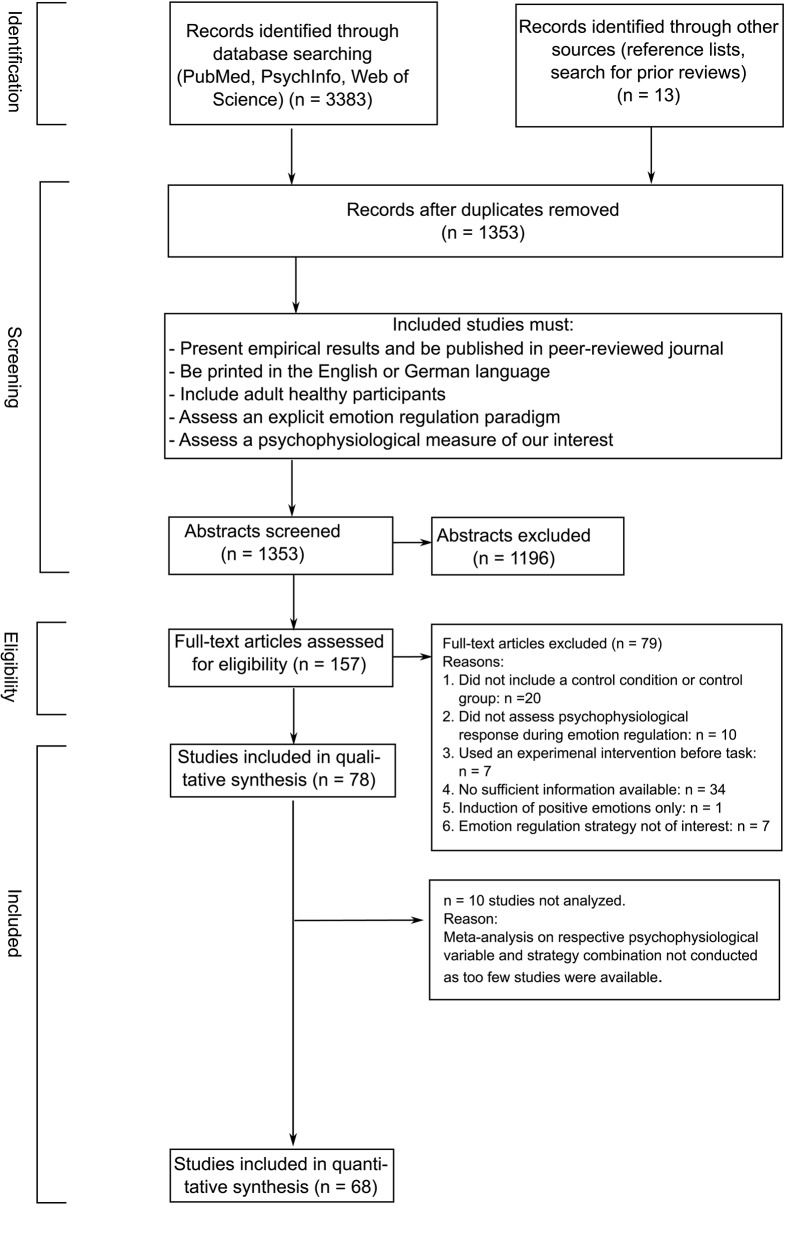
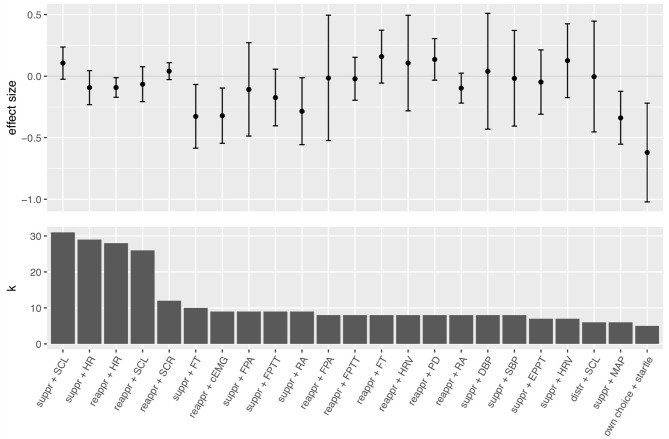
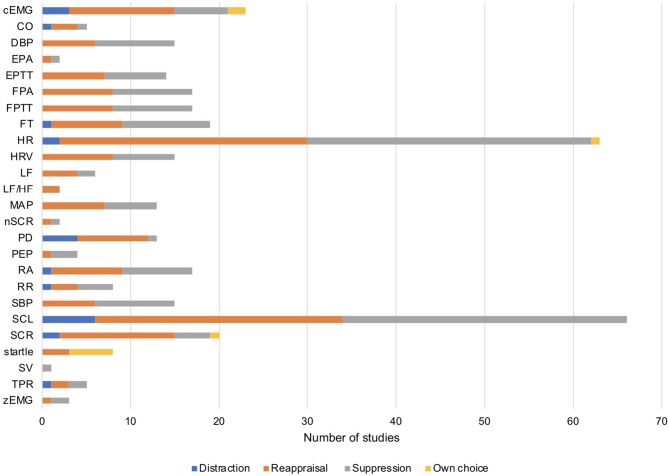
Assessing psychophysiological responses of emotion regulation is a cost-efficient way to quantify emotion regulation and to complement subjective report that may be biased. Previous studies have revealed inconsistent results complicating a sound interpretation of these findings. In the present study, we summarized the existing literature through a systematic search of articles. Meta-analyses were used to evaluate effect sizes of instructed downregulation strategies on common autonomic (electrodermal, respiratory, cardiovascular, and pupillometric) and electromyographic (corrugator activity, emotion-modulated startle) measures. Moderator analyses were conducted, with moderators including study design, emotion induction, control instruction and trial duration. We identified = 78 studies each contributing multiple sub-samples and performed 23 meta-analyses for combinations of emotion regulation strategy and psychophysiological measure. Overall, results showed that effects of reappraisal and suppression on autonomic measures were highly inconsistent across studies with rather small mean effect sizes. Electromyography (startle and corrugator activity) showed medium effect sizes that were consistent across studies. Our findings highlight the diversity as well as the low level of standardization and comparability of research in this area. Significant moderation of effects by study design, trial duration, and control condition emphasizes the need for better standardization of methods. In addition, the small mean effect sizes resulting from our analyses on autonomic measures should be interpreted with caution. Findings corroborate the importance of multi-channel approaches.
评估情绪调节的心理生理反应是一种经济高效的方法,可用于量化情绪调节并补充可能存在偏差的主观报告。先前的研究结果并不一致,这使得对这些发现的合理解释变得复杂。在本研究中,我们通过系统检索文章总结了现有文献。荟萃分析用于评估指导性下调策略对常见自主神经(皮肤电、呼吸、心血管和瞳孔测量)和肌电图(皱眉肌活动、情绪调节惊跳)测量的效应大小。进行了调节分析,调节因素包括研究设计、情绪诱导、对照指令和试验持续时间。我们确定了78项研究,每项研究都提供了多个子样本,并针对情绪调节策略和心理生理测量的组合进行了23项荟萃分析。总体而言,结果表明,在各项研究中,重新评价和抑制对自主神经测量的影响高度不一致,平均效应大小相当小。肌电图(惊跳和皱眉肌活动)显示出中等效应大小,且在各项研究中一致。我们的研究结果突出了该领域研究的多样性以及标准化和可比性水平较低的问题。研究设计、试验持续时间和对照条件对效应的显著调节强调了对方法进行更好标准化的必要性。此外,我们对自主神经测量分析得出的平均效应大小较小,应谨慎解释。研究结果证实了多通道方法的重要性。