Department of Epidemiology, National Cancer Center/National Clinical Research Center for Cancer/Cancer Hospital, Chinese Academy of Medical Sciences and Peking Union Medical College, Beijing, China.
Department of Clinical Trial Research Center, Beijing Hospital, National Center of Gerontology, Institute of Geriatric Medicine, Chinese Academy of Medical Sciences, Beijing, China.
BMC Med. 2023 Apr 17;21(1):149. doi: 10.1186/s12916-023-02840-8.
Self-sampling HPV test and thermal ablation are effective tools to increase screening coverage and treatment compliance for accelerating cervical cancer elimination. We assessed the cost-effectiveness of their combined strategies to inform accessible, affordable, and acceptable cervical cancer prevention strategies.
We developed a hybrid model to evaluate costs, health outcomes, and incremental cost-effectiveness ratios (ICER) of six screen-and-treat strategies combining HPV testing (self-sampling or physician-sampling), triage modalities (HPV genotyping, colposcopy or none) and thermal ablation, from a societal perspective. A designated initial cohort of 100,000 females born in 2015 was considered. Strategies with an ICER less than the Chinese gross domestic product (GDP) per capita ($10,350) were considered highly cost-effective.
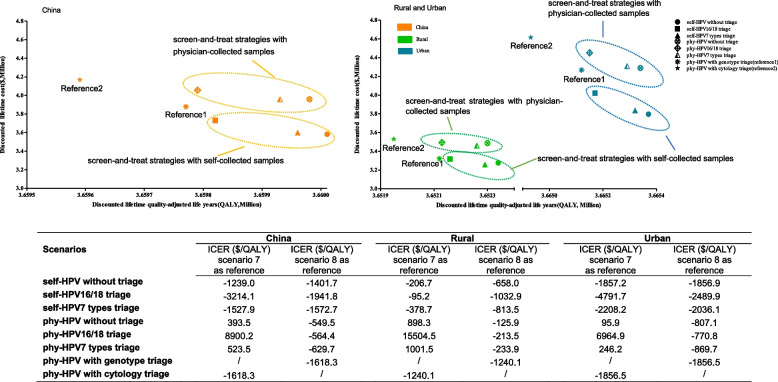
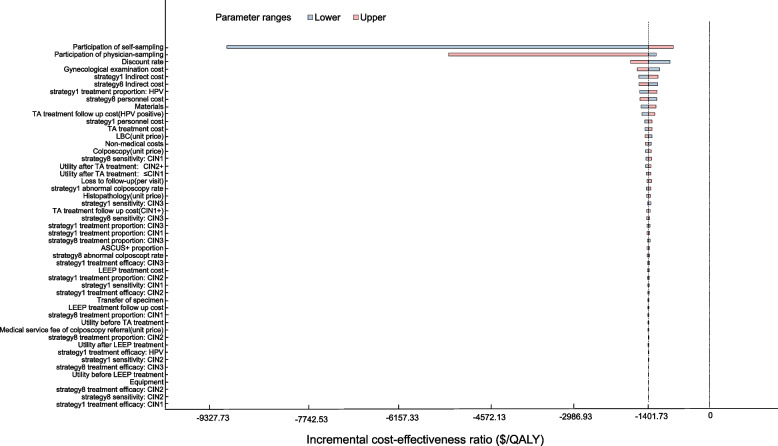
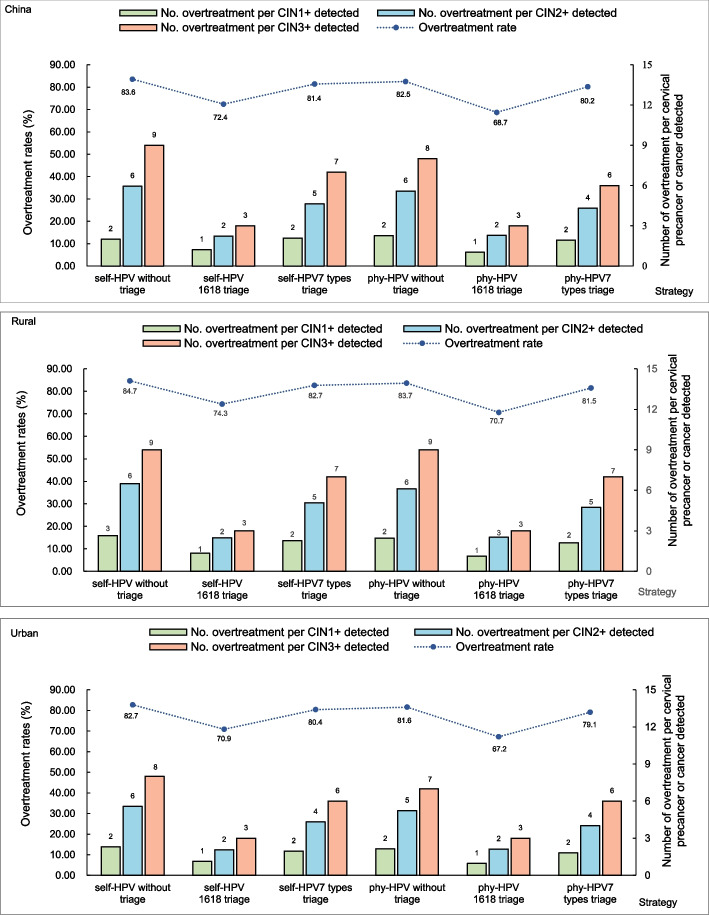
Compared with current strategies in China (physician-HPV with genotype or cytology triage), all screen-and-treat strategies are cost-effective and self-HPV without triage is optimal with the most incremental quality-adjusted life-years (QALYs) gained (220 to 440) in rural and urban China. Each screen-and-treat strategy based on self-collected samples is cost-saving compared with current strategies (-$818,430 to -$3540) whereas more costs are incurred using physician-collected samples compared with current physician-HPV with genotype triage (+$20,840 to +$182,840). For screen-and-treat strategies without triage, more costs (+$9404 to +$380,217) would be invested in the screening and treatment of precancerous lesions rather than the cancer treatment compared with the current screening strategies. Notably, however, more than 81.6% of HPV-positive women would be overtreated. If triaged with HPV 7 types or HPV16/18 genotypes, 79.1% or 67.2% (respectively) of HPV-positive women would be overtreated with fewer cancer cases avoided (19 cases or 69 cases).
Screen-and-treat strategy using self-sampling HPV test linked to thermal ablation could be the most cost-effective for cervical cancer prevention in China. Additional triage with quality-assured performance could reduce overtreatment and remains highly cost-effective compared with current strategies.
自我采样 HPV 检测和热消融是提高筛查覆盖率和治疗依从性以加速宫颈癌消除的有效工具。我们评估了将这两种方法结合起来的策略的成本效益,以制定可及、负担得起和可接受的宫颈癌预防策略。
我们从社会角度出发,建立了一个混合模型,以评估结合 HPV 检测(自我采样或医生采样)、分流方式(HPV 基因分型、阴道镜检查或无)和热消融的六种筛查和治疗策略的成本、健康结果和增量成本效益比(ICER)。考虑了一个指定的初始队列,即 2015 年出生的 10 万名女性。ICER 低于中国人均国内生产总值(GDP)(10350 美元)的策略被认为具有高度成本效益。
与中国目前的策略(医生-HPV 结合基因分型或细胞学分流)相比,所有筛查和治疗策略都是具有成本效益的,自我-HPV 无需分流是最优的,在中国农村和城市中获得的增量质量调整生命年(QALYs)最多(220 至 440)。与目前的策略相比,基于自我采集样本的每一种筛查和治疗策略都具有成本节约效应(-818430 美元至-3540 美元),而使用医生采集样本的成本则高于目前的医生-HPV 结合基因分型分流(+20840 美元至+182840 美元)。对于无需分流的筛查和治疗策略,与目前的筛查策略相比,在癌前病变的筛查和治疗方面投入的成本会更高(+9404 美元至+380217 美元),而癌症治疗方面的投入则会减少。然而,值得注意的是,超过 81.6%的 HPV 阳性女性将被过度治疗。如果使用 HPV7 型或 HPV16/18 基因型进行分流,79.1%或 67.2%(分别)的 HPV 阳性女性将被过度治疗,同时避免的癌症病例更少(19 例或 69 例)。
在中国,使用自我采样 HPV 检测结合热消融的筛查和治疗策略可能是最具成本效益的宫颈癌预防策略。与目前的策略相比,使用质量保证的性能进行额外的分流可以减少过度治疗,并且仍然具有高度的成本效益。