Alsaadi Entedar, Alghezi Dhafer, Jones Ian
Department of Microbiology, College of Medicine, University of Thi-Qar, Thi-Qar, Iraq.
Department of Biomedical Sciences, School of Biological Sciences, University of Reading, Reading, United Kingdom.
Iran J Microbiol. 2023 Feb;15(1):121-127. doi: 10.18502/ijm.v15i1.11926.
The causative agent of Middle East Respiratory Syndrome (MERS) is a zoonotic Coronavirus (MERS-CoV) identified in Saudi Arabia in 2012. The envelope (E) protein of MERS-CoV is a small viral protein which plays several essential roles during virus replication. To facilitate study of the structure and function of the E protein, recombinant MERS-CoV E protein was expressed using the baculovirus expression system.
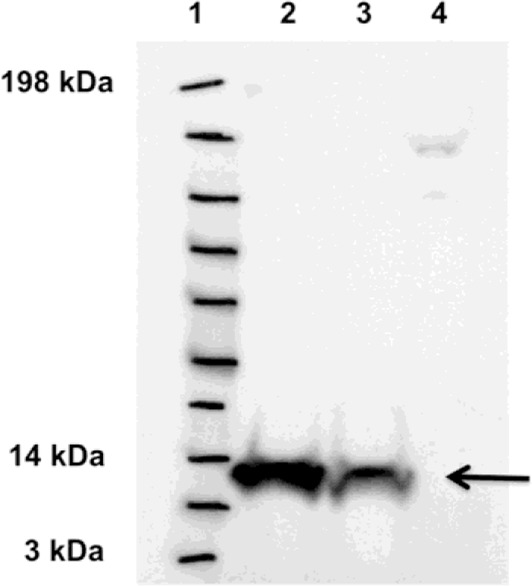
A recombinant E open reading frame including an 8-histidine tag at the amino terminus was designed and cloned into a baculovirus transfer vector. Following construction of a recombinant virus insect cells were infected and the expression of the E protein assessed by SDS-PAGE and Western blotting.
Recombinant E protein, tagged at the N-terminus with a polyhistidine sequence, with a molecular mass of 10.18 kD was identified by Western blotting with an anti-His antibody. Following large scale infection E protein was released by detergent mediated lysis of infected cells and purified by Immobilized Metal Ion Affinity Chromatography (IMAC).
Purified full length recombinant MERS-CoV E protein can be isolated by IMAC and is suitable for further functional, biophysical or immunological studies.
中东呼吸综合征(MERS)的病原体是2012年在沙特阿拉伯发现的一种人畜共患冠状病毒(MERS-CoV)。MERS-CoV的包膜(E)蛋白是一种小病毒蛋白,在病毒复制过程中发挥多种重要作用。为便于研究E蛋白的结构和功能,利用杆状病毒表达系统表达了重组MERS-CoV E蛋白。
设计了一个在氨基末端包含8个组氨酸标签的重组E开放阅读框,并将其克隆到杆状病毒转移载体中。构建重组病毒后,感染昆虫细胞,并通过SDS-PAGE和蛋白质印迹法评估E蛋白的表达。
用抗His抗体进行蛋白质印迹法鉴定出在N末端带有多组氨酸序列、分子量为10.18 kD的重组E蛋白。大规模感染后,通过去污剂介导的感染细胞裂解释放E蛋白,并通过固定化金属离子亲和色谱法(IMAC)进行纯化。
纯化的全长重组MERS-CoV E蛋白可通过IMAC分离,适用于进一步的功能、生物物理或免疫学研究。