Medical College, Weill Cornell Medicine, New York, NY, United States.
Department of Internal Medicine, Weill Cornell Medicine, New York, NY, United States.
JMIR Mhealth Uhealth. 2023 Apr 18;11:e45464. doi: 10.2196/45464.
Over the last decade, augmented reality (AR) has emerged in health care as a tool for visualizing data and enhancing simulation learning. AR, which has largely been explored for communication and collaboration in nonhealth contexts, could play a role in shaping future remote medical services and training. This review summarized existing studies implementing AR in real-time telemedicine and telementoring to create a foundation for health care providers and technology developers to understand future opportunities in remote care and education.
This review described devices and platforms that use AR for real-time telemedicine and telementoring, the tasks for which AR was implemented, and the ways in which these implementations were evaluated to identify gaps in research that provide opportunities for further study.
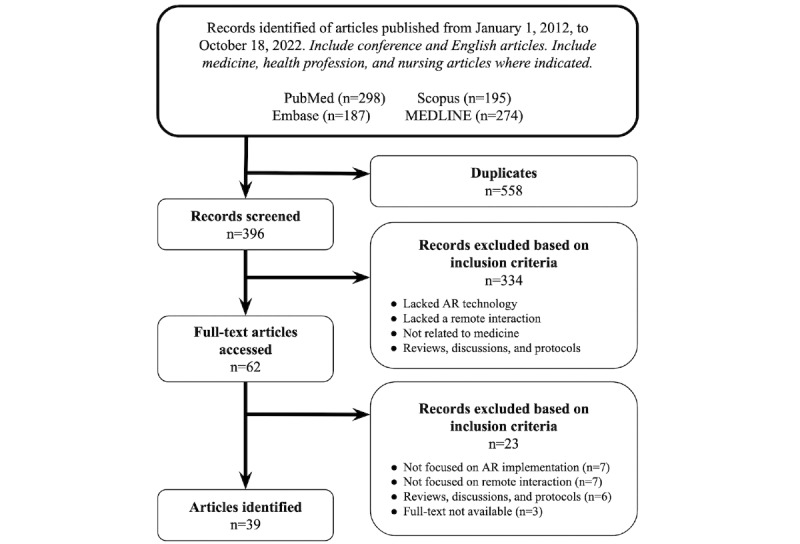
We searched PubMed, Scopus, Embase, and MEDLINE to identify English-language studies published between January 1, 2012, and October 18, 2022, implementing AR technology in a real-time interaction related to telemedicine or telementoring. The search terms were "augmented reality" OR "AR" AND "remote" OR "telemedicine" OR "telehealth" OR "telementoring." Systematic reviews, meta-analyses, and discussion-based articles were excluded from analysis.
A total of 39 articles met the inclusion criteria and were categorized into themes of patient evaluation, medical intervention, and education. In total, 20 devices and platforms using AR were identified, with common features being the ability for remote users to annotate, display graphics, and display their hands or tools in the local user's view. Common themes across the studies included consultation and procedural education, with surgery, emergency, and hospital medicine being the most represented specialties. Outcomes were most often measured using feedback surveys and interviews. The most common objective measures were time to task completion and performance. Long-term outcome and resource cost measurements were rare. Across the studies, user feedback was consistently positive for perceived efficacy, feasibility, and acceptability. Comparative trials demonstrated that AR-assisted conditions had noninferior reliability and performance and did not consistently extend procedure times compared with in-person controls.
Studies implementing AR in telemedicine and telementoring demonstrated the technology's ability to enhance access to information and facilitate guidance in multiple health care settings. However, AR's role as an alternative to current telecommunication platforms or even in-person interactions remains to be validated, with many disciplines and provider-to-nonprovider uses still lacking robust investigation. Additional studies comparing existing methods may offer more insight into this intersection, but the early stage of technical development and the lack of standardized tools and adoption have hindered the conduct of larger longitudinal and randomized controlled trials. Overall, AR has the potential to complement and advance the capabilities of remote medical care and learning, creating unique opportunities for innovator, provider, and patient involvement.
在过去的十年中,增强现实(AR)作为可视化数据和增强模拟学习的工具,在医疗保健领域崭露头角。AR 在非医疗环境中主要用于沟通和协作,它可能在塑造未来远程医疗服务和培训方面发挥作用。本综述总结了目前在实时远程医疗和远程指导中实施 AR 的研究,为医疗保健提供者和技术开发者了解远程护理和教育的未来机会奠定了基础。
本综述描述了用于实时远程医疗和远程指导的使用 AR 的设备和平台、实施 AR 的任务,以及评估这些实施的方法,以确定研究中的差距,为进一步研究提供机会。
我们在 PubMed、Scopus、Embase 和 MEDLINE 中搜索了 2012 年 1 月 1 日至 2022 年 10 月 18 日期间发表的与远程医疗或远程指导相关的实时交互中实施 AR 技术的英语语言研究。搜索词为“augmented reality”或“AR”和“remote”或“telemedicine”或“telehealth”或“telementoring”。系统评价、荟萃分析和基于讨论的文章被排除在分析之外。
共有 39 篇文章符合纳入标准,并分为患者评估、医疗干预和教育三个主题。共有 20 种使用 AR 的设备和平台被确定,其共同特点是远程用户能够注释、显示图形,并在本地用户视图中显示他们的手或工具。研究中的常见主题包括咨询和程序教育,外科、急诊和医院医学是最具代表性的专业。结果主要通过反馈调查和访谈进行测量。最常见的客观测量是任务完成时间和绩效。长期结果和资源成本测量很少。在研究中,用户反馈一直对感知效果、可行性和可接受性持积极态度。比较试验表明,AR 辅助条件的可靠性和性能不劣于面对面控制条件,且并不总是延长手术时间。
在远程医疗和远程指导中实施 AR 的研究表明,该技术能够增强信息获取能力,并在多个医疗保健环境中提供指导。然而,AR 作为当前远程通信平台甚至面对面交互的替代方案的作用仍有待验证,许多学科和医患用途仍缺乏强有力的研究。比较现有方法的进一步研究可能会提供更多关于这一交叉领域的信息,但技术的早期发展阶段以及缺乏标准化工具和采用阻碍了更大规模的纵向和随机对照试验的开展。总的来说,AR 有可能补充和推进远程医疗和学习的能力,为创新者、提供者和患者的参与创造独特的机会。