Hess Olivia, Qian Jimmy, Bruce Janine, Wang Ellen, Rodriguez Samuel, Haber Nick, Caruso Thomas J
Department of Anesthesiology, Perioperative, and Pain Medicine, Stanford University School of Medicine, 300 Pasteur Way, H3580, MC 5640, Stanford, 94304 CA USA.
Department of Pediatrics, Stanford University School of Medicine, Stanford, CA USA.
Med Sci Educ. 2022 Aug 4;32(5):1005-1014. doi: 10.1007/s40670-022-01598-7. eCollection 2022 Oct.
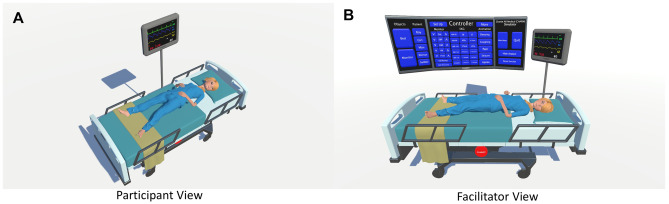
Augmented reality (AR) has promise as a clinical teaching tool, particularly for remote learning. The Chariot Augmented Reality Medical (CHARM) simulator integrates real-time communication into a portable medical simulator with a holographic patient and monitor. The primary aim was to analyze feedback from medical and physician assistant students regarding acceptability and feasibility of the simulator.
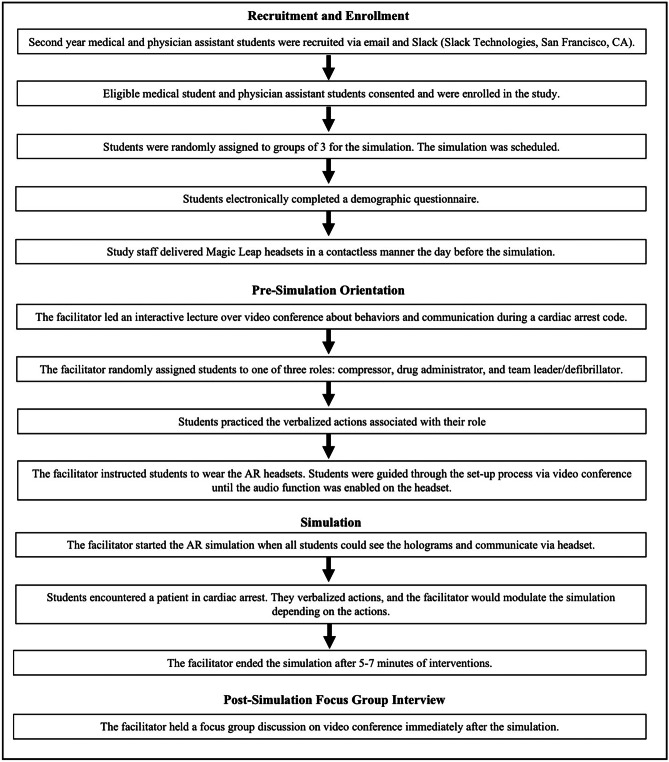
Using the CHARM simulator, we created an advanced cardiovascular life support (ACLS) simulation scenario. After IRB approval, preclinical medical and physician assistant students volunteered to participate from August to September 2020. We delivered augmented reality headsets (Magic Leap One) to students before the study. Prior to the simulation, via video conference, we introduced students to effective communication skills during a cardiac arrest. Participants then, individually and remotely from their homes, synchronously completed an instructor-led ACLS AR simulation in groups of three. After the simulation, students participated in a structured focus group using a qualitative interview guide. Our study team coded their responses and interpreted them using team-based thematic analysis.
Eighteen medical and physician assistant students participated. We identified four domains that reflected trainee experiences: experiential satisfaction, learning engagement, technology learning curve, and opportunities for improvement. Students reported that the simulator was acceptable and enjoyable for teaching trainees communication skills; however, there were some technical difficulties associated with initial use.
This study suggests that multiplayer AR is a promising and feasible approach for remote medical education of communication skills during medical crises.
The online version contains supplementary material available at 10.1007/s40670-022-01598-7.
增强现实(AR)有望成为一种临床教学工具,特别是对于远程学习而言。Chariot增强现实医疗(CHARM)模拟器将实时通信集成到一个带有全息患者和监视器的便携式医疗模拟器中。主要目的是分析医学和医师助理专业学生对该模拟器的可接受性和可行性的反馈。
我们使用CHARM模拟器创建了一个高级心血管生命支持(ACLS)模拟场景。在获得机构审查委员会(IRB)批准后,临床前医学和医师助理专业学生于2020年8月至9月自愿参与。在研究前,我们向学生提供了增强现实头戴设备(Magic Leap One)。在模拟之前,通过视频会议,我们向学生介绍了心脏骤停期间的有效沟通技巧。然后,参与者各自在家中远程以三人一组的形式同步完成了由教师主导的ACLS AR模拟。模拟结束后,学生们使用定性访谈指南参加了一个结构化焦点小组。我们的研究团队对他们的回答进行编码,并使用基于团队的主题分析进行解释。
18名医学和医师助理专业学生参与了研究。我们确定了四个反映学员体验的领域:体验满意度、学习参与度、技术学习曲线和改进机会。学生们报告说,该模拟器对于培训学员的沟通技巧是可接受且有趣的;然而,初始使用存在一些技术困难。
本研究表明,多人AR是在医疗危机期间进行远程医学沟通技能教育的一种有前景且可行的方法。
在线版本包含可在10.1007/s40670-022-01598-7获取的补充材料。