Center of Medical Genetics, University of Antwerp and Antwerp University Hospital, Prins Boudewijnlaan 43, Edegem, Belgium.
Center of Oncological Research (CORE), University of Antwerp, Universiteitsplein 1, Wilrijk, Belgium.
Oncologist. 2023 Jun 2;28(6):e331-e340. doi: 10.1093/oncolo/oyad074.
Patients with left-sided colorectal cancer (L-CRC) are known to have a significantly better prognosis than those with right-sided CRC (R-CRC). It has been hypothesized that RAS, BRAF mutations, or deficient mismatch repair status (MMR) might be responsible for the prognostic effect of primary tumor location (PTL). This study aims to evaluate the prognostic effect of PTL in the Belgian population and to determine the role of biomarkers (MMR, BRAF, and RAS status) in this effect.
We performed a retrospective analysis of Belgian Cancer Registry data. First, we studied the prognostic effect of PTL on 5-year relative survival of 91,946 patients diagnosed with CRC (all stages) from 2004-2015. Second, we investigated the interaction between biomarkers and the prognostic effect of PTL in 1818 patients diagnosed with stage IV CRC in 2014-2015.
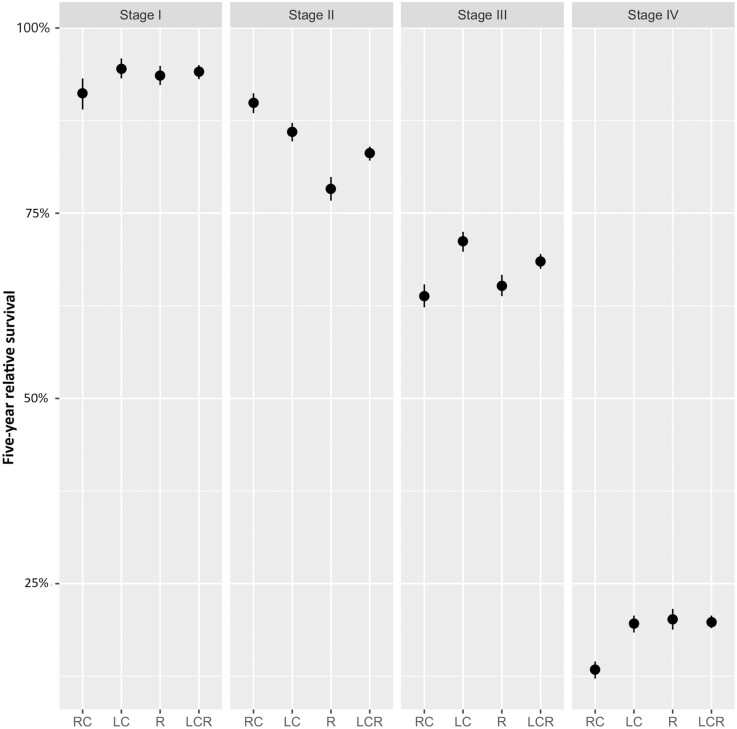
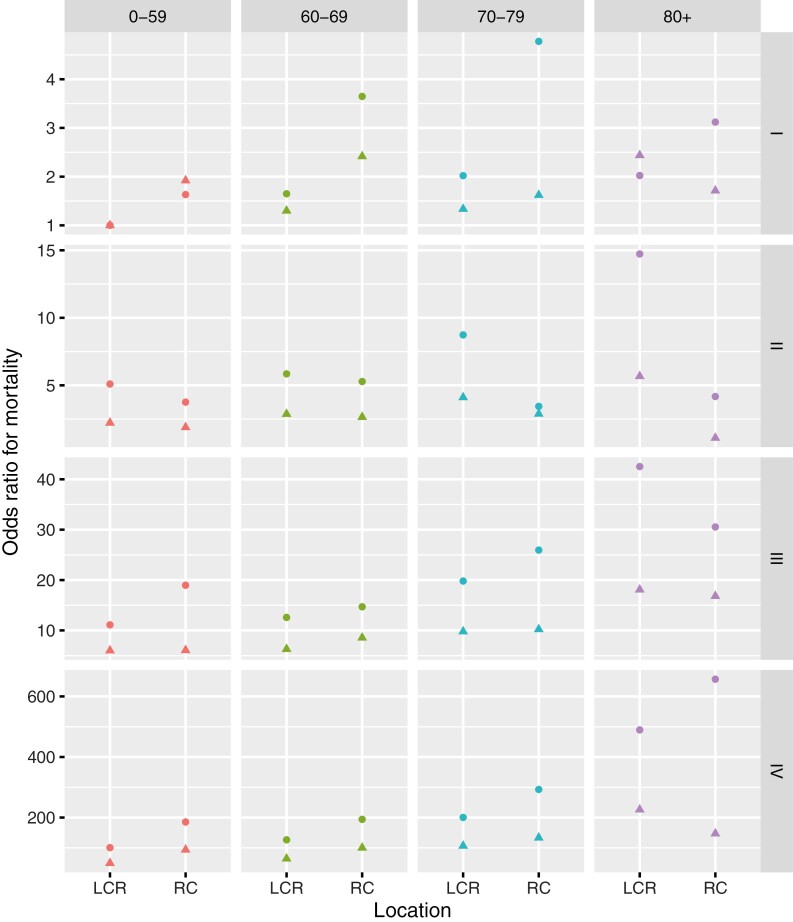
L-CRC was associated with a significantly better 5-year relative survival compared to R-CRC in all stages and ages combined (68.4%, 95% CI, 67.7-69.1% vs 65.6%, 95% CI, 64.7-66.4%). Also, when stratified by age, sex, and stage, the prognosis of L-CRC was better compared to R-CRC in most subgroups. Only in stage II and certain subgroups of elderly patients, the opposite was observed. Furthermore, our data showed that none of the biomarkers had a significant interaction with the effect of PTL on survival.
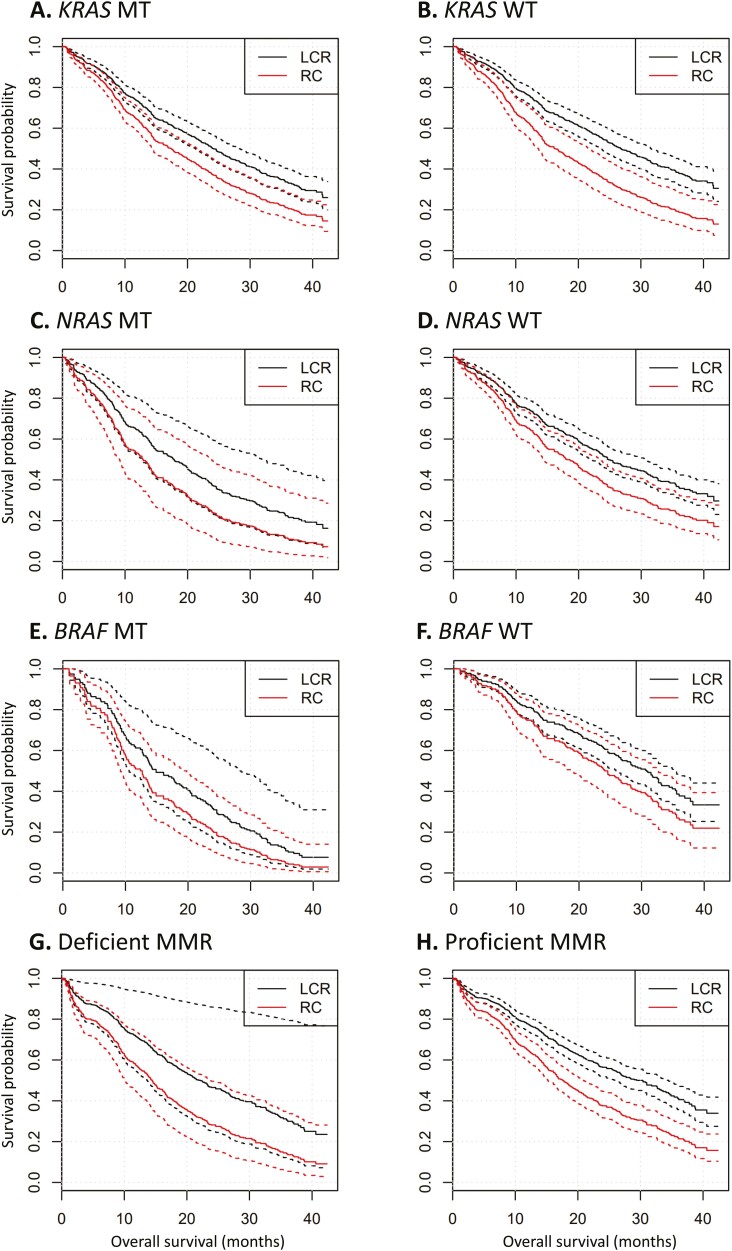
This population-based study confirms that L-CRC is associated with significantly better relative survival compared to R-CRC, in all stages and ages combined. Furthermore, in stage IV L-CRC is associated with a longer survival than R-CRC, regardless of MMR, RAS, and BRAF status.
左侧结直肠癌(L-CRC)患者的预后明显优于右侧结直肠癌(R-CRC)患者。有人假设 RAS、BRAF 突变或错配修复状态(MMR)缺陷可能是原发肿瘤位置(PTL)对预后影响的原因。本研究旨在评估比利时人群中 PTL 的预后作用,并确定生物标志物(MMR、BRAF 和 RAS 状态)在这种作用中的作用。
我们对比利时癌症登记处的数据进行了回顾性分析。首先,我们研究了 PTL 对 2004-2015 年间诊断为 CRC(所有阶段)的 91946 例患者的 5 年相对生存率的预后作用。其次,我们在 2014-2015 年间诊断为 IV 期 CRC 的 1818 例患者中调查了生物标志物与 PTL 预后作用之间的相互作用。
在所有阶段和年龄组合中,L-CRC 与 R-CRC 相比,5 年相对生存率显著提高(68.4%,95%CI,67.7-69.1%比 65.6%,95%CI,64.7-66.4%)。此外,按年龄、性别和分期分层时,L-CRC 在大多数亚组中的预后均优于 R-CRC。只有在 II 期和某些老年患者亚组中,情况相反。此外,我们的数据表明,生物标志物均未与 PTL 对生存的影响产生显著交互作用。
这项基于人群的研究证实,在所有阶段和年龄组合中,L-CRC 的相对生存率明显优于 R-CRC。此外,在 IV 期,无论 MMR、RAS 和 BRAF 状态如何,L-CRC 的生存时间均长于 R-CRC。