Department of Orthopedic Surgery, Chang Gung Memorial Hospital, Linkou, Taiwan, No. 5, Fuxing St., Guishan Dist., Taoyuan City, Taiwan.
College of Medicine, Chang Gung University, Taoyuan, Taiwan.
BMC Musculoskelet Disord. 2023 Apr 18;24(1):302. doi: 10.1186/s12891-023-06413-x.
The advantages of unicompartmental knee arthroplasty (UKA) have led to the procedure being increasingly performed worldwide. However, revision surgery is required after UKA failure. According to the literature review, the choice of implant in revision surgery remains a debatable concern. This study analyzed the clinical results of different types of prostheses used in treating failed UKA.
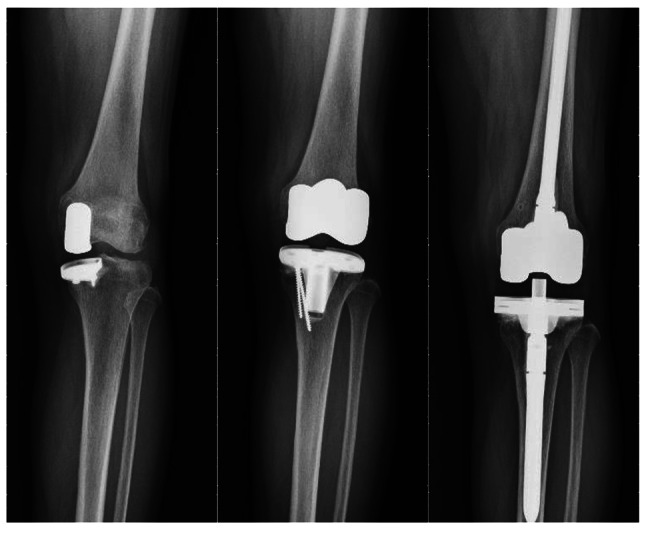
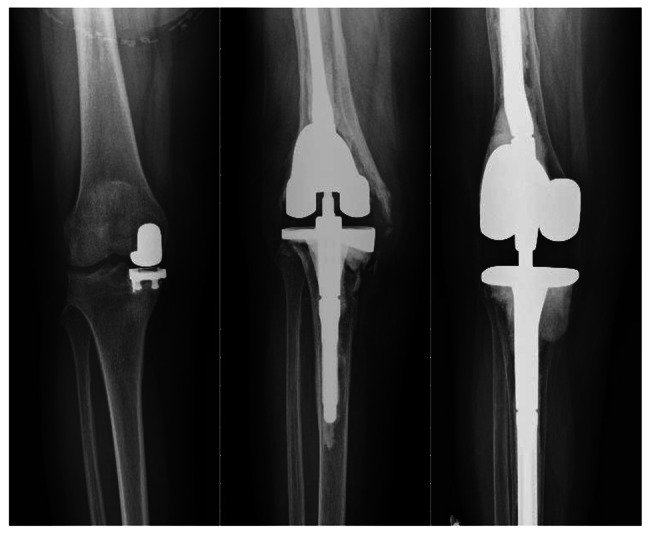
This is a retrospective review of 33 failed medial UKAs between 2006 and 2017. Demographic data, failure reason, types of revision prostheses, and the severity of bone defects were analyzed. The patients were classified into three groups: primary prosthesis, primary prosthesis with a tibial stem, and revision prosthesis. The implant survival rate and medical cost of the procedures were compared.
A total of 17 primary prostheses, 7 primary prostheses with tibial stems, and 9 revision prostheses were used. After a mean follow-up of 30.8 months, the survival outcomes of the three groups were 88.2%, 100%, and 88.9%, respectively (P = 0.640). The common bone defect in tibia site is Anderson Orthopedic Research Institute [AORI] grade 1 and 2a (16 versus 17). In patients with tibial bone defects AORI grade 2a, the failure rates of primary prostheses and primary prostheses with tibial stems were 25% and 0%, respectively.
The most common cause for UKA failure was aseptic loosening. The adoption of a standardized surgical technique makes it easier to perform revision surgeries. Primary prostheses with tibial stems provided higher stability, leading to a lower failure rate due to less risk of aseptic loosening in patients with tibial AORI grade 2a. In our experience, we advise surgeons may try using primary prostheses in patients with tibial AORI grade 1 and primary prostheses with tibial stems in patients with tibial AORI grade 2a.
单髁膝关节置换术(UKA)的优势使得该手术在全球范围内的应用越来越广泛。然而,UKA 失败后需要进行翻修手术。根据文献回顾,翻修手术中植入物的选择仍然是一个有争议的问题。本研究分析了不同类型假体治疗失败 UKA 的临床结果。
这是对 2006 年至 2017 年间 33 例内侧 UKA 失败患者的回顾性分析。分析了患者的人口统计学数据、失败原因、翻修假体类型和骨缺损严重程度。患者分为三组:初次假体、初次假体加胫骨柄和翻修假体。比较了三种手术方法的假体生存率和医疗费用。
共使用 17 个初次假体、7 个带胫骨柄的初次假体和 9 个翻修假体。平均随访 30.8 个月后,三组的生存率分别为 88.2%、100%和 88.9%(P=0.640)。胫骨部位常见的骨缺损为安德森骨科研究协会(AORI)分级 1 和 2a(16 例和 17 例)。胫骨骨缺损 AORI 分级 2a 的患者中,初次假体和带胫骨柄的初次假体的失败率分别为 25%和 0%。
UKA 失败的最常见原因是无菌性松动。采用标准化的手术技术使翻修手术更容易进行。带胫骨柄的初次假体提供了更高的稳定性,降低了胫骨 AORI 分级 2a 患者发生无菌性松动的风险,从而降低了失败率。根据我们的经验,我们建议对于胫骨 AORI 分级 1 的患者,可尝试使用初次假体;对于胫骨 AORI 分级 2a 的患者,可尝试使用带胫骨柄的初次假体。