Department of Trauma Surgery, University Hospital Regensburg, Franz-Josef-Strauß-Allee 11, 93053, Regensburg, Germany.
Exponent Inc, Menlo Park, CA, USA.
J Orthop Surg Res. 2021 Nov 12;16(1):666. doi: 10.1186/s13018-021-02767-x.
Unicompartimental knee arthroplasty (UKA) is a promising and increasing application to treat unicompartimental knee osteoarthritis. However, revision arthroplasty numbers after UKA are unknown. Therefore, aim of this study was to determine the nationwide burden of revision after UKA by answering the following questions: (1) How did numbers of revision UKA procedures developed over the last decade as a function of age and gender? (2) How high is the percentage of revision UKA procedures due to infection? (3) Which therapy strategy was chosen for surgical treatment of aseptic revision UKA?
Revision arthroplasty rates as a function of age, gender, infection and type of prosthesis were quantified based on Operation and Procedure Classification System codes using revision knee arthroplasty data from 2008 to 2018, provided by the Federal Statistical Office of Germany (Destatis).
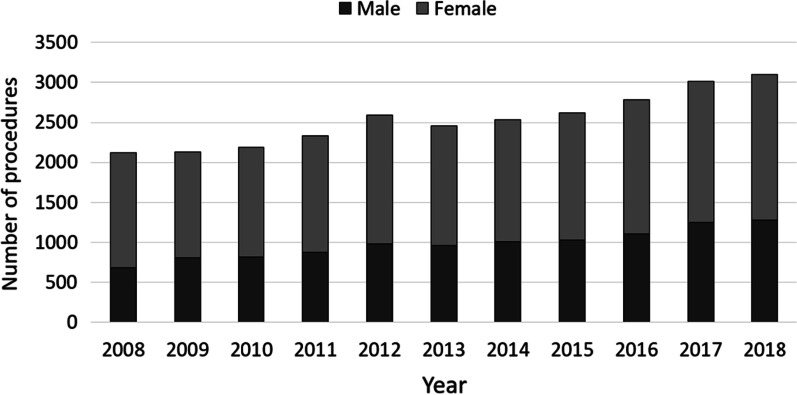
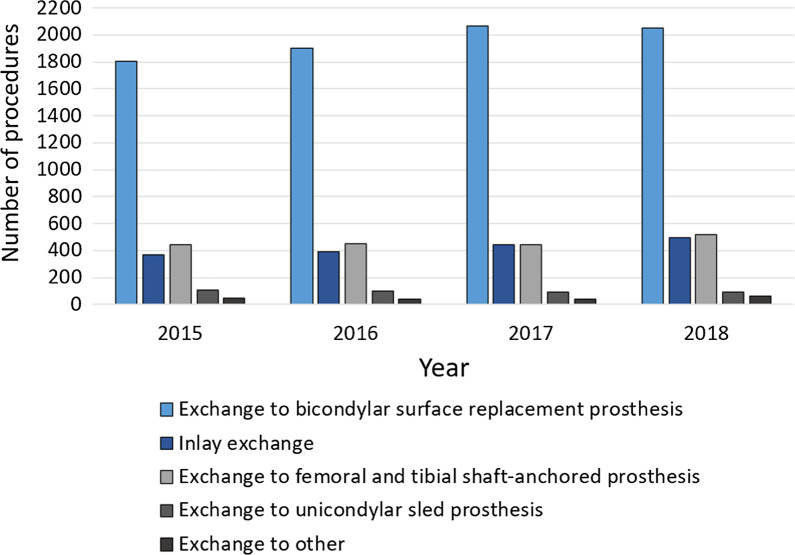
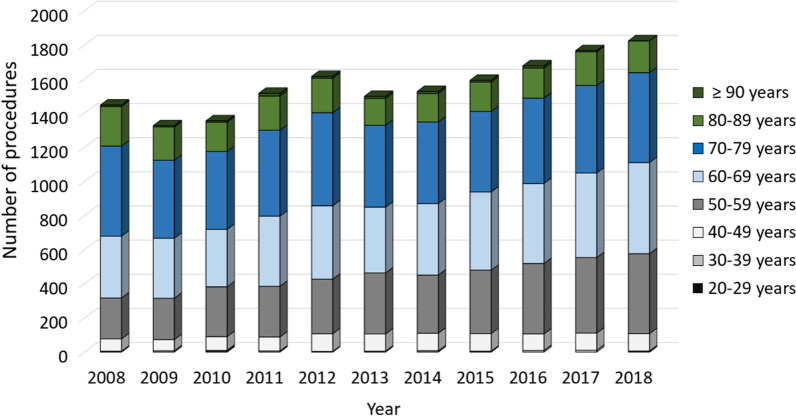
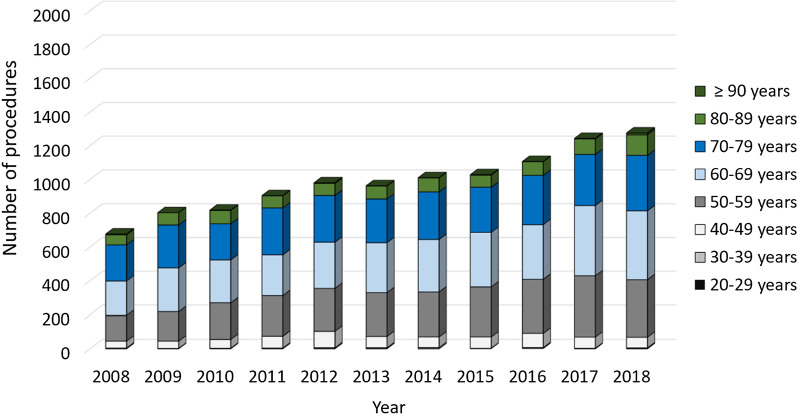
Over the last decade, revision UKA increased by 46.3% up to 3105 procedures in 2018. A trend towards higher numbers in younger patients was observed. Septic interventions constituted 5.7% of all revisions, whereby total procedures increased by 67.1% from 2008 through 2018. The main treatment strategy was an exchange to a bicondylar surface replacement prosthesis, which was done in 63.70% of all cases, followed by exchange to a femoral and tibial shaft-anchored (16.2% of all revisions).
The increasing number of revision arthroplasty after UKA in Germany, especially in younger patients and due to infection, underlines the need for future efforts to improve treatment strategies beyond UKA to delay primary arthroplasty and avoid periprosthetic joint infection.
单髁膝关节置换术(UKA)是一种有前途且日益广泛应用于治疗单间室膝关节骨关节炎的方法。然而,UKA 后翻修手术的数量尚不清楚。因此,本研究旨在通过回答以下问题来确定 UKA 后翻修的全国负担:(1)在过去十年中,UKA 翻修手术数量如何随年龄和性别而发展?(2)因感染而进行 UKA 翻修的比例是多少?(3)无菌性 UKA 翻修的手术治疗选择哪种治疗策略?
根据德国联邦统计局(Destatis)提供的 2008 年至 2018 年的翻修膝关节置换术数据,使用手术和操作分类系统代码,根据年龄、性别、感染和假体类型量化翻修率。
在过去十年中,UKA 翻修增加了 46.3%,2018 年达到 3105 例。观察到年轻患者数量呈上升趋势。感染性干预占所有翻修术的 5.7%,其中 2008 年至 2018 年总手术量增加了 67.1%。主要治疗策略是更换为双髁表面置换假体,在所有病例中占 63.70%,其次是更换为股骨和胫骨柄-锚定假体(所有翻修术的 16.2%)。
德国 UKA 后翻修手术数量的增加,特别是在年轻患者中以及由于感染引起的翻修手术增加,强调了未来需要努力改进 UKA 以外的治疗策略,以延迟初次关节置换并避免假体周围关节感染。