Museum of Vertebrate Zoology, University of California, Berkeley, CA 94720, USA.
Department of Integrative Biology, University of California, Berkeley, CA 94720, USA.
Syst Biol. 2023 Aug 7;72(4):885-911. doi: 10.1093/sysbio/syad020.
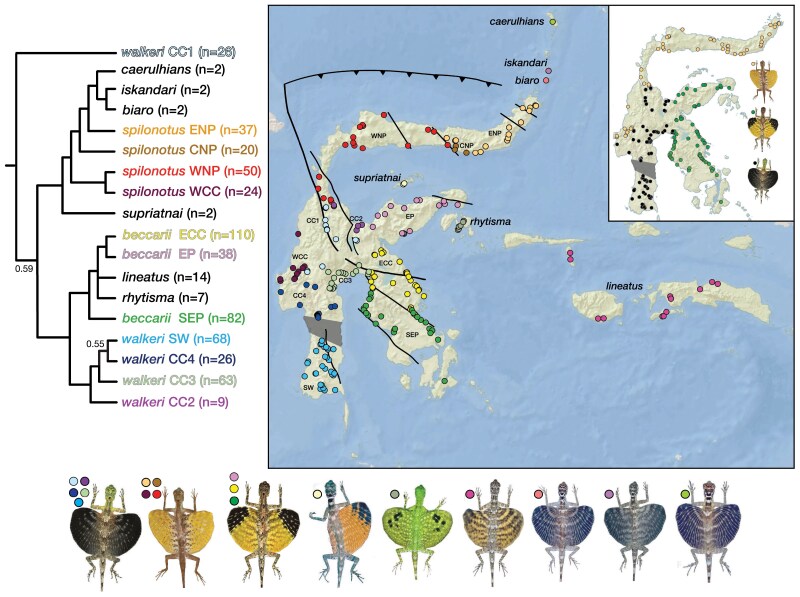
The biota of Sulawesi is noted for its high degree of endemism and for its substantial levels of in situ biological diversification. While the island's long period of isolation and dynamic tectonic history have been implicated as drivers of the regional diversification, this has rarely been tested in the context of an explicit geological framework. Here, we provide a tectonically informed biogeographical framework that we use to explore the diversification history of Sulawesi flying lizards (the Draco lineatus Group), a radiation that is endemic to Sulawesi and its surrounding islands. We employ a framework for inferring cryptic speciation that involves phylogeographic and genetic clustering analyses as a means of identifying potential species followed by population demographic assessment of divergence-timing and rates of bi-directional migration as means of confirming lineage independence (and thus species status). Using this approach, phylogenetic and population genetic analyses of mitochondrial sequence data obtained for 613 samples, a 50-SNP data set for 370 samples, and a 1249-locus exon-capture data set for 106 samples indicate that the current taxonomy substantially understates the true number of Sulawesi Draco species, that both cryptic and arrested speciations have taken place, and that ancient hybridization confounds phylogenetic analyses that do not explicitly account for reticulation. The Draco lineatus Group appears to comprise 15 species-9 on Sulawesi proper and 6 on peripheral islands. The common ancestor of this group colonized Sulawesi ~11 Ma when proto-Sulawesi was likely composed of two ancestral islands, and began to radiate ~6 Ma as new islands formed and were colonized via overwater dispersal. The enlargement and amalgamation of many of these proto-islands into modern Sulawesi, especially during the past 3 Ma, set in motion dynamic species interactions as once-isolated lineages came into secondary contact, some of which resulted in lineage merger, and others surviving to the present. [Genomics; Indonesia; introgression; mitochondria; phylogenetics; phylogeography; population genetics; reptiles.].
苏拉威西的生物群以其高度的特有性和大量原地生物多样化而闻名。虽然该岛长期的隔离和动态构造历史被认为是区域多样化的驱动因素,但这在明确的地质框架背景下很少得到检验。在这里,我们提供了一个受构造影响的生物地理框架,我们用它来探索苏拉威西飞蜥(Draco lineatus 组)的多样化历史,这是一个特有的苏拉威西及其周围岛屿的辐射。我们采用了一种推断隐种形成的框架,该框架涉及系统地理学和遗传聚类分析,作为识别潜在物种的一种手段,然后对种群的分歧时间和双向迁移率进行人口统计学评估,以确认谱系独立性(因此是物种地位)。使用这种方法,对从 613 个样本中获得的线粒体序列数据、370 个样本的 50-SNP 数据集和 106 个样本的 1249 个外显子捕获数据集进行的系统发育和种群遗传分析表明,当前的分类法大大低估了苏拉威西 Draco 物种的真实数量,既发生了隐种形成,也发生了停滞的物种形成,而且古老的杂交使不明确考虑基因流的系统发育分析变得复杂。Draco lineatus 组似乎由 15 个物种组成,其中 9 个在苏拉威西本岛上,6 个在周边岛屿上。该组的共同祖先于 1100 万年前殖民苏拉威西,当时原始苏拉威西可能由两个祖先岛屿组成,600 万年前开始辐射,当时新的岛屿形成并通过水上扩散进行殖民。这些原始岛屿中的许多岛屿在过去 300 万年内扩大和合并,形成了现代苏拉威西,这引发了动态的物种相互作用,曾经孤立的谱系重新接触,其中一些导致谱系合并,而另一些则存活至今。[基因组学;印度尼西亚;基因渗透;线粒体;系统发生学;系统地理学;种群遗传学;爬行动物。]。