Department of Physiology and Biophysics, Case Western Reserve University, Cleveland, Ohio, USA.
Department of Physiology and Biophysics, Case Western Reserve University, Cleveland, Ohio, USA.
J Biol Chem. 2023 Jun;299(6):104722. doi: 10.1016/j.jbc.2023.104722. Epub 2023 Apr 17.
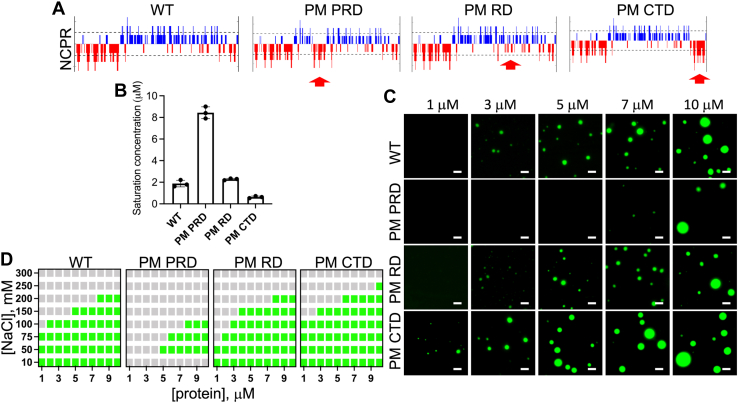
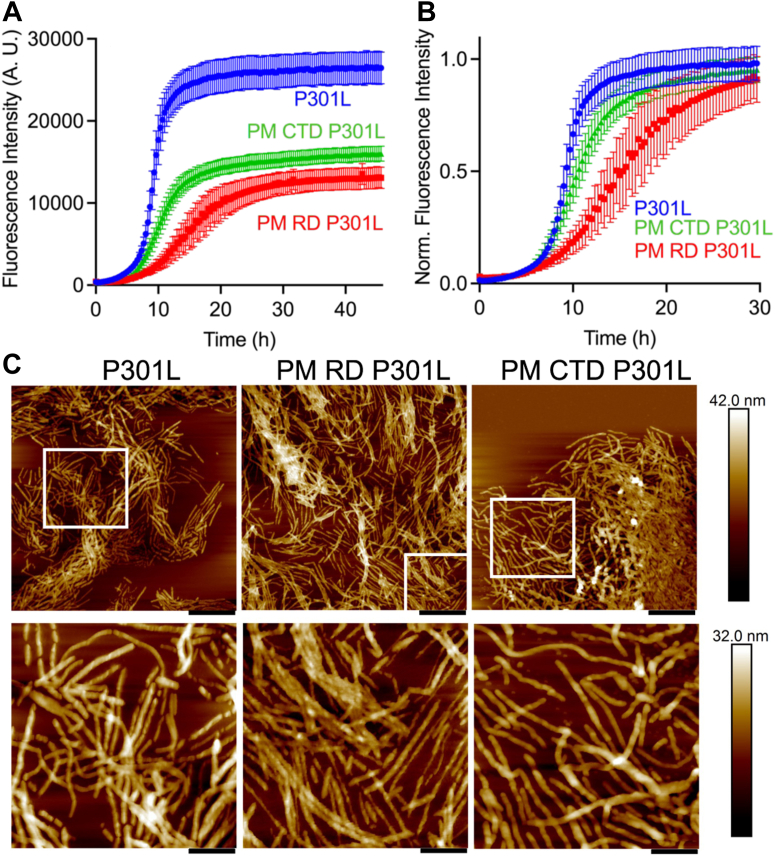
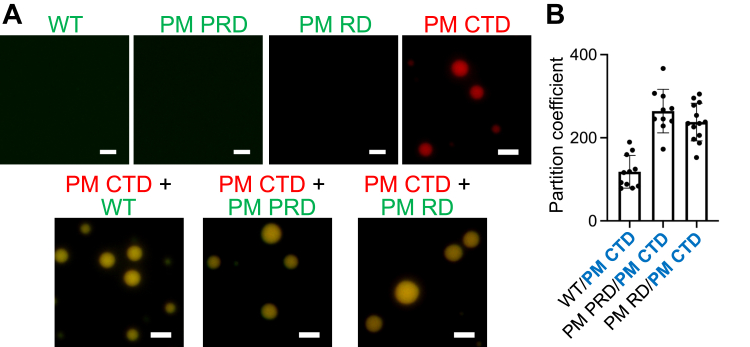
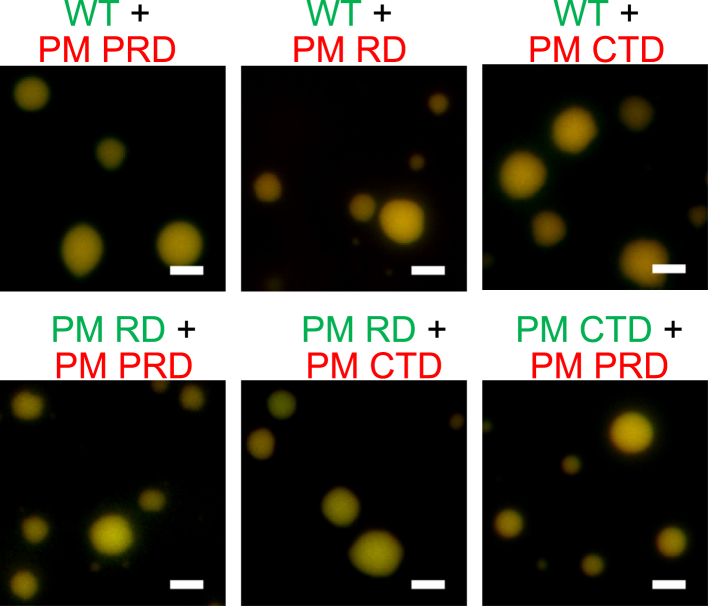
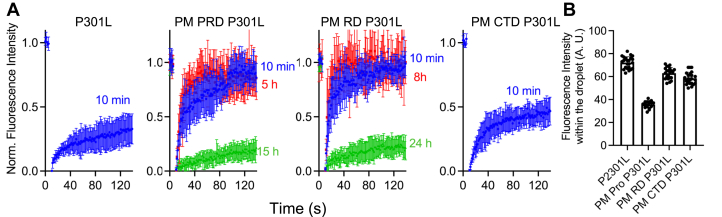
Aggregation of tau is one of the major pathogenic events in Alzheimer's disease and several other neurodegenerative disorders. Recent reports demonstrated that tau can condense into liquid droplets that undergo time-dependent transition to a solid-like state, suggesting that liquid condensates may be on the pathway to pathological aggregation of tau. While hyperphosphorylation is a key feature of tau isolated from brains of patients with Alzheimer's disease and other tauopathies, the mechanistic role of phosphorylation in tau liquid-liquid phase separation (LLPS) remains largely unexplored. In an attempt to bridge this gap, here we performed systematic studies by introducing phosphomimetic substitutions of Ser/Thr residues with negatively charged Asp/Glu residues in different regions of the protein. Our data indicate that the phosphorylation patterns that increase the polarization of charge distribution in full-length tau (tau441) promote protein LLPS, whereas those that decrease charge polarization have an opposite effect. Overall, this study further supports the notion that tau LLPS is driven by attractive intermolecular electrostatic interactions between the oppositely charged domains. We also show that the phosphomimetic tau variants with low intrinsic propensity for LLPS can be efficiently recruited to droplets formed by the variants with high LLPS propensity. Furthermore, the present data demonstrate that phosphomimetic substitutions have a major effect on time-dependent material properties of tau droplets, generally slowing down their aging. The latter effect is most dramatic for the tau variant with substitutions within the repeat domain, which correlates with the decreased fibrillation rate of this variant.
tau 的聚集是阿尔茨海默病和其他几种神经退行性疾病的主要致病事件之一。最近的报告表明,tau 可以凝聚成液滴,这些液滴会随着时间的推移发生向类似固体的状态的转变,这表明液滴可能是 tau 病理性聚集的途径。虽然过度磷酸化是从阿尔茨海默病和其他 tau 病患者大脑中分离出的 tau 的一个关键特征,但磷酸化在 tau 液-液相分离 (LLPS) 中的机制作用在很大程度上仍未得到探索。为了弥补这一空白,我们在这里通过在蛋白质的不同区域用带负电荷的 Asp/Glu 残基替代 Ser/Thr 残基上的磷酸化模拟物进行了系统研究。我们的数据表明,增加全长 tau(tau441)电荷分布极化的磷酸化模式促进了蛋白质的 LLPS,而降低电荷极化的磷酸化模式则有相反的效果。总的来说,这项研究进一步支持了 tau LLPS 是由带相反电荷的结构域之间的吸引力分子间静电相互作用驱动的观点。我们还表明,低固有 LLPS 倾向的磷酸化 tau 变体可以有效地被招募到具有高 LLPS 倾向的变体形成的液滴中。此外,目前的数据表明,磷酸化模拟物对 tau 液滴的时变材料特性有重大影响,通常会减缓其老化。对于重复结构域内有取代的 tau 变体,这种效应最为显著,这与该变体的纤维化速率降低有关。