Department of Biotechnology and Life Science, University of Insubria, Via Dunant, 3, 21100, Varese, Italy.
Department of Biosciences, Biotechnologies and Environment, University of Bari Aldo Moro, Piazza Umberto I, 70121, Bari, Italy.
Sci Rep. 2023 Apr 19;13(1):6380. doi: 10.1038/s41598-023-33580-7.
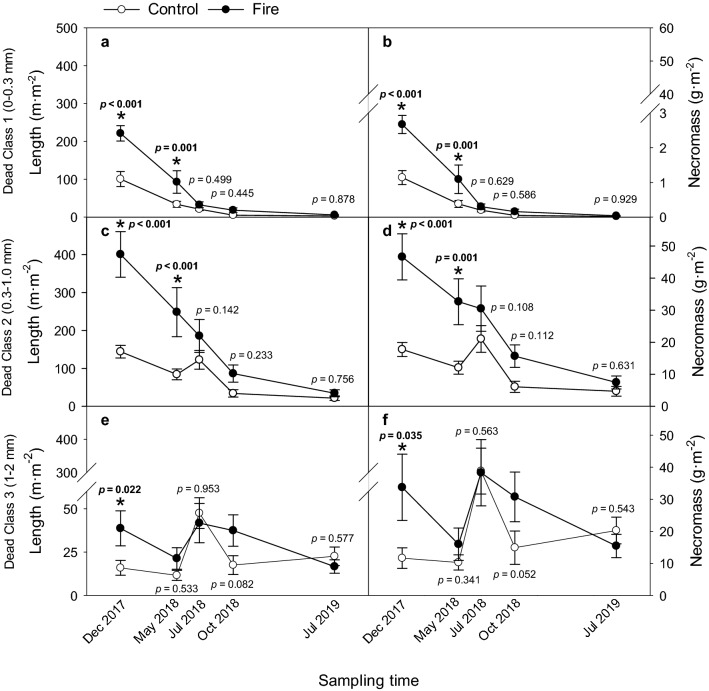
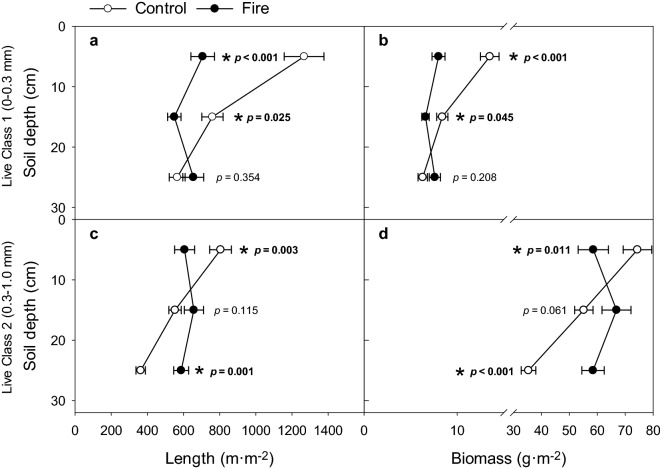
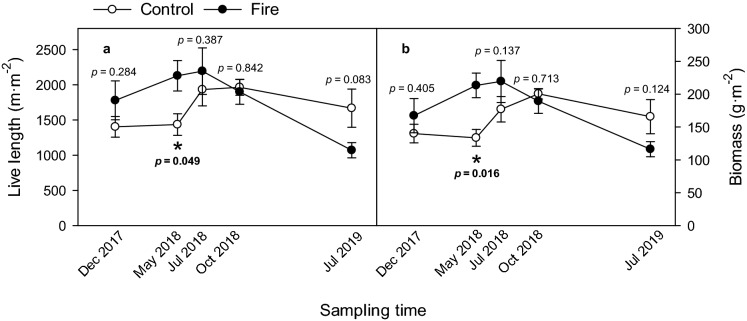
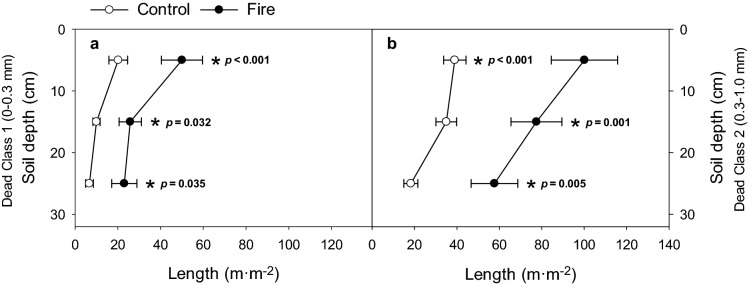
After an unusual, late-fall wildfire in a European beech (Fagus sylvatica L.) forest in the pre-Alps of northern Italy, the finest roots (0‒0.3 mm diameter) were generally the most responsive to fire, with the effect more pronounced at the shallowest soil depth. While roots 0.3‒1 mm in diameter had their length and biomass at the shallowest soil depth reduced by fire, fire stimulated more length and biomass at the deepest soil depth compared to the control. Fire elevated the total length of dead roots and their biomass immediately and this result persisted through the first spring, after which control and fire-impacted trees had similar fine root turnover. Our results unveiled the fine-root response to fire when subdivided by diameter size and soil depth, adding to the paucity of data concerning fire impacts on beech roots in a natural condition and providing the basis for understanding unusual fire occurrence on root traits. This study suggests that F. sylvatica trees can adapt to wildfire by plastically changing the distribution of fine-root growth, indicating a resilience mechanism to disturbance.
在意大利北部阿尔卑斯山前的一片欧洲山毛榉(Fagus sylvatica L.)林发生一场罕见的深秋野火后,最细的根(0-0.3 毫米直径)通常对火灾的反应最为敏感,在最浅的土壤深度处的效果更为明显。虽然直径 0.3-1 毫米的根在最浅的土壤深度处的长度和生物量减少了,但与对照相比,火在最深的土壤深度处刺激了更多的长度和生物量。与对照相比,火增加了死根的总长度及其生物量,这一结果一直持续到第一个春季,之后对照和受火影响的树木的细根周转率相似。我们的研究结果揭示了按直径大小和土壤深度细分的细根对火灾的反应,增加了有关自然条件下山毛榉根受火灾影响的数据的缺乏,并为理解根特征异常火灾的发生提供了基础。本研究表明,欧洲山毛榉树可以通过改变细根生长的分布来适应野火,这表明了一种对干扰的恢复机制。