Department of Neurobiology, Care Sciences and Society, Division of Clinical Geriatrics, Karolinska Institutet, Stockholm, Sweden.
Department of Physics, Goteborg University, Goteborg, Sweden.
Alzheimers Res Ther. 2023 Apr 19;15(1):82. doi: 10.1186/s13195-023-01228-3.
The medial parietal cortex is an early site of pathological protein deposition in Alzheimer's disease (AD). Previous studies have identified different subregions within this area; however, these subregions are often heterogeneous and disregard individual differences or subtle pathological alterations in the underlying functional architecture. To address this limitation, here we measured the continuous connectivity gradients of the medial parietal cortex and assessed their relationship with cerebrospinal fluid (CSF) biomarkers, ApoE ε4 carriership and memory in asymptomatic individuals at risk to develop AD.
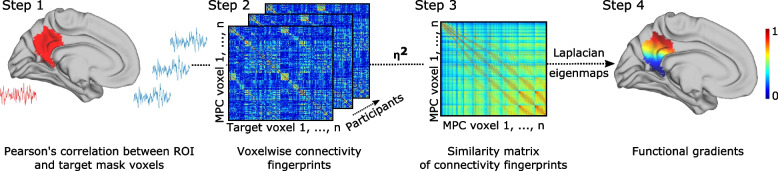
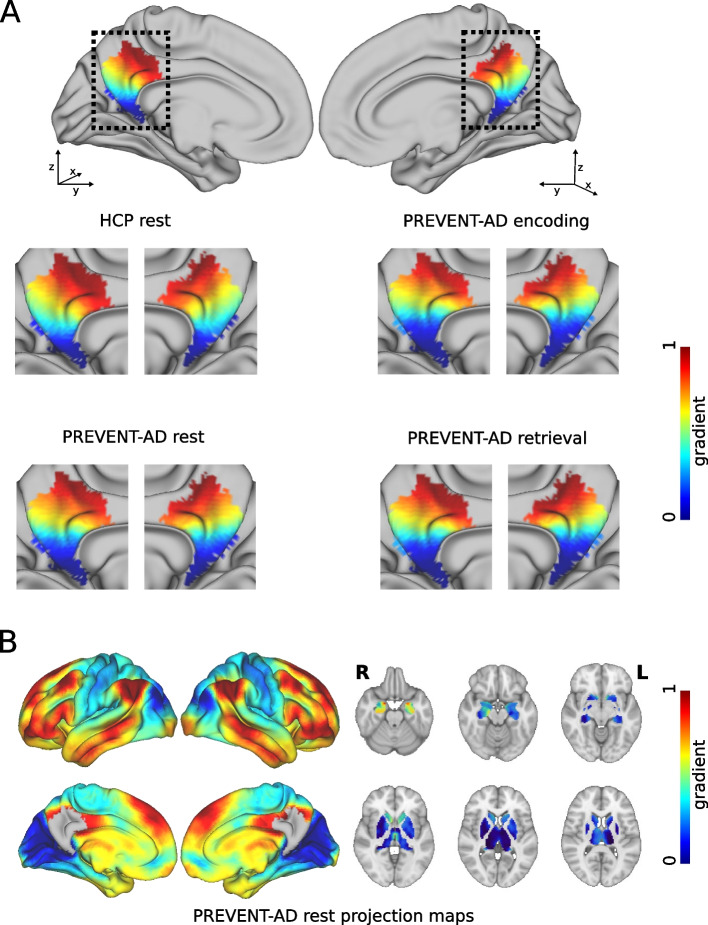
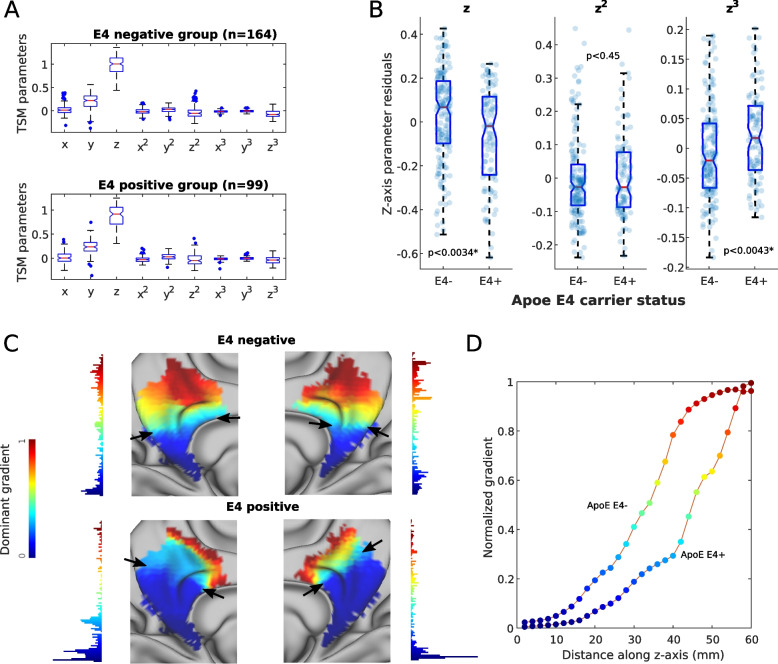
Two hundred sixty-three cognitively normal participants with a family history of sporadic AD who underwent resting-state and task-based functional MRI using encoding and retrieval tasks were included from the PREVENT-AD cohort. A novel method for characterizing spatially continuous patterns of functional connectivity was applied to estimate functional gradients in the medial parietal cortex during the resting-state and task-based conditions. This resulted in a set of nine parameters that described the appearance of the gradient across different spatial directions. We performed correlation analyses to assess whether these parameters were associated with CSF biomarkers of phosphorylated tau (p-tau), total tau (t-tau), and amyloid-ß (Aß). Then, we compared the spatial parameters between ApoE ε4 carriers and noncarriers, and evaluated the relationship between these parameters and memory.
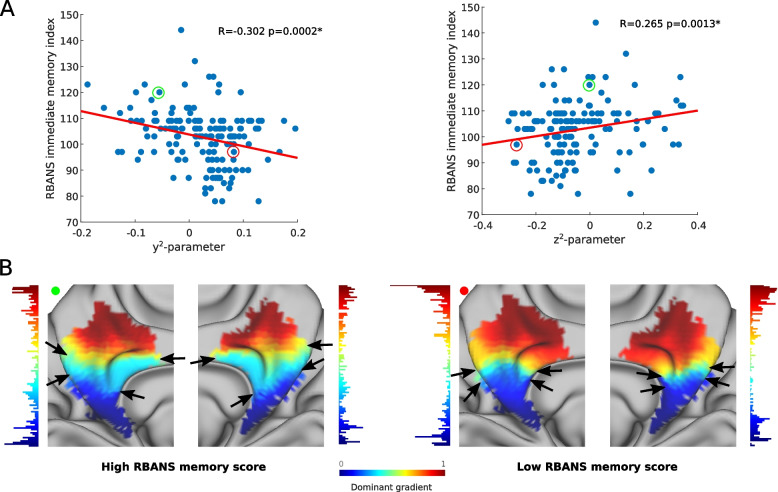
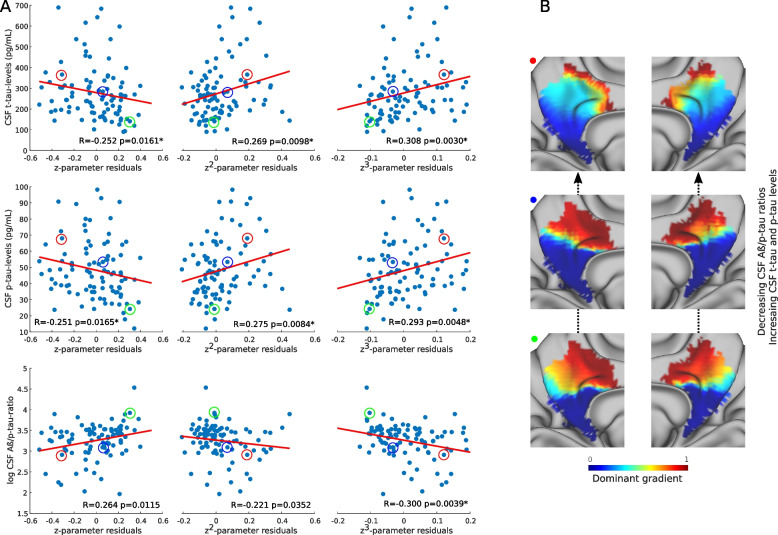
Alterations involving the superior part of the medial parietal cortex, which was connected to regions of the default mode network, were associated with higher p-tau, t-tau levels as well as lower Aß/p-tau levels during the resting-state condition (p < 0.01). Similar alterations were found in ApoE ε4 carriers compared to non-carriers (p < 0.003). In contrast, lower immediate memory scores were associated with changes in the middle part of the medial parietal cortex, which was connected to inferior temporal and posterior parietal regions, during the encoding task (p = 0.001). No results were found when using conventional connectivity measures.
Functional alterations in the medial parietal gradients are associated with CSF AD biomarkers, ApoE ε4 carriership, and lower memory in an asymptomatic cohort with a family history of sporadic AD, suggesting that functional gradients are sensitive to subtle changes associated with early AD stages.
内侧顶叶皮层是阿尔茨海默病(AD)病理性蛋白沉积的早期部位。先前的研究已经确定了该区域内的不同亚区;然而,这些亚区通常是异质的,并且忽略了潜在功能结构中的个体差异或细微的病理改变。为了解决这一限制,我们在这里测量了内侧顶叶皮层的连续连通梯度,并评估了它们与无症状的 AD 高危个体的脑脊液(CSF)生物标志物、ApoE ε4 携带状态和记忆之间的关系。
从 PREVENT-AD 队列中纳入了 263 名认知正常的、有散发性 AD 家族史的个体,他们接受了静息状态和基于任务的功能磁共振成像,使用编码和检索任务。我们应用了一种新的方法来描述静息状态和基于任务条件下内侧顶叶皮层的空间连续功能连接模式,以估计功能梯度。这产生了一组九个参数,描述了梯度在不同空间方向上的出现情况。我们进行了相关性分析,以评估这些参数是否与 CSF 磷酸化 tau(p-tau)、总 tau(t-tau)和淀粉样蛋白-β(Aβ)的生物标志物相关。然后,我们比较了 ApoE ε4 携带者和非携带者之间的空间参数,并评估了这些参数与记忆之间的关系。
与默认模式网络区域相连的内侧顶叶上部的改变与静息状态下更高的 p-tau、t-tau 水平以及更低的 Aβ/p-tau 水平相关(p<0.01)。与非携带者相比,ApoE ε4 携带者也发现了类似的改变(p<0.003)。相反,在编码任务中,与颞下回和顶后区域相连的内侧顶叶中部的改变与即时记忆评分较低相关(p=0.001)。使用传统连通性测量方法时未发现结果。
内侧顶叶梯度的功能改变与无症状的具有散发性 AD 家族史的个体的 CSF AD 生物标志物、ApoE ε4 携带状态和较低的记忆有关,这表明功能梯度对与 AD 早期阶段相关的细微变化敏感。