Department of Midwifery, College of Medicine and Health Sciences, Bahir Dar University, Bahir Dar, Ethiopia.
Pawi Health Science College, Pawi, Ethiopia.
Inquiry. 2023 Jan-Dec;60:469580231167731. doi: 10.1177/00469580231167731.
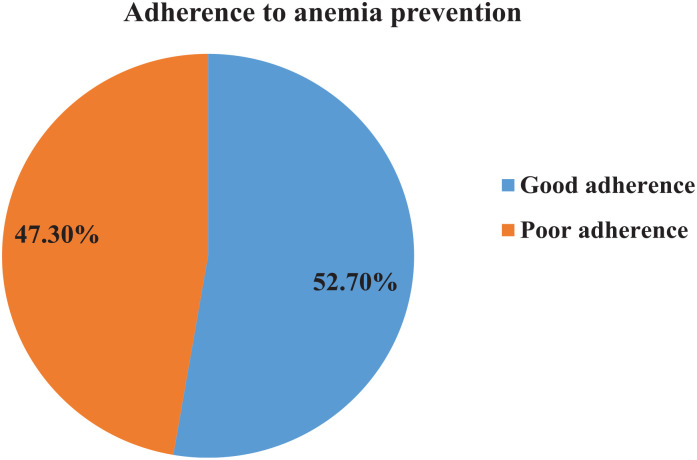
Anemia is a largely preventable and curable medical disease if detected intime. This study aimed to assess maternal knowledge of anemia and its prevention strategies in the public health facilities of Pawi district, Northwest, Ethiopia. A health facility-based cross-sectional study was conducted from February 1/2020 to March 2/2020, among 410 antenatal care attendees in the public health facilities of the Pawi district. The data was collected by systematic random sampling technique and analyzed using SPSS 25.0 version. Logistic regression analyses were done to estimate the crude and adjusted odds ratio with a CI of 95% and a -value of less than .05 considered statistically significant. Less than half, 184 44.9%) [95% CI = 40.0-49.8] and almost half, 216 (52.7%) [95% CI = 47.8-57.5] of the pregnant women had good knowledge of anemia and good adherence to its prevention strategies respectively. Women who are found in the age group of 15 to 19, 20 to 24, and 25 to 29 years, rural residency, secondary, and above educational level, vaginal bleeding, third trimester of pregnancy, and medium and high minimum dietary diversification score were significantly associated with knowledge of anemia. On the other hand: women who are found in the age group of 15 to 19 years, secondary above educational level, primigravida women, having ≤2 and 3 to 4 family sizes, second and third trimester of pregnancy, high minimum dietary diversification score, and good knowledge of anemia were significantly associated with adherence to anemia prevention strategies. Maternal knowledge of anemia and adherence to its prevention strategies were low. Nutritional counseling on the consumption of iron-rich foods and awareness creation on the effects of anemia in pregnant women must be strengthened to increase the knowledge of anemia and adherence to its prevention strategies.
如果能及时发现,贫血是一种可以预防和治疗的医学疾病。本研究旨在评估埃塞俄比亚西北帕维区公共卫生机构产妇对贫血及其预防策略的认知情况。2020 年 2 月 1 日至 3 月 2 日,在帕维区公共卫生机构,采用系统随机抽样技术,对 410 名接受产前护理的孕妇进行了基于卫生机构的横断面研究。采用 SPSS 25.0 版本进行数据分析。采用逻辑回归分析,估计了粗比和调整比,并计算了 95%的置信区间和小于 0.05 的值,认为具有统计学意义。不到一半的孕妇(44.9%)[95%CI=40.0-49.8]和近一半的孕妇(52.7%)[95%CI=47.8-57.5]对贫血有较好的认识,并较好地遵守贫血预防策略。在年龄组为 15 至 19 岁、20 至 24 岁、25 至 29 岁、农村居住、中等和高等教育水平、阴道出血、妊娠第三期、中高最低饮食多样化评分的孕妇中,贫血知识显著相关。另一方面:在年龄组为 15 至 19 岁、中等以上教育水平、初产妇、家庭规模为 2 至 4 人、妊娠第二和第三期、高最低饮食多样化评分和良好的贫血知识的孕妇中,与贫血预防策略的遵守情况显著相关。产妇对贫血的认识和对贫血预防策略的遵守程度较低。必须加强关于食用富含铁的食物的营养咨询和对孕妇贫血影响的认识,以提高对贫血的认识和对贫血预防策略的遵守。