Department of Geriatric Medicine, Aalborg University Hospital, Aalborg, Denmark.
Department of Clinical Medicine, Aalborg University, Aalborg, Denmark.
JAMA Netw Open. 2023 Apr 3;6(4):e238422. doi: 10.1001/jamanetworkopen.2023.8422.
Falls are common and the leading cause of injuries among older adults, but falls may be attenuated by the promising and time-efficient intervention called perturbation-based balance training (PBT).
To evaluate the effects of a 4-session treadmill PBT intervention compared with regular treadmill walking on daily-life fall rates among community-dwelling older adults.
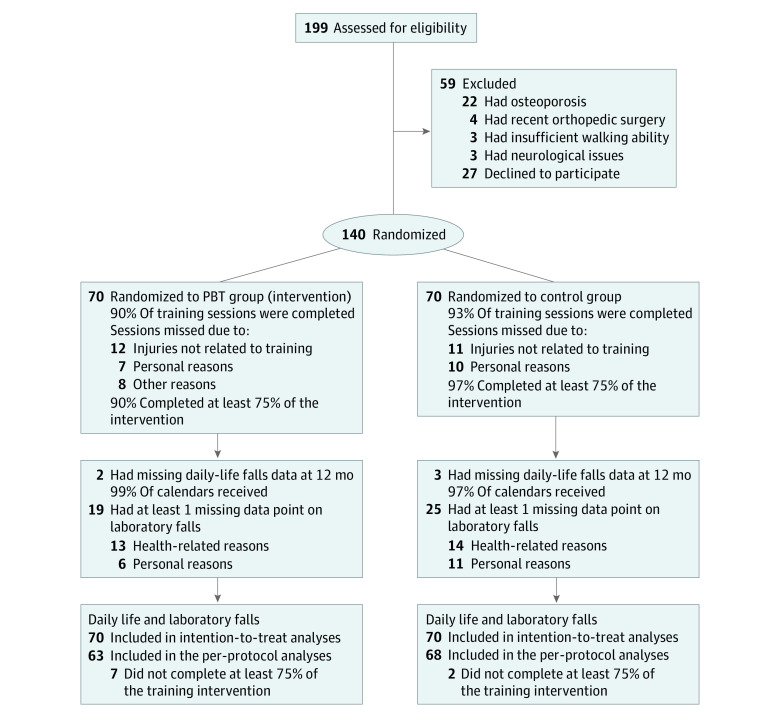
DESIGN, SETTING, AND PARTICIPANTS: This 12-month, assessor-blinded randomized clinical trial was conducted from March 2021 through December 2022 in Aalborg University in Denmark. Participants were community-dwelling adults 65 years or older and were able to walk without a walking aid. Participants were randomized to either PBT (intervention group) or treadmill walking (control group). Data analyses were based on the intention-to-treat principle.
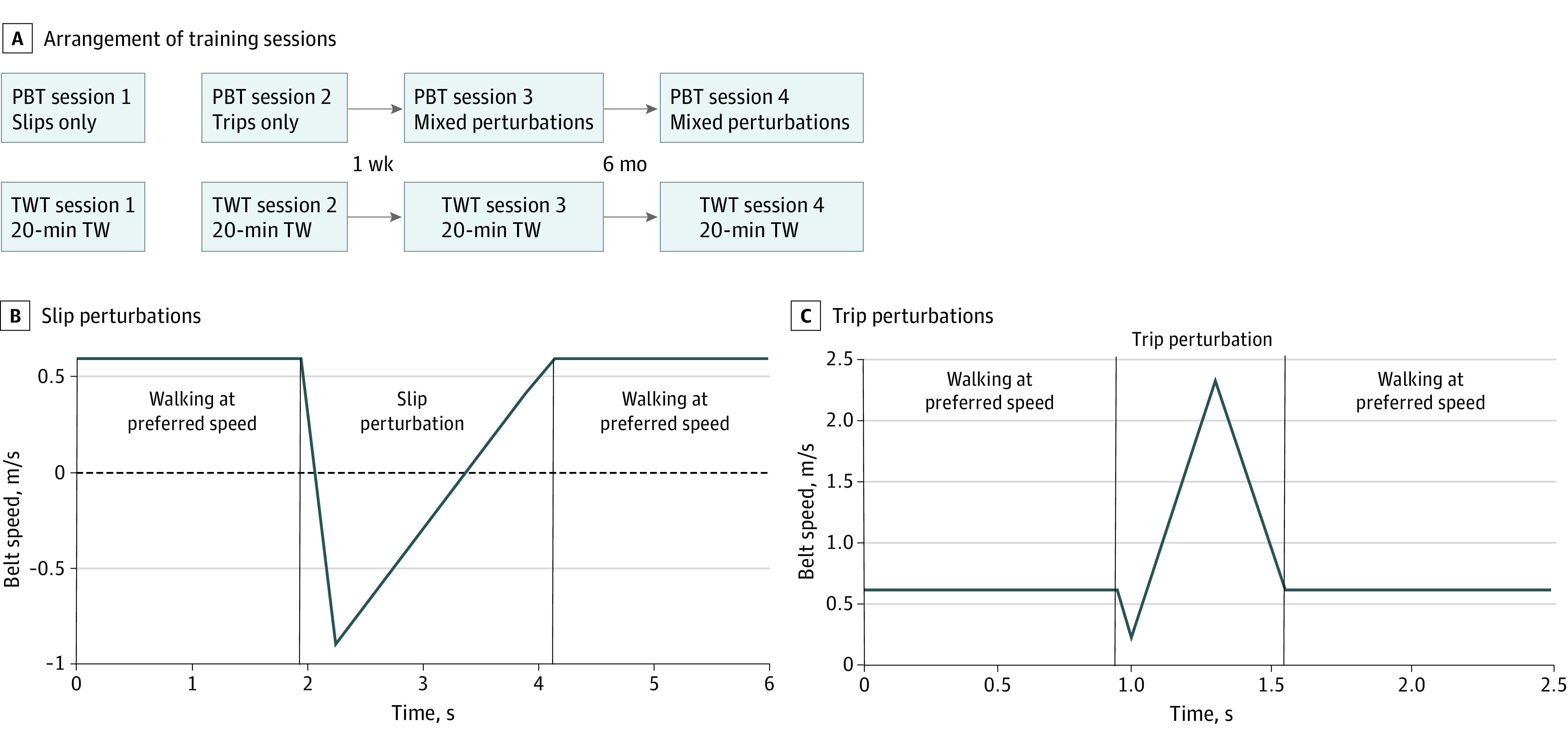
Participants who were randomized to the intervention group underwent four 20-minute sessions of PBT, including 40 slip, trip, or mixed slip and trip perturbations. Participants who were randomized to the control group performed four 20-minute sessions of treadmill walking at their preferred speed. The 3 initial training sessions were completed within the first week, whereas the fourth session was performed after 6 months.
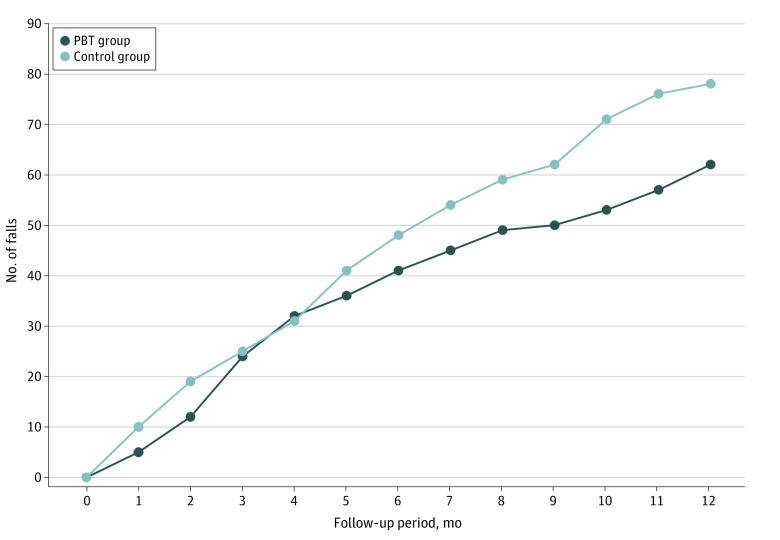
Primary outcome was the daily-life fall rates that were collected from fall calendars for the 12 months after the third training session. Secondary outcomes were the proportion of participants with at least 1 fall and recurrent falls, time to first fall, fall-related fractures, fall-related injuries, fall-related health care contacts, and daily-life slip and trip falls.
A total of 140 highly functioning, community-dwelling older adults (mean [SD] age, 72 [5] years; 79 females [56%]), 57 (41%) of whom had a fall in the past 12 months, were included in this trial. Perturbation training had no significant effect on daily-life fall rate (incidence rate ratio [IRR]: 0.78; 95% CI, 0.48-1.27) or other fall-related metrics. However, there was a significant reduction in laboratory fall rates at the posttraining assessment (IRR, 0.20; 95% CI, 0.10-0.41), 6-month follow-up (IRR, 0.47; 95% CI, 0.26-0.86), and 12-month follow-up (IRR, 0.37; 95% CI, 0.19-0.72).
Results of this trial showed that participants who received an 80-minute PBT intervention experienced a statistically nonsignificant 22% reduction in daily-life fall rates. There was no significant effect on other daily-life fall-related metrics; however, a statistically significant decrease in falls was found in the laboratory setting.
ClinicalTrials.gov Identifier: NCT04733222.
跌倒在老年人中很常见,也是导致伤害的主要原因,但通过一种有前景且高效的干预措施——基于扰动的平衡训练(PBT),可以减少跌倒的发生。
评估 4 节跑步机 PBT 干预与常规跑步机行走对社区居住的老年人日常生活中跌倒率的影响。
设计、地点和参与者:这是一项为期 12 个月、评估者盲法的随机临床试验,于 2021 年 3 月至 2022 年 12 月在丹麦奥尔堡大学进行。参与者为社区居住的 65 岁及以上、无需使用助行器即可行走的成年人。参与者被随机分为 PBT(干预组)或跑步机行走(对照组)。数据分析基于意向治疗原则。
随机分配到干预组的参与者接受了 4 次 20 分钟的 PBT,包括 40 次滑倒、绊倒或混合滑倒和绊倒的扰动。随机分配到对照组的参与者以他们喜欢的速度进行了 4 次 20 分钟的跑步机行走。前 3 次训练课程在第一周内完成,第 4 次课程在 6 个月后进行。
主要结果是从第三次训练课程后 12 个月的跌倒日历中收集的日常生活中跌倒率。次要结果是至少有 1 次跌倒和复发性跌倒、首次跌倒时间、与跌倒相关的骨折、与跌倒相关的损伤、与跌倒相关的医疗保健接触以及日常生活中的滑倒和绊倒跌倒的参与者比例。
共有 140 名功能高度健全的社区居住老年人(平均[标准差]年龄 72[5]岁;79 名女性[56%])参与了这项试验,其中 57 名(41%)在过去 12 个月中有跌倒史。扰动训练对日常生活中的跌倒率(发病率比[IRR]:0.78;95%置信区间,0.48-1.27)或其他与跌倒相关的指标均无显著影响。然而,在训练后评估(IRR,0.20;95%置信区间,0.10-0.41)、6 个月随访(IRR,0.47;95%置信区间,0.26-0.86)和 12 个月随访(IRR,0.37;95%置信区间,0.19-0.72)时,实验室跌倒率显著降低。
这项试验的结果表明,接受 80 分钟 PBT 干预的参与者日常生活中的跌倒率降低了统计学上无显著意义的 22%。对其他日常生活中与跌倒相关的指标没有显著影响;然而,在实验室环境中发现跌倒明显减少。
ClinicalTrials.gov 标识符:NCT04733222。