Cognitive and Systems Neuroscience Group, Swammerdam Institute for Life Sciences, University of Amsterdam, Amsterdam, The Netherlands.
Amsterdam Brain and Cognition, University of Amsterdam, Amsterdam, The Netherlands.
PLoS One. 2023 Apr 20;18(4):e0284735. doi: 10.1371/journal.pone.0284735. eCollection 2023.
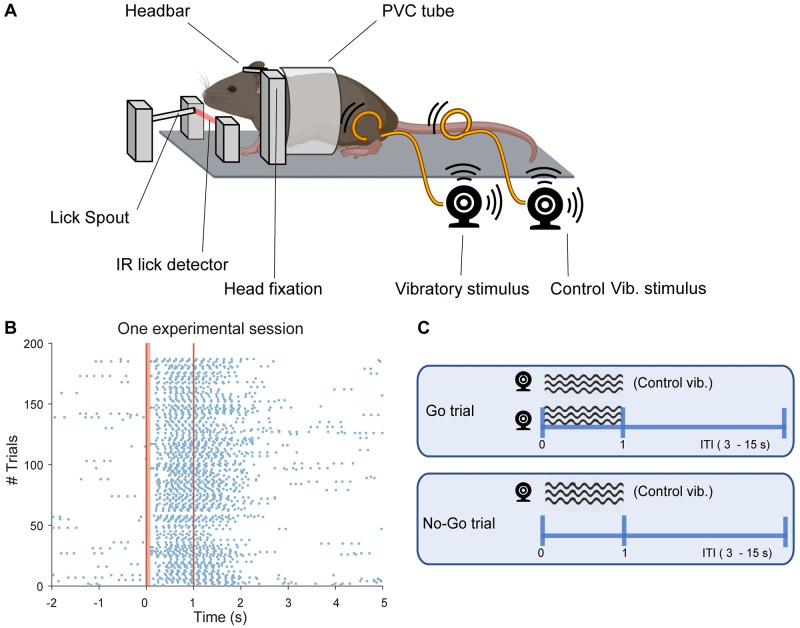
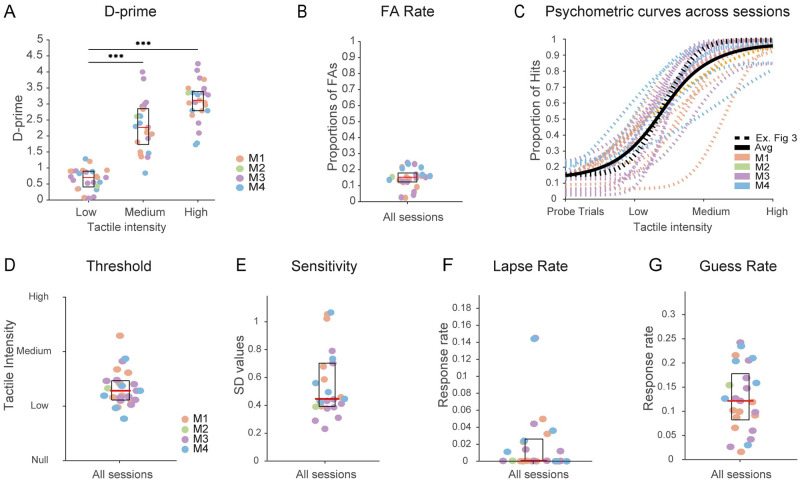
Throughout the last decades, understanding the neural mechanisms of sensory processing has been a key objective for neuroscientists. Many studies focused on uncovering the microcircuit-level architecture of somatosensation using the rodent whisker system as a model. Although these studies have significantly advanced our understanding of tactile processing, the question remains to what extent the whisker system can provide results translatable to the human somatosensory system. To address this, we developed a restrained vibrotactile detection task involving the limb system in mice. A vibrotactile stimulus was delivered to the hindlimb of head-fixed mice, who were trained to perform a Go/No-go detection task. Mice were able to learn this task with satisfactory performance and with reasonably short training times. In addition, the task we developed is versatile, as it can be combined with diverse neuroscience methods. Thus, this study introduces a novel task to study the neuron-level mechanisms of tactile processing in a system other than the more commonly studied whisker system.
在过去的几十年中,理解感觉处理的神经机制一直是神经科学家的主要目标。许多研究都集中在利用啮齿动物胡须系统作为模型来揭示触觉的微电路结构。尽管这些研究极大地促进了我们对触觉处理的理解,但仍存在一个问题,即胡须系统在多大程度上可以提供可转化为人类触觉系统的结果。为了解决这个问题,我们开发了一种限制的振动触觉检测任务,涉及小鼠的肢体系统。振动触觉刺激被传递到头部固定的小鼠的后肢,他们接受训练以执行 Go/No-go 检测任务。小鼠能够以令人满意的表现和相对较短的训练时间来学习这个任务。此外,我们开发的任务具有多功能性,因为它可以与各种神经科学方法结合使用。因此,这项研究在除了更常研究的胡须系统之外的系统中引入了一种新的任务来研究触觉处理的神经元水平机制。