Department of Epidemiology and Health Statistics, School of Public Health at Guangdong Medical University, Dongguan 560001, China.
Department of Preventive Medicine, School of Public Health at Zunyi Medical University, Zunyi 56006, China.
J Affect Disord. 2023 Jul 15;333:58-64. doi: 10.1016/j.jad.2023.04.033. Epub 2023 Apr 18.
The prolonged COVID-19 pandemic has burdened health professionals mentally and physically. This study aims to explore the relationship between moral injury (MI) and suicidal ideation (SI), and the role of mental health conditions in this relationship.
Three-wave repeated online cross-sectional study with a total of 10,388 health professionals were conducted in different stages (2020-2022) of the COVID-19 pandemic in mainland China. Participants completed the Chinese version of the Moral Injury Symptoms Scale-Health Professional, Post-Traumatic Stress Disorder (PTSD) Checklist for DSM-5 coupled with a blanket of scales.
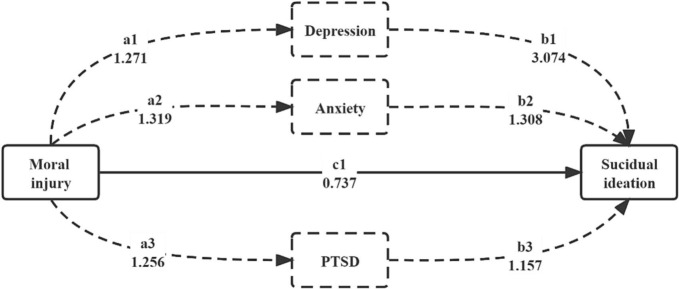
The prevalence of SI and MI among health professionals was 9.8 % and 40.2 %, respectively. The prevalence risk of SI was lower in wave 2 (OR = 0.64, 95 % CI: 0.54-0.77) and wave 3 (OR = 0.71, 95 % CI: 0.60-0.84) when compared with wave 1. MI (OR = 4.66, 95 % CI: 3.99-5.43), medical error (OR = 1.15, 95 % CI: 1.00-1.32), workplace violence (OR = 1.13, 95 % CI: 0.97-1.32), depression (OR = 94.08, 95 % CI: 63.37-139.69), anxiety (OR = 25.54, 95 % CI: 21.22-30.74), PTSD (OR = 24.51, 95 % CI: 19.01-31.60) were associated with a higher risk of SI. The mediation model revealed that depressive, anxiety, and PTSD symptoms explained 90.6 % of the total variance in the relationship between MI and SI.
The risk of SI has reduced among health professionals since the first peak of the COVID-19 pandemic in China. MI may contribute to prevalent SI, and mental health conditions, especially depressive symptoms, play a significant role as mediators.
Cross-sectional design precludes the investigation of casual relationships. The nonrandom sampling method limits the generalization.
COVID-19 大流行长期以来对医疗专业人员的身心健康造成了沉重负担。本研究旨在探讨道德伤害(MI)与自杀意念(SI)之间的关系,以及心理健康状况在这种关系中的作用。
这是一项在 COVID-19 大流行期间在中国不同阶段(2020-2022 年)进行的三波重复在线横断面研究,共有 10388 名卫生专业人员参与。参与者完成了中文版本的道德伤害症状量表-卫生专业人员、创伤后应激障碍(PTSD)检查表 DSM-5 与一套量表相结合。
卫生专业人员的 SI 和 MI 发生率分别为 9.8%和 40.2%。与第 1 波相比,第 2 波(OR=0.64,95%CI:0.54-0.77)和第 3 波(OR=0.71,95%CI:0.60-0.84)的 SI 发病风险较低。MI(OR=4.66,95%CI:3.99-5.43)、医疗差错(OR=1.15,95%CI:1.00-1.32)、工作场所暴力(OR=1.13,95%CI:0.97-1.32)、抑郁(OR=94.08,95%CI:63.37-139.69)、焦虑(OR=25.54,95%CI:21.22-30.74)、PTSD(OR=24.51,95%CI:19.01-31.60)与 SI 风险增加相关。中介模型表明,抑郁、焦虑和 PTSD 症状解释了 MI 和 SI 之间关系总方差的 90.6%。
自中国 COVID-19 大流行的第一个高峰以来,卫生专业人员的 SI 风险有所降低。MI 可能导致普遍存在的 SI,心理健康状况,尤其是抑郁症状,作为中介发挥着重要作用。
横断面设计排除了因果关系的调查。非随机抽样方法限制了推广。