Hodgson Daniel D, King Jordan A, Darici Osman, Dalton Brian H, Cleworth Taylor W, Cluff Tyler, Peters Ryan M
Faculty of Kinesiology, University of Calgary, Calgary, AB, Canada.
Biomedical Engineering, University of Calgary, Calgary, AB, Canada.
Front Hum Neurosci. 2023 Apr 4;17:1128548. doi: 10.3389/fnhum.2023.1128548. eCollection 2023.
The mechanisms regulating neuromuscular control of standing balance can be influenced by visual sensory feedback and arousal. Virtual reality (VR) is a cutting-edge tool for probing the neural control of balance and its dependence on visual feedback, but whether VR induces neuromodulation akin to that seen in real environments (eyes open vs. closed or ground level vs. height platform) remains unclear.
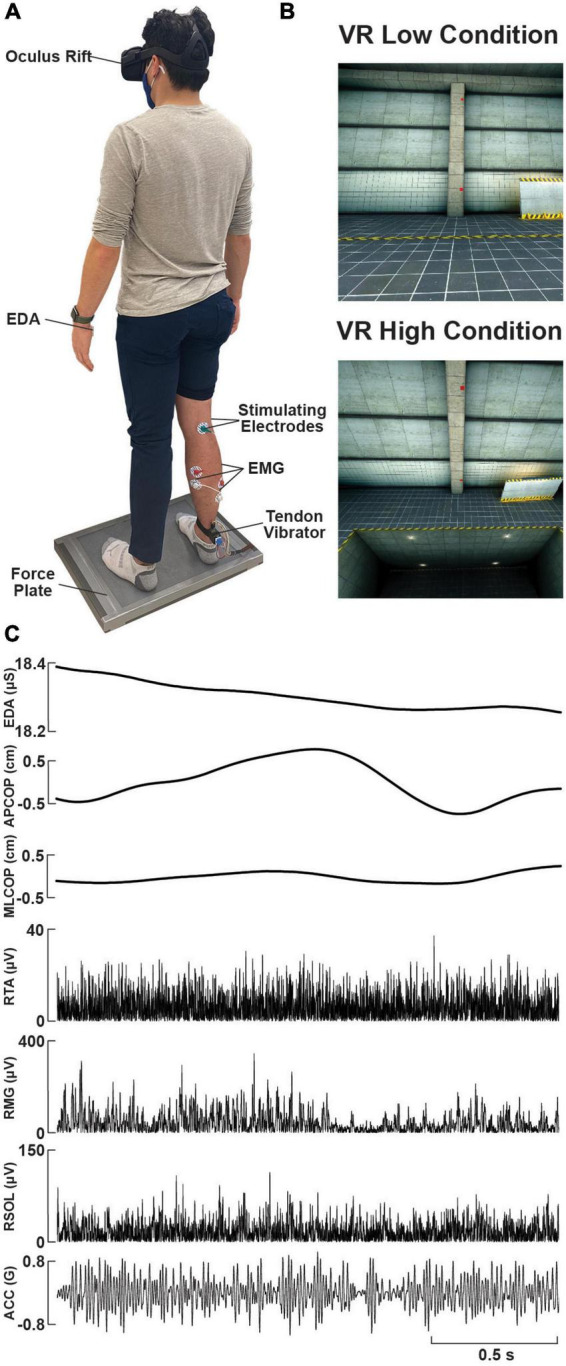
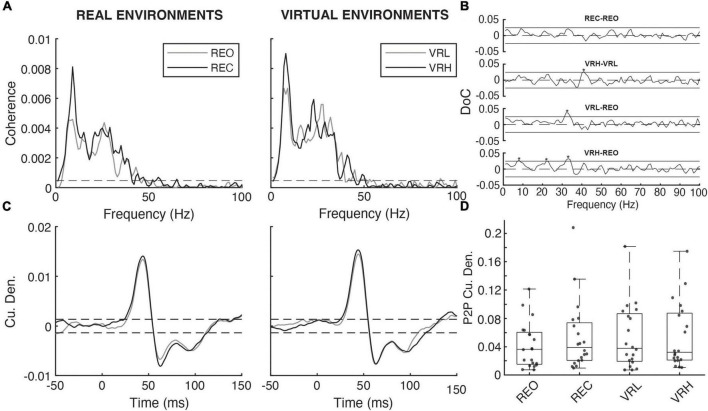
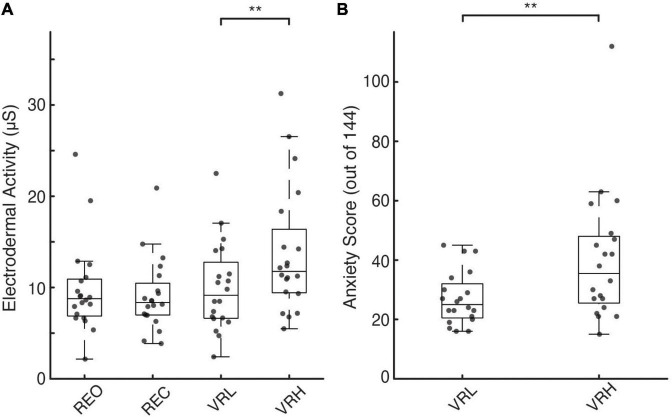
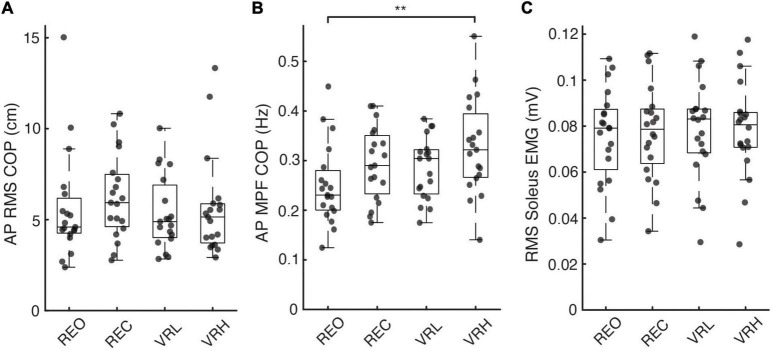
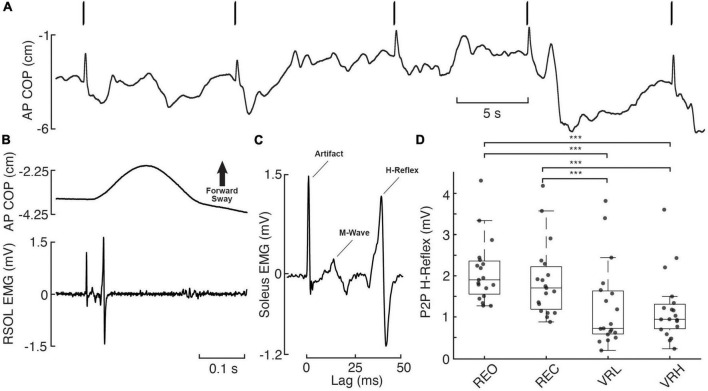
Here we monitored 20 healthy young adults (mean age 23.3 ± 3.2 years; 10 females) during four conditions of quiet standing. Two real world conditions (eyes open and eyes closed; REO and REC) preceded two eyes-open virtual '' (ground level; VRL) and '' (14 m height platform; VRH) conditions. We measured arousal via electrodermal activity and psychosocial questionnaires rating perceived fear and anxiety. We recorded surface electromyography over the right soleus, medial gastrocnemius, and tibialis anterior, and performed force plate posturography. As a proxy for modulations in neural control, we assessed lower limb reflexive muscle responses evoked by tendon vibration and electrical stimulation.
Physiological and perceptual indicators of fear and anxiety increased in the VRH condition. Background soleus muscle activation was not different across conditions; however, significant increases in muscle activity were observed for medial gastrocnemius and tibialis anterior in VRH relative to REO. The mean power frequency of postural sway also increased in the VRH condition relative to REO. Finally, with a fixed stimulus level across conditions, mechanically evoked reflexes remained constant, while H-reflex amplitudes decreased in strength within virtual reality.
Notably, H-reflexes were lower in the VRL condition than REO, suggesting that these ostensibly similar visual environments produce different states of reflexive balance control. In summary, we provide novel evidence that VR can be used to modulate upright postural control, but caution that standing balance in analogous real and virtual environments may involve different neural control states.
调节站立平衡的神经肌肉控制机制会受到视觉感觉反馈和觉醒的影响。虚拟现实(VR)是一种用于探究平衡的神经控制及其对视觉反馈依赖性的前沿工具,但VR是否会引起类似于在真实环境中(睁眼与闭眼或地面水平与高台)所观察到的神经调节尚不清楚。
在此,我们监测了20名健康的年轻成年人(平均年龄23.3±3.2岁;10名女性)在四种安静站立条件下的情况。在两种虚拟现实条件(地面水平;VRL)和(14米高台;VRH)之前,先进行了两种现实世界条件(睁眼和闭眼;REO和REC)。我们通过皮肤电活动和评估感知到的恐惧和焦虑的心理社会问卷来测量觉醒。我们记录了右侧比目鱼肌、腓肠肌内侧头和胫骨前肌的表面肌电图,并进行了测力平台姿势描记。作为神经控制调节的替代指标,我们评估了由肌腱振动和电刺激诱发的下肢反射性肌肉反应。
在VRH条件下,恐惧和焦虑的生理及感知指标增加。比目鱼肌的背景肌肉激活在各条件下并无差异;然而,相对于REO,VRH条件下腓肠肌内侧头和胫骨前肌的肌肉活动显著增加。相对于REO,VRH条件下姿势摆动的平均功率频率也增加了。最后,在各条件下刺激水平固定的情况下,机械诱发的反射保持不变,而在虚拟现实中H反射幅度的强度降低。
值得注意的是,VRL条件下的H反射低于REO,这表明这些表面上相似的视觉环境会产生不同的反射性平衡控制状态。总之,我们提供了新的证据表明VR可用于调节直立姿势控制,但需谨慎的是,在类似的真实和虚拟环境中站立平衡可能涉及不同的神经控制状态。