Queensland Aphasia Research Centre, School of Health and Rehabilitation Sciences, The University of Queensland, Brisbane Australia.
Surgical Treatment and Rehabilitation Service (STARS) Education and Research Alliance, The University of Queensland and Metro North Health, Queensland, Australia.
Neurorehabil Neural Repair. 2023 Apr;37(4):218-227. doi: 10.1177/15459683231168384. Epub 2023 Apr 21.
White matter hyperintensities (WMH) are considered to contribute to diminished brain reserve, negatively impacting on stroke recovery. While WMH identified in the chronic phase after stroke have been associated with post-stroke aphasia, the contribution of premorbid WMH to the early recovery of language across production and comprehension has not been investigated.
To investigate the relationship between premorbid WMH severity and longitudinal comprehension and production outcomes in aphasia, after controlling for stroke lesion variables.
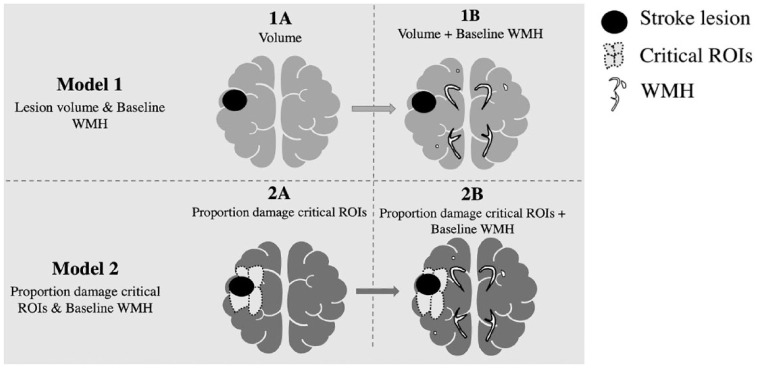
Longitudinal behavioral data from individuals with a left-hemisphere stroke were included at the early subacute (n = 37) and chronic (n = 28) stage. Spoken language comprehension and production abilities were assessed at both timepoints using word and sentence-level tasks. Magnetic resonance imaging (MRI) was performed at the early subacute stage to derive stroke lesion variables (volume and proportion damage to critical regions) and WMH severity rating.
The presence of severe WMH explained an additional 18% and 25% variance in early subacute ( = -3.00, = .004) and chronic ( = -3.60, = .001) language comprehension abilities respectively, after controlling for stroke lesion variables. WMH did not predict additional variance of language production scores.
Subacute clinical MRI can be used to improve prognoses of recovery of aphasia after stroke. We demonstrate that severe early subacute WMH add to the prediction of impaired longitudinal language recovery in comprehension, but not production. This emphasizes the need to consider different domains of language when investigating novel neurobiological predictors of aphasia recovery.
脑白质高信号(WMH)被认为会削弱大脑储备,对中风后的恢复产生负面影响。虽然中风后慢性期的 WMH 与中风后失语症有关,但未研究 WMH 对语言产出和理解的早期恢复的影响。
在控制中风病灶变量后,研究中风前 WMH 严重程度与失语症语言理解和产出的纵向恢复之间的关系。
纳入了 37 名处于早期亚急性期和 28 名处于慢性期的左半球中风患者的纵向行为数据。在这两个时间点都使用单词和句子级任务评估口语语言理解和表达能力。在早期亚急性期进行磁共振成像(MRI)以得出中风病灶变量(体积和关键区域损伤的比例)和 WMH 严重程度评分。
在控制中风病灶变量后,严重 WMH 分别解释了早期亚急性期( = -3.00, = .004)和慢性期( = -3.60, = .001)语言理解能力的额外 18%和 25%的变化。WMH 并未预测语言表达得分的额外变化。
亚急性临床 MRI 可用于改善中风后失语症恢复的预后。我们证明,严重的早期亚急性期 WMH 除了预测语言理解的纵向恢复受损外,还会增加预测能力,但对语言表达的预测能力则没有增加。这强调了在研究新的失语症恢复的神经生物学预测因子时,需要考虑语言的不同领域。