Comparative Immunogenetics Laboratory, Department of Veterinary Pathobiology, School of Veterinary Medicine and Biomedical Sciences, Texas A&M University, College Station, TX, USA.
Department of Veterinary Integrative Sciences, School of Veterinary Medicine and Biomedical Sciences, Texas A&M University, College Station, TX, USA.
Immunogenetics. 2023 Aug;75(4):323-339. doi: 10.1007/s00251-023-01305-9. Epub 2023 Apr 21.
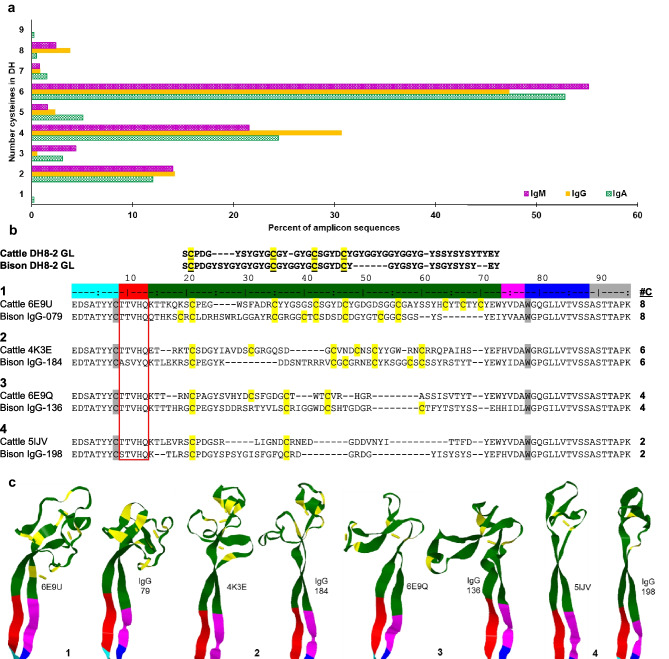
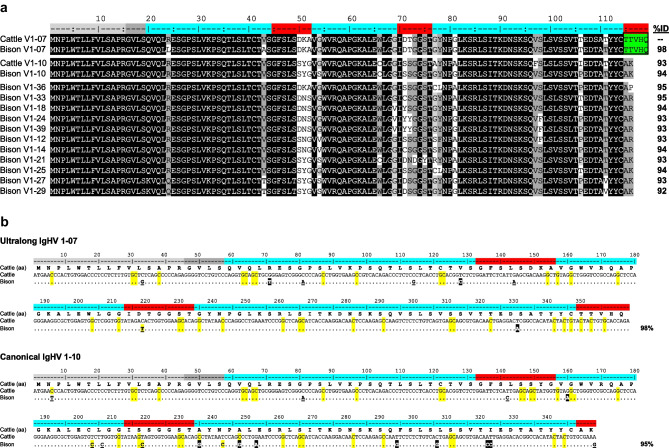
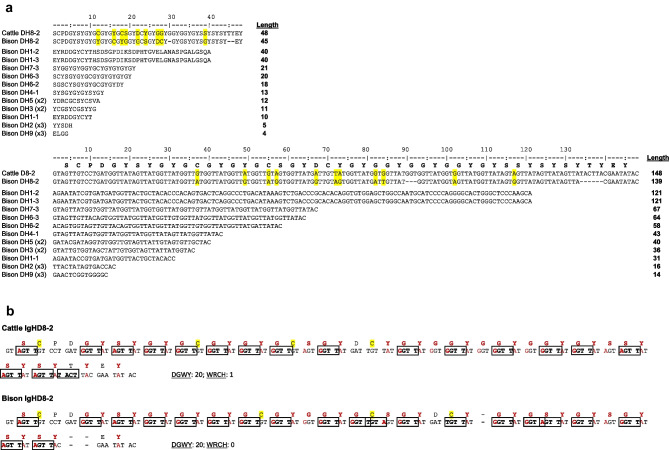
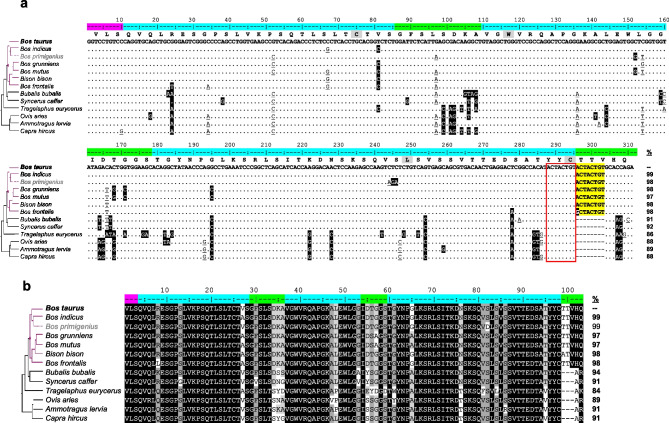
The genomes of most vertebrates contain many V, D, and J gene segments within their Ig loci to construct highly variable CDR3 sequences through combinatorial diversity. This nucleotide variability translates into an antibody population containing extensive paratope diversity. Cattle have relatively few functional VDJ gene segments, requiring innovative approaches for generating diversity like the use of ultralong-encoding IGHV and IGHD gene segments that yield dramatically elongated CDR H3. Unique knob and stalk microdomains create protracted paratopes, where the antigen-binding knob sits atop a long stalk, allowing the antibody to bind both surface and recessed antigen epitopes. We examined genomes of twelve species of Bovidae to determine when ultralong-encoding IGHV and IGHD gene segments evolved. We located the 8-bp duplication encoding the unique TTVHQ motif in ultralong IGHV segments in six Bovid species (cattle, zebu, wild yak, domestic yak, American bison, and domestic gayal), but we did not find evidence of the duplication in species beyond the Bos and Bison genera. Additionally, we analyzed mRNA from bison spleen and identified a rich repertoire of expressed ultralong CDR H3 antibody mRNA, suggesting that bison use ultralong IGHV transcripts in their host defense. We found ultralong-encoding IGHD gene segments in all the same species except domestic yak, but again not beyond the Bos and Bison clade. Thus, the duplication event leading to this ultralong-encoding IGHV gene segment and the emergence of the ultralong-encoding IGHD gene segment appears to have evolved in a common ancestor of the Bos and Bison genera 5-10 million years ago.
大多数脊椎动物的基因组在其 Ig 基因座中包含许多 V、D 和 J 基因片段,通过组合多样性构建高度可变的 CDR3 序列。这种核苷酸多样性转化为含有广泛的结合部位多样性的抗体群体。牛具有相对较少的功能性 VDJ 基因片段,需要创新的方法来产生多样性,例如使用超长编码的 IGHV 和 IGHD 基因片段,这些基因片段产生显著延长的 CDR H3。独特的旋钮和柄微域创造了延长的结合部位,抗原结合的旋钮位于长柄的顶部,使抗体能够结合表面和凹陷的抗原表位。我们检查了 12 种牛科动物的基因组,以确定超长编码 IGHV 和 IGHD 基因片段何时进化。我们在六种牛科动物(牛、瘤牛、野生牦牛、家养牦牛、美洲野牛和家养瘤牛)中定位了编码独特 TTVHQ 基序的 8 个碱基对重复的 8-bp 重复,在牛属和野牛属以外的物种中没有发现该重复的证据。此外,我们分析了野牛脾脏的 mRNA,并鉴定了丰富的表达超长 CDR H3 抗体 mRNA 库,这表明野牛在其宿主防御中使用超长 IGHV 转录本。我们在所有相同的物种中发现了超长编码 IGHD 基因片段,除了家养牦牛,但在牛属和野牛属以外的物种中没有发现。因此,导致这种超长编码 IGHV 基因片段的重复事件和超长编码 IGHD 基因片段的出现似乎在 500 万至 1000 万年前在牛属和野牛属的共同祖先中进化而来。