Kontaxis Spyridon, Laporta Estela, Garcia Esther, Guerrero Ana Isabel, Zabalza Ana, Matteo Martinis, Lucia Roselli, Simblett Sara, Weyer Janice, Hotopf Matthew, Narayan Vaibhav A, Rashid Zulqarnain, Folarin Amos A, Dobson Richard J B, Buron Mathias Due, Leocani Letizia, Cummins Nicholas, Vairavan Srinivasan, Costa Gloria Dalla, Magyari Melinda, Sørensen Per Soelberg, Nos Carlos, Bailón Raquel, Comi Giancarlo
Laboratory of Biomedical Signal Interpretation and Computational Simulation (BSICoS), University of Zaragoza, Zaragoza, Spain.
Biomedical Research Networking Center in Bioengineering, Biomaterials and Nanomedicine (CIBER-BBN), Barcelona, Spain.
Front Physiol. 2023 Apr 6;14:1145818. doi: 10.3389/fphys.2023.1145818. eCollection 2023.
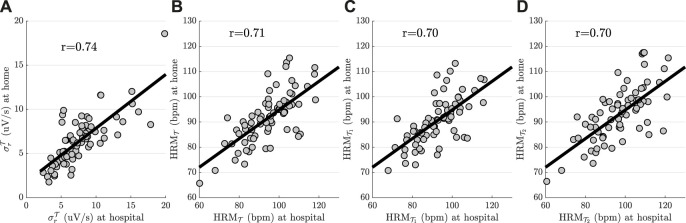
The aim of this study was to evaluate the association between changes in the autonomic control of cardiorespiratory system induced by walk tests and outcome measures in people with Multiple Sclerosis (pwMS). Electrocardiogram (ECG) recordings of 148 people with Relapsing-Remitting MS (RRMS) and 58 with Secondary Progressive MS (SPMS) were acquired using a wearable device before, during, and after walk test performance from a total of 386 periodical clinical visits. A subset of 90 participants repeated a walk test at home. Various MS-related symptoms, including fatigue, disability, and walking capacity were evaluated at each clinical visit, while heart rate variability (HRV) and ECG-derived respiration (EDR) were analyzed to assess autonomic nervous system (ANS) function. Statistical tests were conducted to assess differences in ANS control between pwMS grouped based on the phenotype or the severity of MS-related symptoms. Furthermore, correlation coefficients () were calculated to assess the association between the most significant ANS parameters and MS-outcome measures. People with SPMS, compared to RRMS, reached higher mean heart rate (HRM) values during walk test, and larger sympathovagal balance after test performance. Furthermore, pwMS who were able to adjust their HRM and ventilatory values, such as respiratory rate and standard deviation of the ECG-derived respiration, were associated with better clinical outcomes. Correlation analyses showed weak associations between ANS parameters and clinical outcomes when the Multiple Sclerosis phenotype is not taken into account. Blunted autonomic response, in particular HRM reactivity, was related with worse walking capacity, yielding = 0.36 = 0.29 (RRMS) and > 0.5 (SPMS). A positive strong correlation > 0.7 > 0.65 between cardiorespiratory parameters derived at hospital and at home was also found. Autonomic function, as measured by HRV, differs according to MS phenotype. Autonomic response to walk tests may be useful for assessing clinical outcomes, mainly in the progressive stage of MS. Participants with larger changes in HRM are able to walk longer distance, while reduced ventilatory function during and after walk test performance is associated with higher fatigue and disability severity scores. Monitoring of disorder severity could also be feasible using ECG-derived cardiac and respiratory parameters recorded with a wearable device at home.
本研究旨在评估步行试验诱发的心肺系统自主控制变化与多发性硬化症患者(pwMS)的预后指标之间的关联。在总共386次定期临床就诊期间,使用可穿戴设备在步行试验前、试验期间和试验后采集了148例复发缓解型多发性硬化症(RRMS)患者和58例继发进展型多发性硬化症(SPMS)患者的心电图(ECG)记录。90名参与者的一个子集在家中重复了步行试验。在每次临床就诊时评估各种与MS相关的症状,包括疲劳、残疾和步行能力,同时分析心率变异性(HRV)和心电图衍生呼吸(EDR)以评估自主神经系统(ANS)功能。进行统计测试以评估根据MS表型或MS相关症状严重程度分组的pwMS之间ANS控制的差异。此外,计算相关系数()以评估最显著的ANS参数与MS预后指标之间的关联。与RRMS相比,SPMS患者在步行试验期间达到更高的平均心率(HRM)值,并且在试验后具有更大的交感迷走平衡。此外,能够调整其HRM和通气值(如呼吸频率和心电图衍生呼吸的标准差)的pwMS与更好的临床结果相关。相关性分析表明,在不考虑多发性硬化症表型时,ANS参数与临床结果之间的关联较弱。自主反应迟钝,特别是HRM反应性,与较差的步行能力相关,RRMS的相关系数为 = 0.36, = 0.29,SPMS的相关系数 > 0.5。还发现医院和家中得出的心肺参数之间存在 > 0.7, > 0.65的强正相关。通过HRV测量的自主功能因MS表型而异。对步行试验的自主反应可能有助于评估临床结果,主要是在MS的进展阶段。HRM变化较大的参与者能够行走更长的距离,而步行试验期间和试验后通气功能降低与更高的疲劳和残疾严重程度评分相关。使用在家中可穿戴设备记录的心电图衍生的心脏和呼吸参数监测疾病严重程度也是可行的。