Pedersen Britt Stævnsbo, Kodal Louise Sloth, Kaalund Anna Bundgaard, Holm-Yildiz Sonja, Pedersen Mette Merete, Dysgaard Tina
Copenhagen Neuromuscular Center, Department of Neurology, Rigshospitalet, Copenhagen University Hospital, Copenhagen, Denmark.
Department of Clinical Research and Physical Medicine and Rehabilitation Research Copenhagen (PMR-C), Copenhagen University Hospital Amager and Hvidovre, Hvidovre, Denmark.
Front Physiol. 2023 Apr 6;14:1158039. doi: 10.3389/fphys.2023.1158039. eCollection 2023.
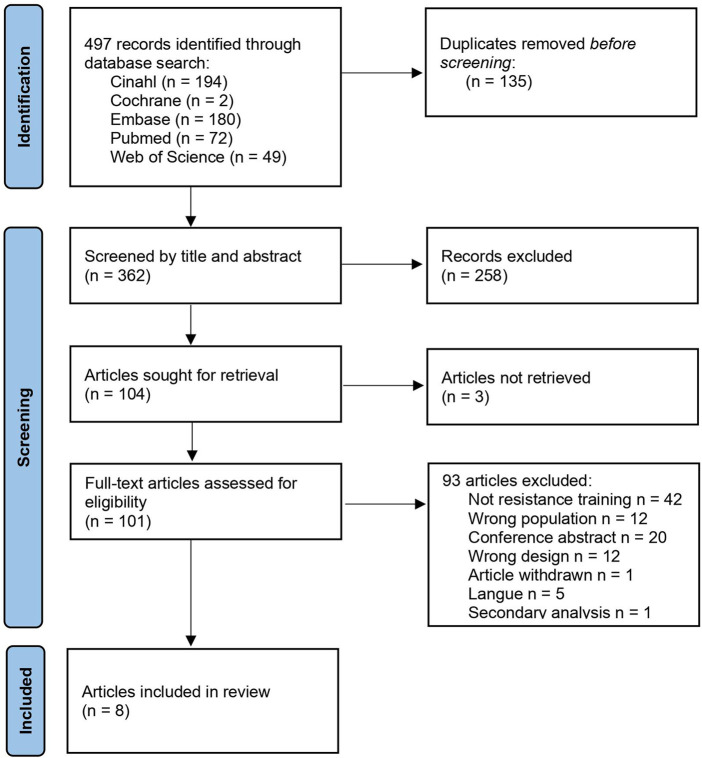
Polyneuropathy (PNP) is a chronic progressive disease that over time can lead to damage of sensory, motor and/or autonomic peripheral nerves. Symptoms vary from predominantly sensory to severe sensorimotor affection both proximally and distally. This can result in considerable functional impairments that affect activities of daily living. In other neurological patients, strength training has shown to improve strength and functional outcomes. Since medical treatment only exists for very few percentages of the underlying causes it is obvious to consider if strength training could be a potential treatment for functional impairments. To date little is known on the effect of strength training in patients with PNP. The aim of this scoping review was to summarize research on strength training and outcomes on physical function in patients with PNP. We systematically searched five data bases; Pubmed, Embase, Cinahl, Cochrane library and Web of science. Studies on strength training (load ≥70% of 1RM) in patients with PNP were included. The search was carried out in November 2022. 362 articles were screened by title and abstract, 101 articles were full text screened. Eight studies were included. Patients with Charcot-Marie-Tooth (CMT), chronic inflammatory polyneuropathy (CIDP) and diabetic polyneuropathy (DPN) were represented in the studies (five RCTs, two case-series, and one cross-over trial). The methodological quality ranged from fair-poor in seven studies, one study reached good quality. Results from the studies indicated that strength training in CMT, CIDP and DPN may improve strength. However, various outcomes were used to evaluate strength training, so direct comparisons were difficult. In this scoping review we summarized research on strength training and outcomes evaluated in interventions in patients with PNP. Eight studies were included, they indicated that strength training may be beneficial for patients with PNP. However, due to low methodological strength of most studies a recommendation for patients with PNP cannot be made. Thus, the low number of studies with relatively low quality, where various functional outcomes were used, underscores the importance of future studies to evaluate the effect of strength training on relevant functional outcomes and strength in patients with PNP.
多发性神经病(PNP)是一种慢性进行性疾病,随着时间的推移,可导致感觉、运动和/或自主神经周围神经受损。症状从主要为感觉障碍到近端和远端严重的感觉运动障碍不等。这可能导致严重的功能障碍,影响日常生活活动。在其他神经系统疾病患者中,力量训练已被证明可改善力量和功能结局。由于仅极少数潜在病因有相应的药物治疗,因此考虑力量训练是否可能是治疗功能障碍的一种潜在方法是很有必要的。迄今为止,关于力量训练对PNP患者的影响知之甚少。本综述的目的是总结关于PNP患者力量训练及其对身体功能影响的研究。我们系统检索了五个数据库;即PubMed、Embase、CINAHL、Cochrane图书馆和科学网。纳入了关于PNP患者力量训练(负荷≥1RM的70%)的研究。检索于2022年11月进行。通过标题和摘要筛选出362篇文章,对101篇文章进行了全文筛选。纳入了八项研究。这些研究涵盖了夏科-马里-图思病(CMT)、慢性炎症性多发性神经病(CIDP)和糖尿病性多发性神经病(DPN)患者(五项随机对照试验、两项病例系列研究和一项交叉试验)。七项研究的方法学质量为中等至较差,一项研究达到了高质量。研究结果表明,CMT、CIDP和DPN患者进行力量训练可能会增强力量。然而,用于评估力量训练的结果各不相同,因此难以进行直接比较。在本综述中,我们总结了关于PNP患者干预中力量训练及其评估结果的研究。纳入了八项研究,结果表明力量训练可能对PNP患者有益。然而,由于大多数研究的方法学强度较低,无法为PNP患者给出推荐。因此,研究数量较少且质量相对较低,同时使用了各种功能结局指标,这凸显了未来研究评估力量训练对PNP患者相关功能结局和力量影响的重要性。