Demers Marika, Cain Amelia, Bishop Lauri, Gunby Tanisha, Rowe Justin B, Zondervan Daniel, Winstein Carolee J
University of Montreal.
University of California, Los Angeles.
Res Sq. 2023 Apr 13:rs.3.rs-2789807. doi: 10.21203/rs.3.rs-2789807/v1.
In stroke rehabilitation, wearable technology can be used as an intervention modality by providing timely, meaningful feedback on motor performance. Stroke survivors' preferences may offer a unique perspective on what metrics are intuitive, actionable, and meaningful to change behavior. However, few studies have identified feedback preferences from stroke survivors. This project aims to determine stroke survivors' satisfaction with feedback from wearable sensors (both mobility and arm/hand use) and to identify preferences for feedback type and delivery schedule.
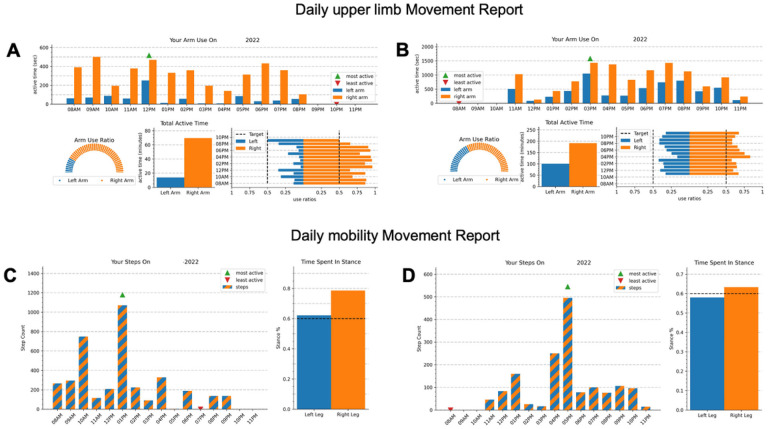
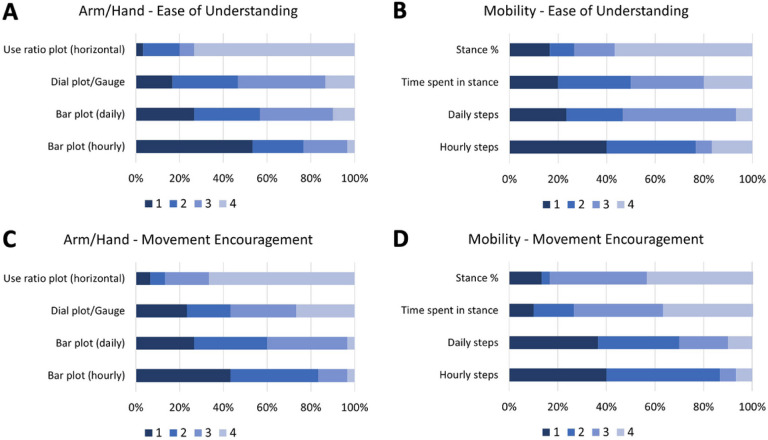
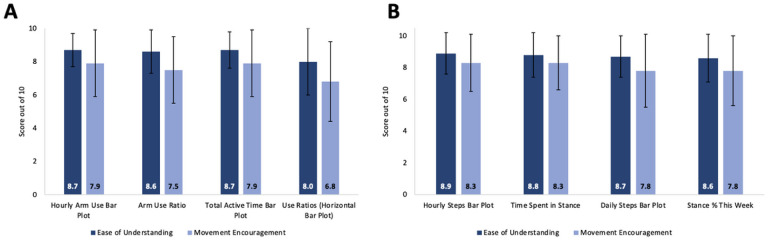
A sample of 30 chronic stroke survivors wore a multi-sensor system in the natural environment over a 1-week monitoring period. The sensor system captured time in active movement of each arm, arm use ratio, step counts and stance time symmetry. Using the data from the monitoring period, participants were presented with a movement report with visual displays of quantitative and qualitative feedback. A survey and qualitative interview were used to assess ease of understanding, actionability and components of feedback that users found most meaningful to drive lasting behavior change.
Arm/hand use and mobility sensor-derived feedback metrics were easy to understand and actionable. The preferred metric to encourage arm/hand use was the hourly arm use bar plot, and similarly the preferred metric to encourage mobility was the hourly steps bar plot, which were each ranked as top choice by 40% of participants. Participants perceived that quantitative (i.e., step counts) and qualitative (i.e., stance time symmetry) mobility metrics provided complementary information. Three main themes emerged from the qualitative analysis: 1) Motivation for behavior change, 2) Real-time feedback based on individual goals, and 3) Value of experienced clinicians for prescription and accountability. Participants stressed the importance of having feedback tailored to their own personalized goals and receiving guidance from clinicians on strategies to progress and increase functional movement behavior in the unsupervised home and community setting.
The resulting technology has the potential to integrate engineering and personalized rehabilitation to maximize participation in meaningful life activities outside clinical settings in a less structured environment-one where stroke survivors live their lives.
在中风康复中,可穿戴技术可通过提供有关运动表现的及时、有意义的反馈作为一种干预方式。中风幸存者的偏好可能会为哪些指标直观、可操作且对改变行为有意义提供独特视角。然而,很少有研究确定中风幸存者的反馈偏好。本项目旨在确定中风幸存者对可穿戴传感器反馈(包括移动性和手臂/手部使用情况)的满意度,并确定对反馈类型和传递时间表的偏好。
30名慢性中风幸存者的样本在自然环境中佩戴多传感器系统,为期1周的监测期。该传感器系统记录了每只手臂的主动运动时间、手臂使用比例、步数和站立时间对称性。利用监测期的数据,为参与者提供一份带有定量和定性反馈可视化显示的运动报告。通过一项调查和定性访谈来评估理解的难易程度、可操作性以及用户认为对推动持久行为改变最有意义的反馈内容。
手臂/手部使用情况和移动性传感器得出的反馈指标易于理解且可操作。鼓励手臂/手部使用的首选指标是每小时手臂使用柱状图,同样,鼓励移动性的首选指标是每小时步数柱状图,各有40%的参与者将其列为首选。参与者认为定量(即步数)和定性(即站立时间对称性)移动性指标提供了互补信息。定性分析出现了三个主要主题:1)行为改变的动机,2)基于个人目标的实时反馈,3)经验丰富的临床医生在处方和问责方面的价值。参与者强调了根据自身个性化目标定制反馈以及在无监督的家庭和社区环境中接受临床医生关于进步策略和增加功能性运动行为的指导的重要性。
由此产生的技术有潜力整合工程学和个性化康复,以在中风幸存者生活的结构化程度较低的环境(即临床环境之外)中最大限度地参与有意义的生活活动。