Newton Mario Victor, Subramanyam S G
Department of Surgery, St. John's Medical College Hospital, Bengaluru, Karnataka, India.
J Family Med Prim Care. 2023 Feb;12(2):326-331. doi: 10.4103/jfmpc.jfmpc_1532_22. Epub 2023 Feb 28.
Even developed countries lack computed tomography (CT) scan in rural areas. Availability, affordability and accessibility of CT scan play an important role in the management of blunt hepatic trauma.
A descriptive observational study among 56 hepatic blunt trauma patients as Group 1 and 56 non-hepatic blunt trauma patients as Group 2 enrolled retrospectively. Observational analysis of presence of liver trauma, grades of liver injury (I-VI) and clinical course with the liver function tests are done.
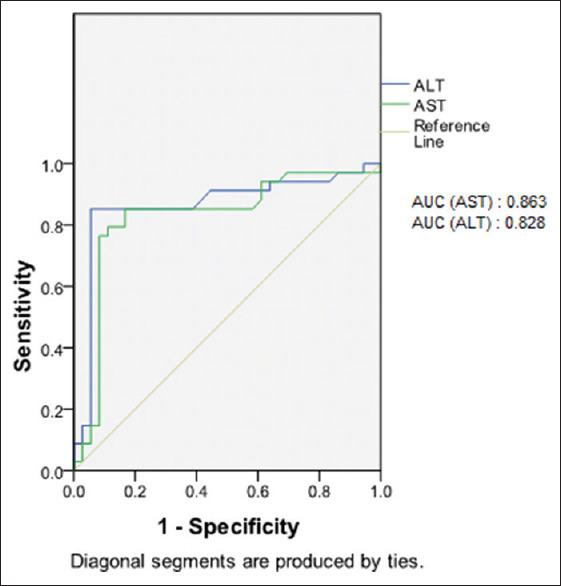
Aspartate transaminase (AST) ( = 0.02) and alanine transaminase (ALT) ( = 0.003) levels were significantly elevated among Group 1. Significantly elevated levels in Group 1 than Group 2 of AST [467.5 (22-5097) vs. 95 (23-1780); < 0.001] and of ALT [422 (28-1548) vs. 69 (20-727); < 0.001] noted. Significant elevation of AST and ALT levels, as the AAST (American Association for the Surgery of Trauma) CT grade of liver injury increases, noted ( = 0.001). Using the ROC curve analysis, the optimal cut-off values of AST and ALT were set at ≥467.5 U/L and ≥111.5 U/L, respectively. At this cut-off, AST had sensitivity 50%, specificity 91.7%, PPV 85%, NPV 66%, ALT had sensitivity 85.3%, specificity 86.1%, PPV 85.3% and NPV 86.1% for liver injury.
ALT is more sensitive for liver injury. AST peak is seen in the immediate period. Combining clinical assessment, transaminase levels and Focused Assessment with Sonography in Trauma improves the sensitivity and specificity. Transaminase levels can vary with ethnicity and local epidemiological diseases; therefore, optimal cut-off levels should be established for local population. This would predict and grade the liver injury, helping in early decision-making and avoid wasting the golden hour in trauma.
即使在发达国家,农村地区也缺乏计算机断层扫描(CT)设备。CT扫描的可获得性、可承受性和可及性在钝性肝外伤的处理中起着重要作用。
回顾性纳入56例肝钝性外伤患者作为第1组,56例非肝钝性外伤患者作为第2组进行描述性观察研究。对肝外伤的存在情况、肝损伤分级(I - VI级)以及肝功能检查的临床病程进行观察分析。
第1组天冬氨酸转氨酶(AST)(P = 0.02)和丙氨酸转氨酶(ALT)(P = 0.003)水平显著升高。第1组AST水平[467.5(22 - 50,97)对比95(23 - 1,780);P < 0.001]和ALT水平[422(28 - 1,548)对比69(20 - 727);P < 0.001]显著高于第2组。随着美国创伤外科学会(AAST)CT肝损伤分级增加,AST和ALT水平显著升高(P = 0.001)。采用ROC曲线分析,AST和ALT的最佳截断值分别设定为≥467.5 U/L和≥111.5 U/L。在此截断值下,AST对肝损伤的敏感性为50%,特异性为91.7%,阳性预测值为85%,阴性预测值为66%;ALT对肝损伤的敏感性为85.3%,特异性为86.1%,阳性预测值为85.3%,阴性预测值为86.1%。
ALT对肝损伤更敏感。AST峰值出现在伤后即刻。结合临床评估、转氨酶水平以及创伤超声重点评估可提高敏感性和特异性。转氨酶水平可能因种族和当地流行疾病而异;因此,应针对当地人群确定最佳截断水平。这将有助于预测和分级肝损伤,辅助早期决策并避免在创伤救治中浪费黄金时间。