Byeon Y Vivian, Lau Anna S, Lind Teresa, Hamilton Alison B, Brookman-Frazee Lauren
Department of Psychology, University of California, Los Angeles, Los Angeles, CA, USA.
Department of Child & Family Development, San Diego State University, San Diego, CA, USA.
Implement Res Pract. 2022 Jul 4;3:26334895221110263. doi: 10.1177/26334895221110263. eCollection 2022 Jan-Dec.
Inner context organizational factors proximally shape therapist experiences with evidence-based practice (EBP) implementation and may influence therapist self-efficacy, which has been linked to sustained use of EBPs in community mental health settings. Research has primarily focused on constructs such as implementation leadership and climate. However, the effects of such factors may depend upon other inner context dimensions, such as psychological safety. Psychologically safe environments are conducive to taking risks, speaking up about problems, and requesting feedback and may promote therapist self-efficacy during implementation. This study examines whether organizational sustainment leadership and sustainment climate relate to therapist EBP self-efficacy only under conditions of psychological safety.
Data were collected from 410 clinicians in 85 programs during the sustainment phase of a system-driven implementation of multiple EBPs in children's mental health services. Therapists reported on their organization's sustainment leadership, sustainment climate, psychological safety, and their own self-efficacy in delivering specific EBPs. Multilevel regression analyses were conducted to account for nested data structure.
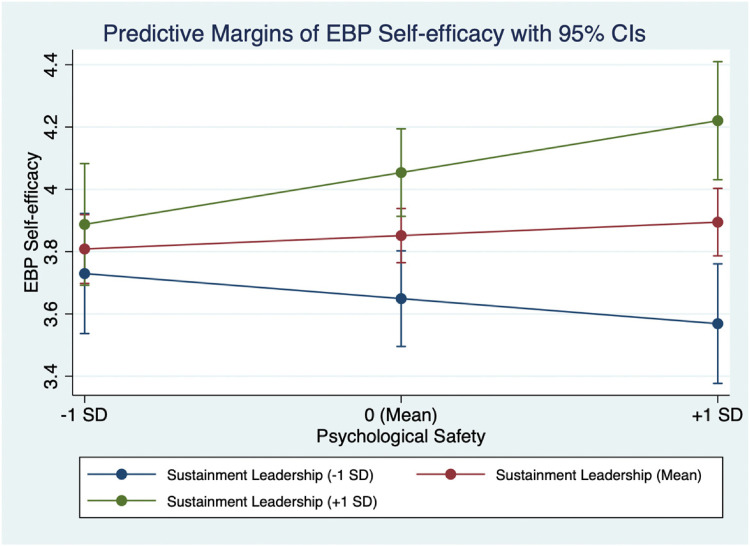
Among program-level variables, sustainment leadership and psychological safety both significantly predicted therapist self-efficacy. However, there were no significant interactions between program-level sustainment climate and psychological safety. Exploratory post-hoc analyses revealed a significant interaction between program-level sustainment leadership and therapist-level perceptions of psychological safety such that that the conditional effect of psychological safety on EBP self-efficacy was significant at high levels of sustainment leadership, but not at low or average levels.
We noted independent links between sustainment leadership, organizational psychological safety and therapists feelings of confidence and mastery with EBPs. Therapists' individual perceptions of psychological safety were linked to self-efficacy only in programs with high sustainment leadership. Thus, sustainment leadership and psychological safety may both represent implementation intervention targets, but it may not be critical to assess for perceptions of psychological safety before deploying organizational leadership strategies. Therapist self-efficacy is a therapist's belief that they are capable, knowledgeable, and skilled enough to deliver evidence-based practices (EBPs), and is thought to promote improved clinical and implementation outcomes, such as therapists' sustained use of EBPs. Conditions within community mental health organizations may influence therapists' sense of EBP self-efficacy. Leaders' support and expectations for EBP implementation, and collective staff perceptions about the organization's climate to support EBPs are linked to positive therapist attitudes and EBP adoption. However, less is known about how these implementation-specific organizational factors associated with therapist EBP self-efficacy in the long-term, and how this may depend on general workplace conditions. Specifically, psychologically safe environments - where therapists feel safe taking risks such as asking questions, admitting mistakes, and trying new skills - may be needed to promote self-efficacy when therapists are tasked with learning and using complex multi-component EBP innovations. The current study tested the prediction that leader-driven and program-wide focus on EBP sustainment may promote therapist EBP self-efficacy only in organizations where conditions for learning are psychologically safe. Our findings confirmed that fostering strong sustainment focused leadership and psychologically safe environments may each be important for increasing therapists' EBP self-efficacy. The model results suggested that individual therapist perceptions of psychological safety were more strongly related to EBP self-efficacy in programs with greater implementation leadership. Findings suggest the importance of increasing EBP leadership behavior to fully potentiate other facilitating conditions for therapist learning in the sustainment phase of EBP implementation initiatives.

内部组织因素直接塑造了治疗师在实施循证实践(EBP)过程中的体验,并可能影响治疗师的自我效能感,而自我效能感与在社区心理健康环境中持续使用循证实践有关。研究主要集中在实施领导力和氛围等构念上。然而,这些因素的影响可能取决于其他内部环境维度,如心理安全感。心理安全的环境有利于冒险、直言问题以及寻求反馈,并可能在实施过程中提升治疗师的自我效能感。本研究考察组织维持领导力和维持氛围是否仅在心理安全的条件下与治疗师的循证实践自我效能感相关。
在儿童心理健康服务中对多种循证实践进行系统驱动实施的维持阶段,从85个项目中的410名临床医生处收集数据。治疗师报告了他们所在组织的维持领导力、维持氛围、心理安全感以及他们在实施特定循证实践方面的自我效能感。进行了多层次回归分析以考虑嵌套数据结构。
在项目层面的变量中,维持领导力和心理安全感均显著预测了治疗师的自我效能感。然而,项目层面的维持氛围与心理安全感之间没有显著的交互作用。探索性事后分析显示,项目层面的维持领导力与治疗师层面的心理安全感认知之间存在显著的交互作用,即心理安全感对循证实践自我效能感的条件效应在高维持领导力水平时显著,但在低或中等水平时不显著。
我们注意到维持领导力、组织心理安全感与治疗师对循证实践的信心和掌握感之间存在独立的联系。治疗师个人对心理安全感的认知仅在具有高维持领导力的项目中与自我效能感相关。因此,维持领导力和心理安全感可能都代表了实施干预的目标,但在部署组织领导策略之前评估心理安全感认知可能并非关键。治疗师自我效能感是指治疗师相信自己有能力、有知识且有技能来实施循证实践,并且被认为能促进改善临床和实施结果,例如治疗师持续使用循证实践。社区心理健康组织内部的条件可能会影响治疗师的循证实践自我效能感。领导者对循证实践实施的支持和期望,以及员工对组织支持循证实践氛围的集体认知与治疗师的积极态度和循证实践的采用相关。然而,对于这些特定于实施的组织因素如何长期与治疗师的循证实践自我效能感相关,以及这可能如何取决于一般工作场所条件,我们所知较少。具体而言,当治疗师负责学习和使用复杂的多成分循证实践创新时,可能需要心理安全的环境——在这种环境中治疗师感到安全去冒险,如提问、承认错误和尝试新技能——来提升自我效能感。当前研究检验了这样一种预测,即领导者驱动且全项目范围内对循证实践维持的关注可能仅在学习条件心理安全的组织中促进治疗师的循证实践自我效能感。我们的研究结果证实,培养强大的以维持为重点领导能力和心理安全的环境对于提高治疗师循证实践自我效能感可能都很重要。模型结果表明,在具有更强实施领导力的项目中,治疗师个人对心理安全感的认知与循证实践自我效能感的关联更强。研究结果表明,在循证实践实施举措的维持阶段,增加循证实践领导行为对于充分增强治疗师学习的其他促进条件很重要。