Casadei-Gardini Andrea, Leone Francesco, Brandi Giovanni, Scartozzi Mario, Silvestris Nicola, Santini Daniele, Faloppi Luca, Aglietta Massimo, Satolli Maria Antonietta, Rizzo Alessandro, Lonardi Sara, Aprile Giuseppe, Fornaro Lorenzo
Department of Oncology, Vita-Salute San Raffaele University, IRCCS San Raffaele Scientific Institute Hospital, Milan, Italy.
Division of Medical Oncology, ASL BI, Nuovo Ospedale degli Infermi, Ponderano, BI, Italy.
Front Oncol. 2023 Apr 5;13:1128930. doi: 10.3389/fonc.2023.1128930. eCollection 2023.
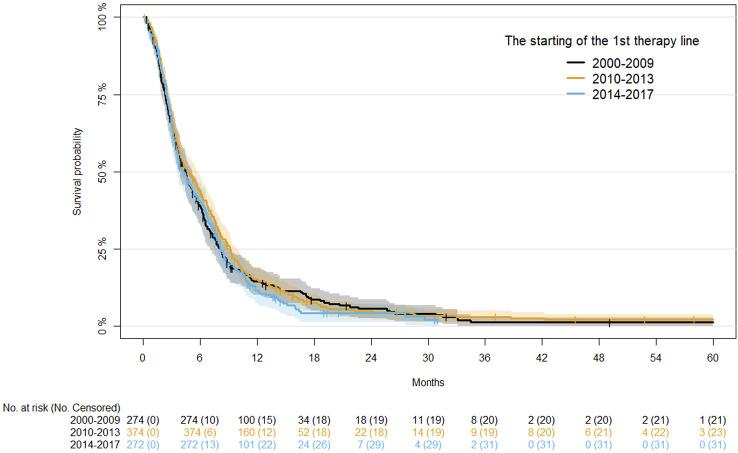
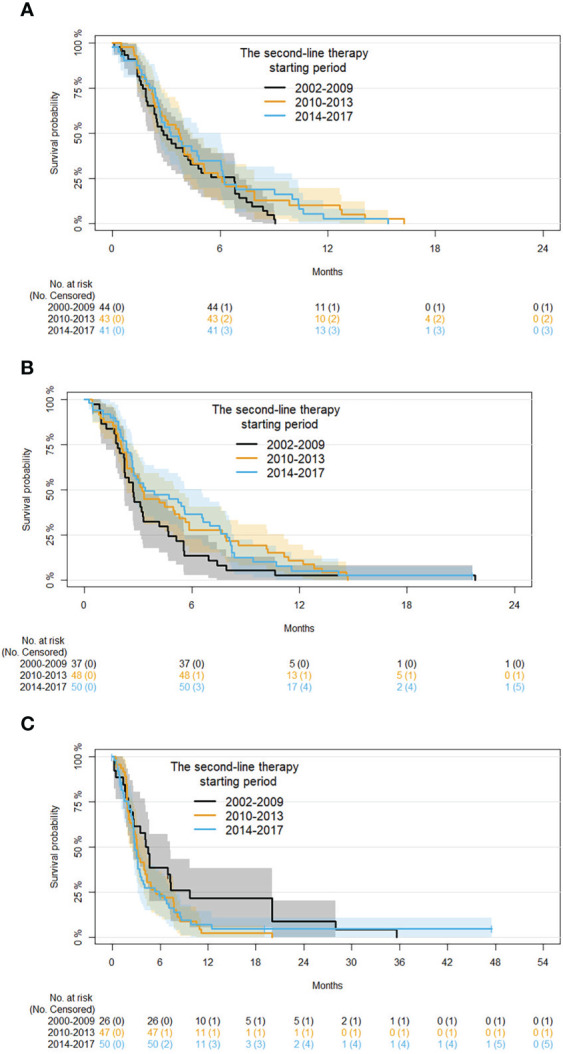
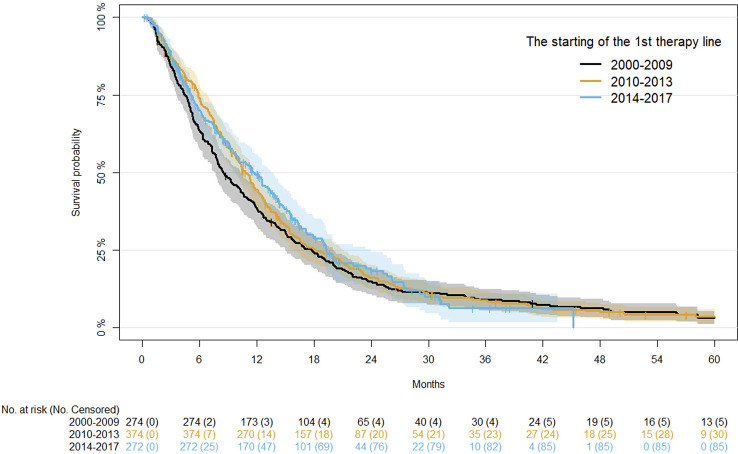
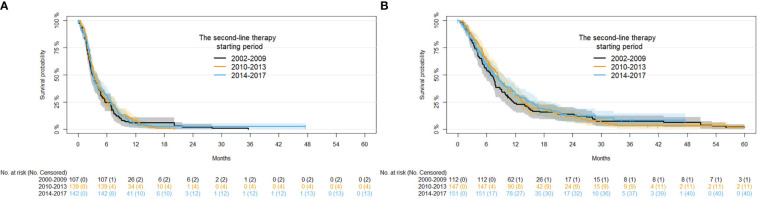
Cholangiocarcinoma is a rare group of tumors that involve the hepatic biliary tree. Prognosis for patients with cholangiocarcinoma remains dismal. Herein, we present survival trends over a long time period spanning almost 20 years in patients with advanced cholangiocarcinoma receiving systemic chemotherapy. We retrospectively analyzed a large multicenter dataset of cholangiocarcinoma outpatients evaluated in 14 centers within the Cholangiocarcinoma Italian Group Onlus (Gruppo Italiano Colangiocarcinoma Onlus, G.I.C.O.) between 2000 and 2017 (first-line), and 2002 and 2017 (second-line). Three time periods were considered: 2000-2009, 2010-2013, and 2014-2017. A total of 922 patients (51.19% male) with cholangiocarcinoma undergoing first-line therapy were evaluated. The median durations of follow-up for progression-free survival (PFS) and overall survival (OS) were 37 and 57 months, respectively. PFS at 12 months in the three periods of starting first-line therapy was similar, ranging from 11.71% to 15.25%. OS at 12 months progressively improved (38.30%, 44.61% and 49.52%, respectively), although the differences were not statistically significant after adjusting for age, disease status, and primary tumor site. A total of 410 patients (48.5% male) underwent second-line chemotherapy. The median durations of follow-up for PFS and OS were 47.6 and 41.90 months, respectively. An OS of 24.3%, 32.3%, and 33.1% was observed in 2002-2009, 2010-2013, and 2014-2017, respectively. Despite incremental benefits across years, our clinical experience confirms that modest overall advances have been achieved with first- and second-line chemotherapy in advanced cholangiocarcinoma. Efforts should focus on the identification of patients who derive the greatest benefit from treatment.
胆管癌是一组罕见的累及肝内胆管树的肿瘤。胆管癌患者的预后仍然很差。在此,我们展示了接受全身化疗的晚期胆管癌患者近20年的长期生存趋势。我们回顾性分析了意大利胆管癌患者组织(Gruppo Italiano Colangiocarcinoma Onlus,G.I.C.O.)的14个中心在2000年至2017年(一线治疗)以及2002年至2017年(二线治疗)期间评估的胆管癌门诊患者的大型多中心数据集。研究考虑了三个时间段:2000 - 2009年、2010 - 2013年和2014 - 2017年。共有922例接受一线治疗的胆管癌患者(51.19%为男性)接受了评估。无进展生存期(PFS)和总生存期(OS)的中位随访时间分别为37个月和57个月。三个一线治疗起始时间段的12个月PFS相似,范围为11.71%至15.25%。12个月时的OS逐渐改善(分别为38.30%、44.61%和49.52%),尽管在调整年龄、疾病状态和原发肿瘤部位后差异无统计学意义。共有410例患者(48.5%为男性)接受了二线化疗。PFS和OS的中位随访时间分别为47.6个月和41.90个月。在2002 - 2009年、2010 - 2013年和2014 - 2017年分别观察到OS为24.3%、32.3%和33.1%。尽管多年来有渐进性益处,但我们的临床经验证实,晚期胆管癌的一线和二线化疗仅取得了适度的总体进展。应努力确定从治疗中获益最大的患者。