Department of Radiation Oncology, Clinical Oncology School of Fujian Medical University, Fujian Cancer Hospital, Fuzhou, 350014, Fujian, China.
Department of Radiation Oncology, Xiangtan City Central Hospital, Xiangtan, 411100, Hunan, China.
Sci Rep. 2023 Apr 24;13(1):6624. doi: 10.1038/s41598-023-33472-w.
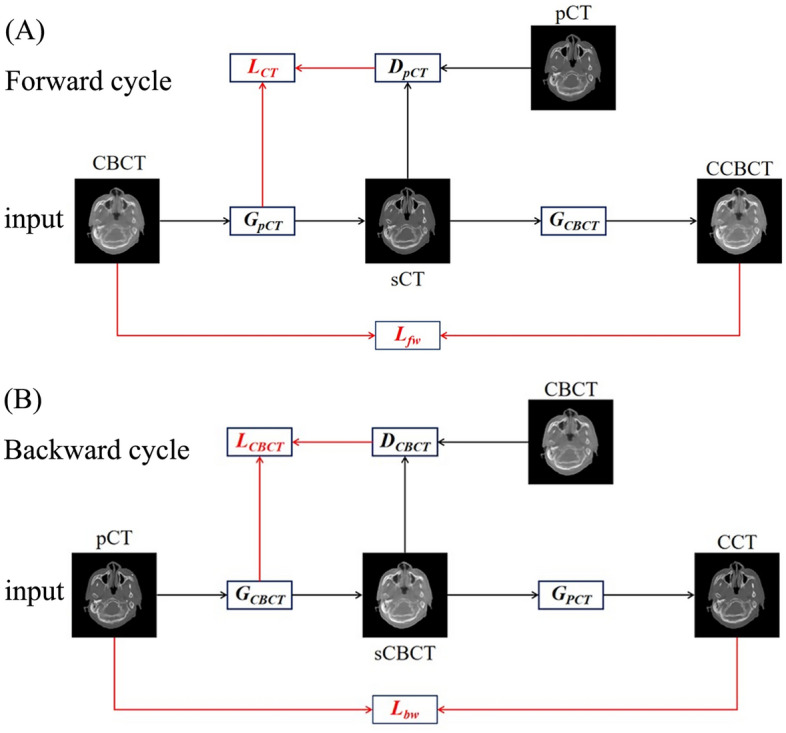
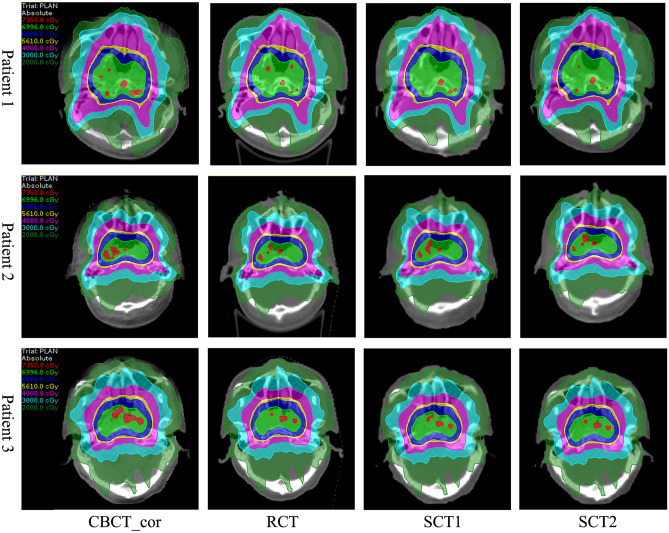
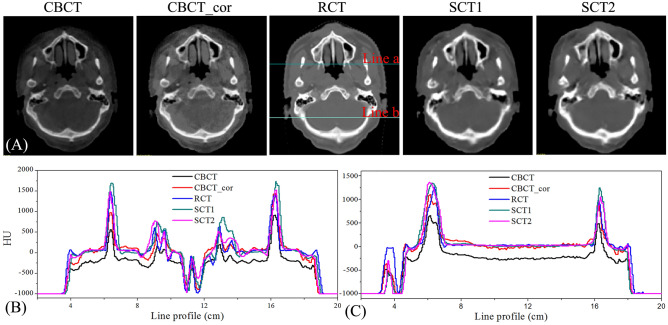
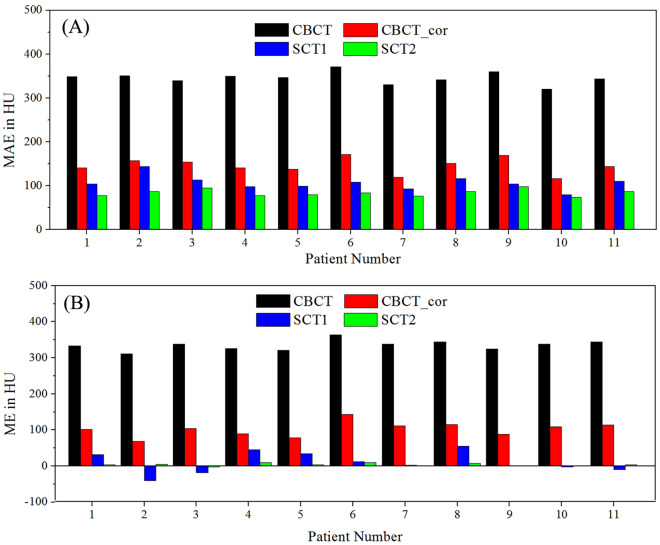
This study aims to utilize a hybrid approach of phantom correction and deep learning for synthesized CT (sCT) images generation based on cone-beam CT (CBCT) images for nasopharyngeal carcinoma (NPC). 52 CBCT/CT paired images of NPC patients were used for model training (41), validation (11). Hounsfield Units (HU) of the CBCT images was calibrated by a commercially available CIRS phantom. Then the original CBCT and the corrected CBCT (CBCT_cor) were trained separately with the same cycle generative adversarial network (CycleGAN) to generate SCT1 and SCT2. The mean error and mean absolute error (MAE) were used to quantify the image quality. For validations, the contours and treatment plans in CT images were transferred to original CBCT, CBCT_cor, SCT1 and SCT2 for dosimetric comparison. Dose distribution, dosimetric parameters and 3D gamma passing rate were analyzed. Compared with rigidly registered CT (RCT), the MAE of CBCT, CBCT_cor, SCT1 and SCT2 were 346.11 ± 13.58 HU, 145.95 ± 17.64 HU, 105.62 ± 16.08 HU and 83.51 ± 7.71 HU, respectively. Moreover, the average dosimetric parameter differences for the CBCT_cor, SCT1 and SCT2 were 2.7% ± 1.4%, 1.2% ± 1.0% and 0.6% ± 0.6%, respectively. Using the dose distribution of RCT images as reference, the 3D gamma passing rate of the hybrid method was significantly better than the other methods. The effectiveness of CBCT-based sCT generated using CycleGAN with HU correction for adaptive radiotherapy of nasopharyngeal carcinoma was confirmed. The image quality and dose accuracy of SCT2 were outperform the simple CycleGAN method. This finding has great significance for the clinical application of adaptive radiotherapy for NPC.
本研究旨在利用混合方法,即通过锥形束 CT(CBCT)图像对鼻咽癌进行体素校正和深度学习,以生成合成 CT(sCT)图像。共使用 52 例鼻咽癌患者的 CBCT/CT 配对图像进行模型训练(41 例)和验证(11 例)。通过商用 CIRS 体模对 CBCT 图像的 Hounsfield 单位(HU)进行校准。然后,使用相同的循环生成对抗网络(CycleGAN)分别对原始 CBCT 和校正后的 CBCT(CBCT_cor)进行训练,以生成 SCT1 和 SCT2。使用平均误差和平均绝对误差(MAE)来量化图像质量。在验证中,将 CT 图像中的轮廓和治疗计划转移到原始 CBCT、CBCT_cor、SCT1 和 SCT2 上,进行剂量比较。分析剂量分布、剂量学参数和 3D 伽马通过率。与刚性配准 CT(RCT)相比,CBCT、CBCT_cor、SCT1 和 SCT2 的 MAE 分别为 346.11±13.58 HU、145.95±17.64 HU、105.62±16.08 HU 和 83.51±7.71 HU。此外,CBCT_cor、SCT1 和 SCT2 的平均剂量学参数差异分别为 2.7%±1.4%、1.2%±1.0%和 0.6%±0.6%。以 RCT 图像的剂量分布为参考,混合方法的 3D 伽马通过率明显优于其他方法。证实了基于 CBCT 的使用 HU 校正的 sCT 生成方法用于鼻咽癌自适应放疗的有效性。SCT2 的图像质量和剂量准确性优于简单的 CycleGAN 方法。这一发现对鼻咽癌自适应放疗的临床应用具有重要意义。