Global Health and Tropical Medicine, GHTM, Instituto de Higiene e Medicina Tropical, IHMT, Universidade Nova de Lisboa, UNL., Rua da Junqueira 100, 1349-008, Lisboa, Portugal.
Unidade de Ciências da Natureza, da Vida E Do Ambiente, Universidade Jean Piaget de Cabo Verde, Praia, Cape Verde.
Parasit Vectors. 2023 Apr 25;16(1):142. doi: 10.1186/s13071-023-05745-w.
Wolbachia pipientis is an endosymbiont bacterium that induces cytoplasmic incompatibility and inhibits arboviral replication in mosquitoes. This study aimed to assess Wolbachia prevalence and genetic diversity in different mosquito species from Cape Verde.
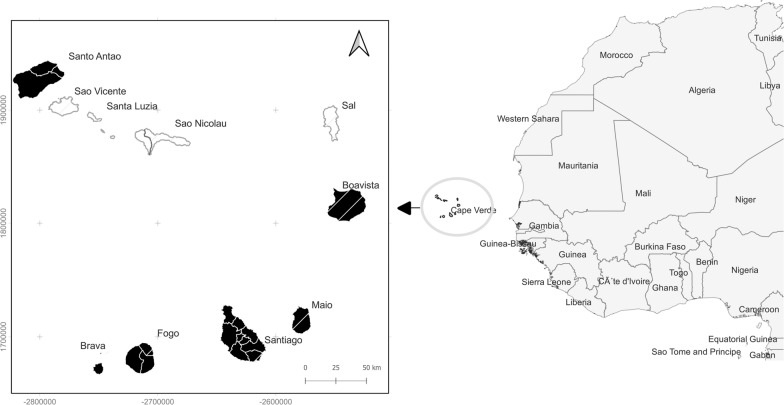
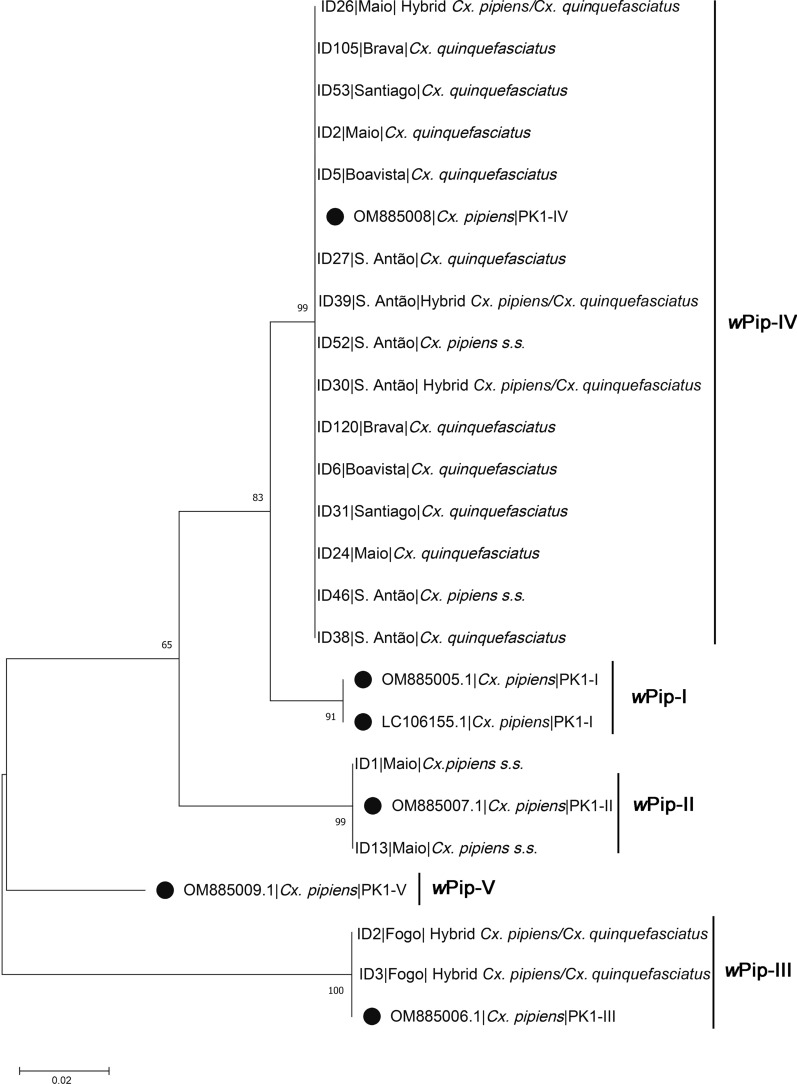
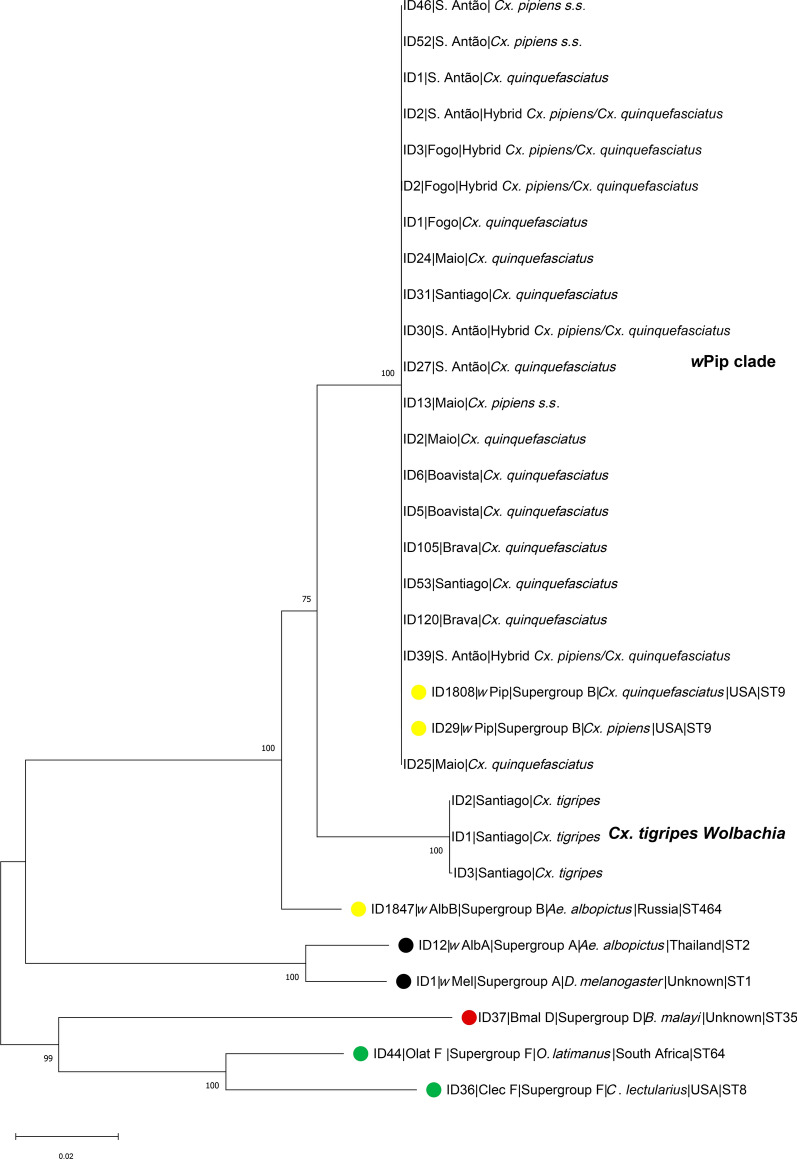
Mosquitoes were collected on six islands of Cape Verde and identified to species using morphological keys and PCR-based assays. Wolbachia was detected by amplifying a fragment of the surface protein gene (wsp). Multilocus sequence typing (MLST) was performed with five housekeeping genes (coxA, gatB, ftsZ, hcpA, and fbpA) and the wsp hypervariable region (HVR) for strain identification. Identification of wPip groups (wPip-I to wPip-V) was performed using PCR-restriction fragment length polymorphism (RFLP) assay on the ankyrin domain gene pk1.
Nine mosquito species were collected, including the major vectors Aedes aegypti, Anopheles arabiensis, Culex pipiens sensu stricto, and Culex quinquefasciatus. Wolbachia was only detected in Cx. pipiens s.s. (100% prevalence), Cx. quinquefasciatus (98.3%), Cx. pipiens/quinquefasciatus hybrids (100%), and Culex tigripes (100%). Based on the results of MLST and wsp hypervariable region typing, Wolbachia from the Cx. pipiens complex was assigned to sequence type 9, wPip clade, and supergroup B. PCR/RFLP analysis revealed three wPip groups in Cape Verde, namely wPip-II, wPip-III, and wPip-IV. wPip-IV was the most prevalent, while wPip-II and wPip-III were found only on Maio and Fogo islands. Wolbachia detected in Cx. tigripes belongs to supergroup B, with no attributed MLST profile, indicating a new strain of Wolbachia in this mosquito species.
A high prevalence and diversity of Wolbachia was found in species from the Cx. pipiens complex. This diversity may be related to the mosquito's colonization history on the Cape Verde islands. To the best of our knowledge, this is the first study to detect Wolbachia in Cx. tigripes, which may provide an additional opportunity for biocontrol initiatives.
沃尔巴克氏体是一种内共生菌,可诱导细胞质不亲和并抑制蚊子中的虫媒病毒复制。本研究旨在评估佛得角不同蚊子物种中沃尔巴克氏体的流行率和遗传多样性。
从佛得角的六个岛屿收集蚊子,并使用形态学关键和基于 PCR 的检测方法鉴定到物种。通过扩增表面蛋白基因(wsp)的片段来检测沃尔巴克氏体。使用五个管家基因(coxA、gatB、ftsZ、hcpA 和 fbpA)和 wsp 高变区(HVR)进行多位点序列分型(MLST),以鉴定菌株。使用 ankryn 结构域基因 pk1 的 PCR-限制性片段长度多态性(RFLP)检测鉴定 wPip 组(wPip-I 至 wPip-V)。
共收集到 9 种蚊子,包括主要传播媒介埃及伊蚊、阿拉伯按蚊、淡色库蚊和致倦库蚊。仅在淡色库蚊(100%流行率)、致倦库蚊(98.3%)、淡色库蚊/致倦库蚊杂种(100%)和三带喙库蚊(100%)中检测到沃尔巴克氏体。基于 MLST 和 wsp 高变区分型的结果,来自淡色库蚊复合体的沃尔巴克氏体被分配到序列型 9、wPip 枝、和超级组 B。PCR/RFLP 分析显示佛得角有 3 个 wPip 组,即 wPip-II、wPip-III 和 wPip-IV。wPip-IV 最为流行,而 wPip-II 和 wPip-III 仅在马约岛和福戈岛发现。在三带喙库蚊中检测到的沃尔巴克氏体属于超级组 B,没有归因于 MLST 谱,表明该蚊种中存在一种新的沃尔巴克氏体菌株。
在淡色库蚊复合体的物种中发现了高流行率和多样性的沃尔巴克氏体。这种多样性可能与蚊子在佛得角岛屿上的殖民历史有关。据我们所知,这是首次在三带喙库蚊中检测到沃尔巴克氏体,这可能为生物控制计划提供了一个额外的机会。