Instituto do Coração (InCor), Hospital das Clínicas HCFMUSP, Faculdade de Medicina, Universidade de São Paulo, São Paulo, SP - Brasil.
Arq Bras Cardiol. 2023 Mar;120(4):e20220185. doi: 10.36660/abc.20220185.
Exercise plays a positive role in the course of the ischemic heart disease, enhancing functional capacity and preventing ventricular remodeling.
To investigate the impact of exercise on left ventricular (LV) contraction mechanics after an uncomplicated acute myocardial infarction (AMI).
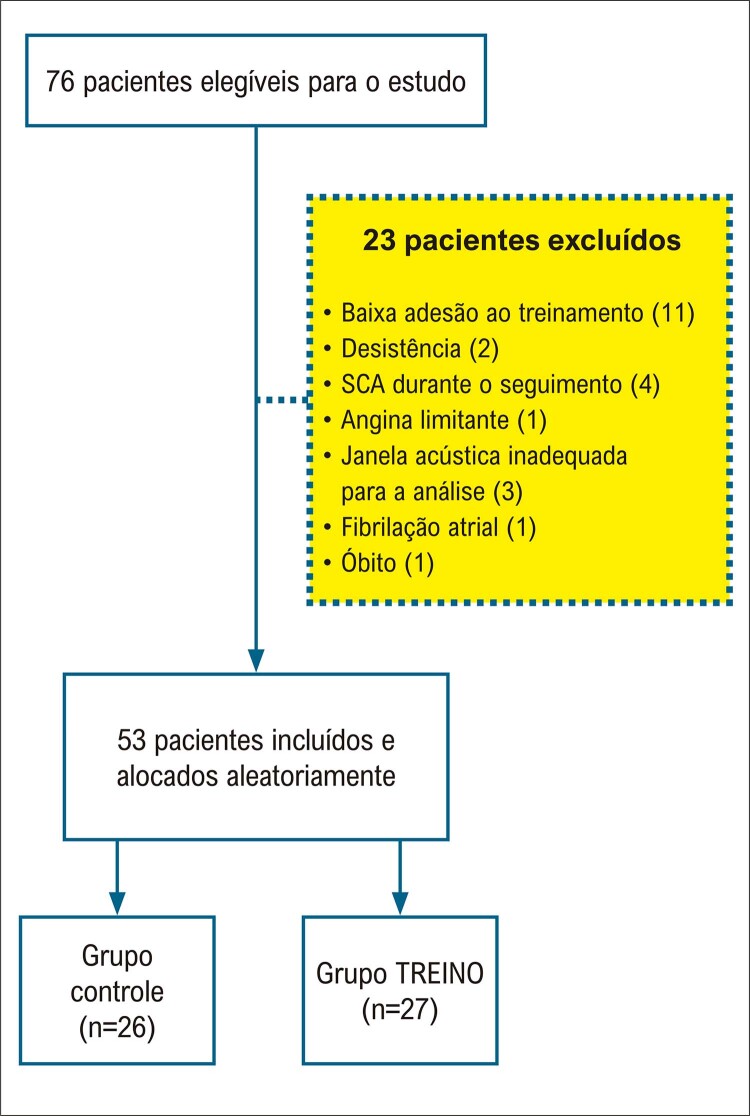
A total of 53 patients was included, 27 of whom were randomized to a supervised training program (TRAINING group), and 26 to a CONTROL group, who received usual recommendations on physical exercise after AMI. All patients underwent cardiopulmonary stress testing and a speckle tracking echocardiography to measure several parameters of LV contraction mechanics at one month and five months after AMI. A p value < 0.05 was considered statistically significant for the comparisons of the variables.
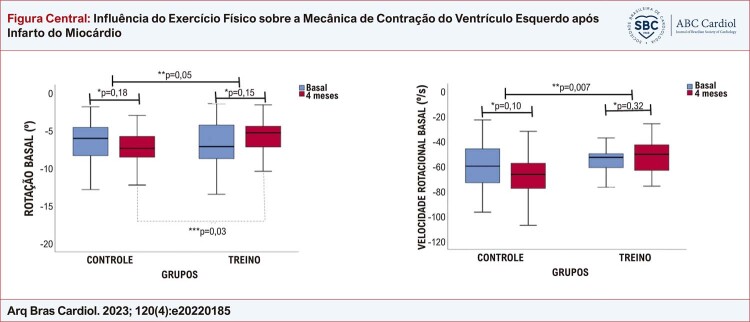
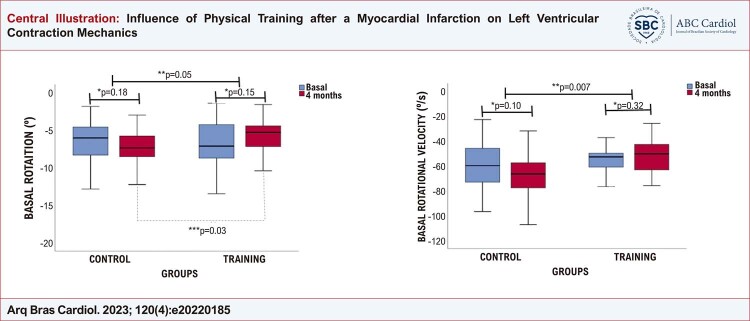
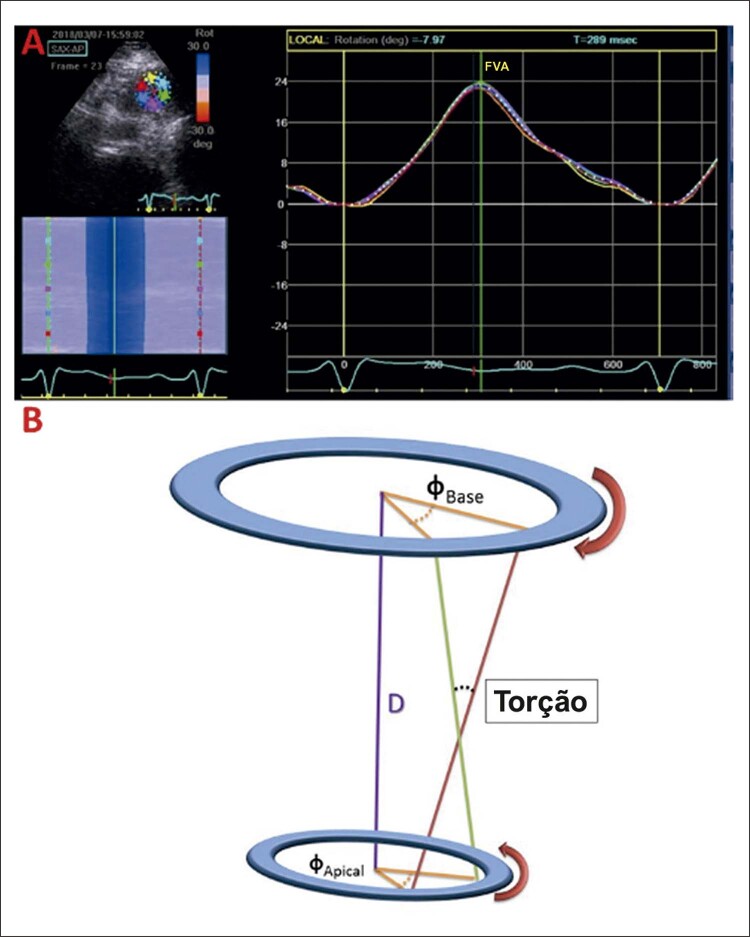
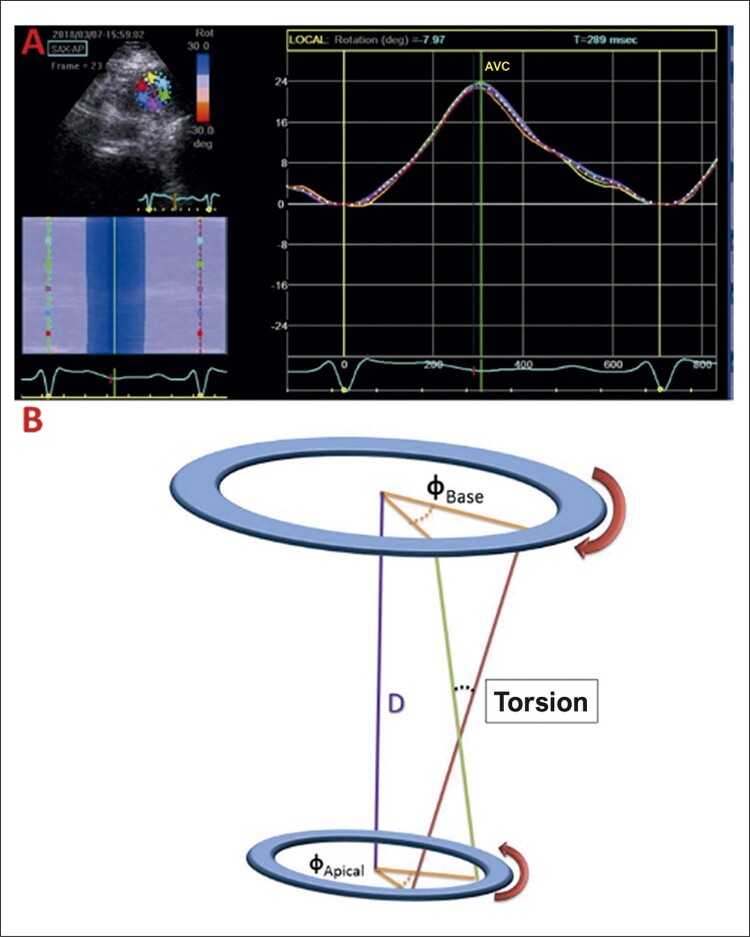
No significant difference were found in the analysis of LV longitudinal, radial and circumferential strain parameters between groups after the training period. After the training program, analysis of torsional mechanics demonstrated a reduction in the LV basal rotation in the TRAINING group in comparison to the CONTROL group (5.9±2.3 vs. 7.5±2.9o; p=0.03), and in the basal rotational velocity (53.6±18.4 vs.68.8±22.1 º/s; p=0.01), twist velocity (127.4±32.2 vs. 149.9±35.9 º/s; p=0.02) and torsion (2.4±0.4 vs. 2.8±0.8 º/cm; p=0.02).
Physical activity did not cause a significant improvement in LV longitudinal, radial and circumferential deformation parameters. However, the exercise had a significant impact on the LV torsional mechanics, consisting of a reduction in basal rotation, twist velocity, torsion and torsional velocity which can be interpreted as a ventricular "torsion reserve" in this population.
运动在缺血性心脏病的病程中起着积极的作用,它可以增强功能能力并预防心室重构。
研究运动对非复杂性急性心肌梗死(AMI)后左心室(LV)收缩力学的影响。
共纳入 53 例患者,其中 27 例随机分为监督训练组(TRAINING 组),26 例为 CONTROL 组,CONTROL 组在 AMI 后接受了有关体育锻炼的常规建议。所有患者在 AMI 后 1 个月和 5 个月时均进行心肺运动测试和斑点追踪超声心动图检查,以测量 LV 收缩力学的多个参数。p 值<0.05 被认为是变量比较的统计学显著差异。
在训练期间,两组之间的 LV 纵向、径向和周向应变参数的分析没有发现显著差异。在训练计划之后,LV 扭转力学分析显示与 CONTROL 组相比,TRAINING 组的 LV 基底旋转减少(5.9±2.3 对 7.5±2.9o;p=0.03),并且基底旋转速度(53.6±18.4 对 68.8±22.1 º/s;p=0.01),扭速(127.4±32.2 对 149.9±35.9 º/s;p=0.02)和扭转(2.4±0.4 对 2.8±0.8 º/cm;p=0.02)。
体育活动并未导致 LV 纵向、径向和周向变形参数的显著改善。然而,运动对 LV 扭转力学有显著影响,包括基底旋转、扭速、扭转和扭转速度的减少,这可以解释为该人群的心室“扭转储备”。