Center for Translational Cancer Research, The Brown Foundation Institute of Molecular Medicine, The University of Texas Health Science Center at Houston, Houston, TX, 77030, USA; The University of Texas MD Anderson Cancer Center UTHealth Houston Graduate School of Biomedical Sciences, Houston, TX, 77030, USA.
Center for Translational Cancer Research, The Brown Foundation Institute of Molecular Medicine, The University of Texas Health Science Center at Houston, Houston, TX, 77030, USA.
Cancer Lett. 2023 Jun 28;564:216191. doi: 10.1016/j.canlet.2023.216191. Epub 2023 Apr 25.
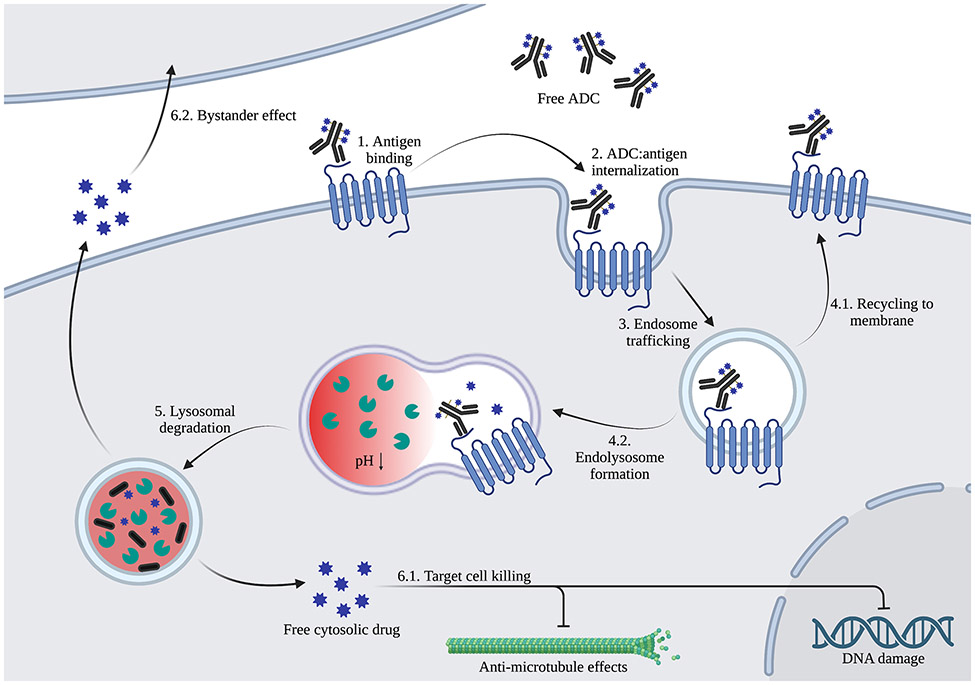
In recent years, antibody-drug conjugates (ADCs) have emerged as promising anti-cancer therapeutic agents with several having already received market approval for the treatment of solid tumor and hematological malignancies. As ADC technology continues to improve and the range of indications treatable by ADCs increases, the repertoire of target antigens has expanded and will undoubtedly continue to grow. G protein-coupled receptors (GPCRs) are well-characterized therapeutic targets implicated in many human pathologies, including cancer, and represent a promising emerging target of ADCs. In this review, we will discuss the past and present therapeutic targeting of GPCRs and describe ADCs as therapeutic modalities. Moreover, we will summarize the status of existing preclinical and clinical GPCR-targeted ADCs and address the potential of GPCRs as novel targets for future ADC development.
近年来,抗体药物偶联物(ADCs)已成为一种很有前途的抗癌治疗药物,已有几种药物获得批准,用于治疗实体瘤和血液恶性肿瘤。随着 ADC 技术的不断改进和 ADC 可治疗的适应证范围不断扩大,靶抗原谱不断扩大,而且无疑还会继续扩大。G 蛋白偶联受体(GPCRs)是一种经过充分研究的治疗靶点,与许多人类疾病有关,包括癌症,是 ADC 的一个很有前途的新兴靶点。在这篇综述中,我们将讨论过去和现在 GPCR 的治疗靶向,并将 ADC 描述为治疗方式。此外,我们将总结现有的临床前和临床 GPCR 靶向 ADC 的现状,并探讨 GPCR 作为未来 ADC 开发的新型靶点的潜力。