
元素生物成像和转录组学显示,单次注射镧系元素基造影剂后,小鼠小脑的基因表达没有变化。
Elemental bioimaging and transcriptomics reveal unchanged gene expression in mouse cerebellum following a single injection of Gadolinium-based contrast agents.
机构信息
Diagnostic Imaging Research Unit, (DIRU), Clinic for Diagnostic Imaging, Department of Clinical Diagnostics and Services, Vetsuisse Faculty, University of Zurich, Winterthurerstraße 258C, 8057, Zurich, Switzerland.
Institute of Neuropathology, University Hospital Münster, Pottkamp 2, 48149, Münster, Germany.
出版信息
Sci Rep. 2023 Apr 26;13(1):6844. doi: 10.1038/s41598-023-33066-6.
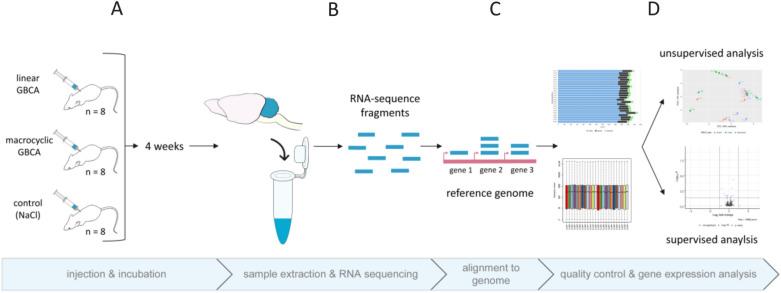
Gadolinium (Gd) deposition in the brain, first and foremost in the dentate nucleus in the cerebellum, following contrast enhanced MRI, rose awareness of potential adverse effects of gadolinium-based contrast agent (GBCA) administration. According to previous in vitro experiments, a conceivable side-effect of Gd deposition could be an alteration of gene expression. In the current study, we aimed to investigate the influence of GBCA administration on gene expression in the cerebellum of mice using a combination of elemental bioimaging and transcriptomics. In this prospective animal study, three groups of eight mice each were intravenously injected with either linear GBCA gadodiamide, macrocyclic GBCA gadoterate (1 mmol GBCA/kg body weight) or saline (NaCl 0.9%). Animals were euthanized four weeks after injection. Subsequently, Gd quantification via laser ablation-ICP-MS and whole genome gene expression analysis of the cerebellum were performed. Four weeks after single application of GBCAs to 24-31 days old female mice, traces of Gd were detectable in the cerebellum for both, the linear and macrocyclic group. Subsequent transcriptome analysis by RNA sequencing using principal component analysis did not reveal treatment-related clustering. Also differential expression analysis did not reveal any significantly differentially expressed genes between treatments.
在进行对比增强磁共振成像后,钆(Gd)在大脑中的沉积,首先是在小脑齿状核中,引起了人们对基于钆的造影剂(GBCA)给药的潜在不良反应的关注。根据之前的体外实验,Gd 沉积的一个可能的副作用可能是基因表达的改变。在目前的研究中,我们旨在使用元素生物成像和转录组学相结合的方法,研究 GBCA 给药对小鼠小脑基因表达的影响。在这项前瞻性动物研究中,三组各 8 只小鼠分别静脉注射线性 GBCA 钆喷酸葡胺、大环 GBCA 钆特酸葡胺(1mmol GBCA/kg 体重)或生理盐水(NaCl 0.9%)。注射后 4 周处死动物。随后,通过激光烧蚀 ICP-MS 进行 Gd 定量分析,以及小脑的全基因组基因表达分析。在对 24-31 天大的雌性小鼠单次应用 GBCA 4 周后,线性组和大环组的小脑均可检测到 Gd 的痕迹。使用主成分分析的 RNA 测序进行随后的转录组分析并未显示出与处理相关的聚类。差异表达分析也未显示出处理之间有任何显著差异表达的基因。


 Zotero 插件